
WASHINGTON — The Cybersecurity and Infrastructure Security Agency has published its first guidance document devoted specifically to defensive cyber deception, urging critical infrastructure owners and operators to seed their networks with realistic decoy systems and data as a counter to adversaries who no longer need malware to operate inside them.
The guide, Using Cyber Decoys to Strengthen Detection and Response, was released September 16 and represents the first time the agency has set out the defensive decoy process in detail rather than referencing deception in passing within broader hardening advice. It is written for defensive teams at any skill level, a deliberate signal that CISA regards deception as something other than a capability reserved for mature security operations centers.
The Detection Gap the Guidance Targets
The document’s premise is an operational problem that has dominated federal advisories for the better part of two years. Intrusion sets operating against U.S. critical infrastructure increasingly avoid custom tooling altogether, instead authenticating with legitimate credentials and conducting discovery, lateral movement and data access using the native administrative utilities already present on target systems. Behavior of that kind produces few of the signatures that conventional endpoint and network monitoring are tuned to catch, and it closely resembles the activity of a busy system administrator.
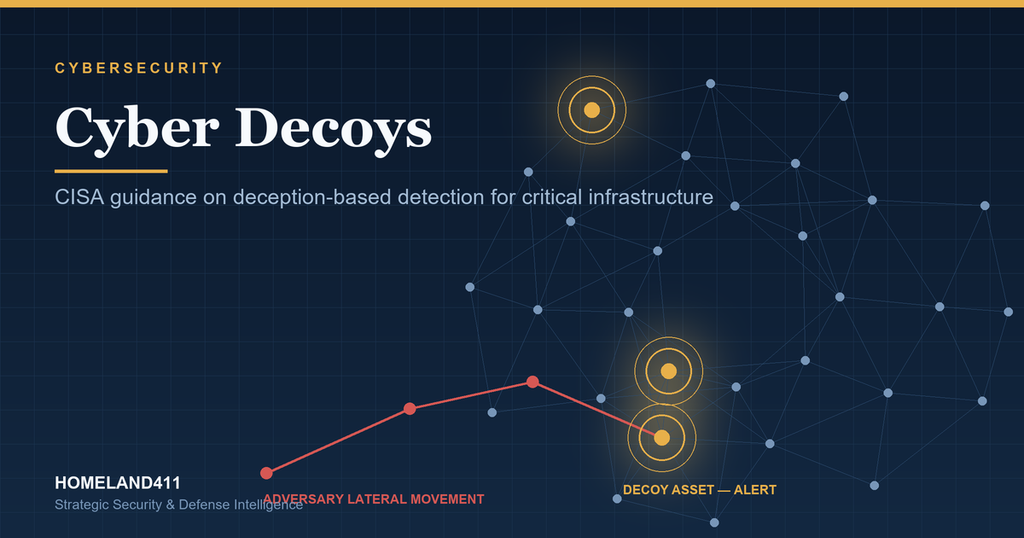
Deception inverts that asymmetry. A decoy asset has no legitimate business function, so it generates no legitimate traffic. Any authentication attempt, file access or lateral connection involving it is therefore anomalous by construction rather than by statistical inference — a property that yields high-fidelity alerts without the tuning burden that accompanies behavioral analytics.
“Cyber decoys used in a proactive cyber defense strategy help make critical infrastructure networks unfriendly places for adversaries and enhance resilience to compromise, even against living-off-the-land techniques,” said Chris Butera, CISA’s acting executive assistant director for cybersecurity.
Placement, Fidelity and Framework Alignment
The guidance emphasizes placement over volume. Decoys are to be positioned in high-value areas of the network the segments an intruder would be expected to traverse while pursuing operational objectives rather than scattered broadly in the hope of a chance encounter. The stated objective is a measurable reduction in mean time to detection, with decoy-generated alerts treated as high-confidence indicators warranting immediate response.
CISA anchors the methodology in two MITRE frameworks. The ATT&CK knowledge base supplies the adversary behaviors that decoy placement is meant to intercept, allowing defenders to reason about which techniques a given deployment would plausibly surface. MITRE Engage supplies the corresponding denial and deception vocabulary. The pairing gives owners and operators a way to document what a deception program is intended to detect, which matters for organizations that must justify security investment to regulators or boards.
Notably, the agency frames decoys as complementary to Zero Trust rather than as an alternative. Zero Trust architectures constrain what a compromised identity can reach; deception is offered as the instrumentation that reveals the identity has been compromised in the first place. The two address different halves of the same problem.
Convergence With Mandatory Incident Reporting
The timing places the guidance alongside a regulatory milestone. CISA has signaled that the final rule implementing the Cyber Incident Reporting for Critical Infrastructure Act is expected in September 2026, concluding a rulemaking that has run well past its original schedule. The agency missed an October 2025 statutory deadline, attributing the delay to the volume of comments received on the proposed rule, and town hall sessions planned for March and April 2026 were postponed following a lapse in Department of Homeland Security appropriations.
Once effective, the rule will require covered entities — defined by sector-based and size-based criteria to report covered cyber incidents to CISA within 72 hours and ransom payments within 24 hours. Those windows change the calculus around detection capability. An organization that identifies an intrusion late does not receive additional time to investigate; it consumes its reporting window discovering what happened. Detection methods that compress dwell time therefore carry compliance value independent of their security value, and deception is among the few that do so without extensive tuning.
Implementation Considerations
The practical constraint for most operators is realism. A decoy that is trivially distinguishable from a production system — stale hostnames, absent service banners, no plausible account activity — will be identified and avoided by a competent intruder, converting the investment into maintenance overhead. The guidance’s emphasis on realistic decoy systems and information assets reflects that failure mode.
Operational technology environments introduce a further wrinkle. Decoys must not introduce new pathways into protected control networks, and they must not be mistaken for live assets by the personnel responsible for keeping physical processes running. Asset inventories and response playbooks require updating in step with any deployment, and alerting must distinguish decoy interactions from production events so that incident responders are not dispatched against their own instrumentation.
Outlook
For the utilities, pipeline operators, water systems and transportation authorities that constitute CISA’s primary audience, the guidance does not impose obligations. It is advisory, and adoption will depend on staffing and budget conditions that vary widely across sectors. Its significance lies in the endorsement: a federal cybersecurity authority has now formally recommended deception as a baseline detection technique for critical infrastructure rather than as a specialist discipline.
Paired with a reporting regime that penalizes slow discovery, that endorsement is likely to move deception from the margins of enterprise security programs toward their center over the coming fiscal year.