WASHINGTON — The public comment window on the interim final rules implementing the SAFER SKIES Act closed September 4, moving the most significant expansion of domestic drone mitigation authority since 2018 out of the drafting stage and into an implementation problem measured in training slots, equipment approvals and spectrum authorizations.
The statute, enacted December 18, 2025 as part of the National Defense Authorization Act for Fiscal Year 2026, extends counter-unmanned aircraft systems authority beyond the federal departments that have held it for years. For the first time, state, local, tribal and territorial law enforcement agencies may be authorized to detect and physically address drone threats. The Departments of Justice and Homeland Security issued implementing interim final rules on July 1 and 2, 2026, with the Federal Communications Commission acting in parallel on July 2.
A Two-Tier Certification Structure
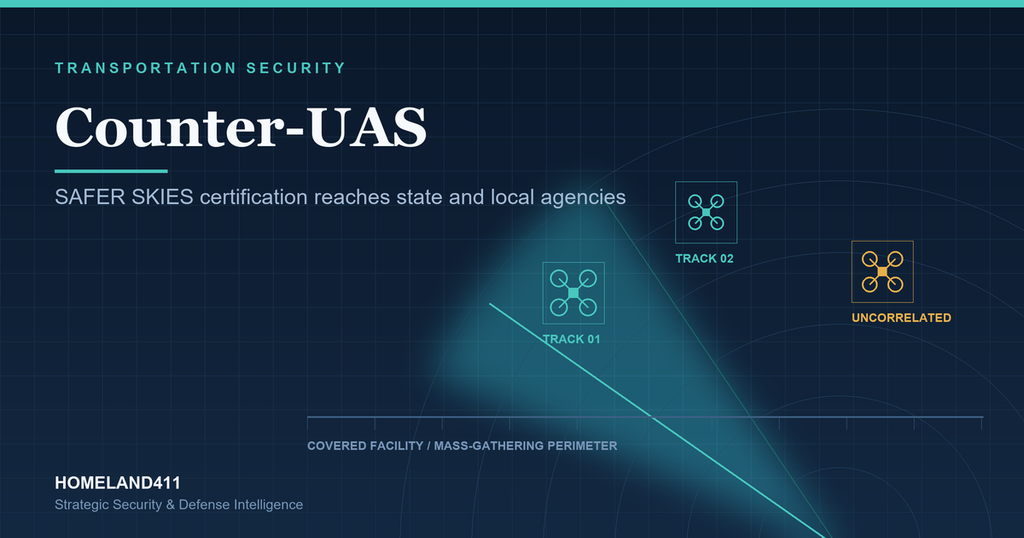
The framework separates authority into two tiers, each with its own certification. The first covers detection and warning: identifying, monitoring, tracking and warning of potentially threatening unmanned aircraft, along with confiscation. It requires a Detection and Warning Certification.
The second tier covers mitigation, defined as actively transmitting radio frequency signals to detect, disrupt, disable or seize control of an unmanned aircraft system. That authority requires a separate Mitigation Certification administered through the FBI’s National Counter-UAS Training Center. The separation is consequential: an agency may be cleared to see a drone and warn about it long before it is cleared to bring one down, and the two populations of certified agencies are unlikely to converge quickly.
Certification is not the only precondition. Participating agencies must adopt implementation policies, prepare operational plans, comply with reporting and audit requirements, and observe detailed privacy and data-handling safeguards — the last a recognition that detection systems capable of characterizing an unmanned aircraft frequently capture information about its operator as well.
Equipment Constrained by Authorized Lists
Agencies cannot simply procure commercially available counter-drone equipment. Technologies must appear on an Authorized Technologies List, and systems must appear on an Authorized Systems List where one has been populated for the relevant category. Both are maintained through an interagency process and distributed through the FBI’s Law Enforcement Enterprise Portal.
The mechanism gives federal agencies durable control over the domestic counter-UAS market, and it introduces a procurement dependency that local budget cycles are poorly suited to absorb. An agency that funds a system in one fiscal year has no guarantee the category will be populated in time to field it, and vendors face a gating process that will determine which products are viable in the state and local segment at all.
Spectrum: A 180-Day Bridge
Mitigation by radio frequency transmission collides directly with communications law, and the FCC’s response was expedient rather than permanent. The Commission granted a nationwide 180-day Special Temporary Authority for qualifying state, local, tribal and territorial agencies, waiving 18 parts of its rules to the extent necessary to permit certified operations.
Agencies nevertheless remain subject to spectrum requirements and equipment authorization rules, and harmful interference protections are preserved. The temporary nature of the authority is the salient detail. A 180-day instrument implies either a successor authorization or a lapse, and agencies building programs on that foundation are doing so without assurance that the spectrum basis will exist when the window closes.
Funding and an Event-Driven Timeline
The financial architecture is in place ahead of the regulatory one. The Federal Emergency Management Agency is distributing $500 million for counter-UAS activities across 2026 and 2027, with $250 million routed to State Administrative Agencies in 2026 and a further $250 million to be obligated in 2027. Homeland Security has separately finalized a $115 million investment in counter-drone technologies concentrated on venues associated with America250 and the 2026 FIFA World Cup. The department established a Program Executive Office for Unmanned Aircraft Systems and Counter-Unmanned Aircraft Systems in January to manage the portfolio.
Those events explain the compressed schedule. Mass-gathering venues operating under temporary flight restrictions represent precisely the environment the two-tier structure was designed for, and they arrive on fixed dates that regulatory timelines must accommodate rather than the reverse.
The scale of the underlying airspace problem continues to grow. FAA records listed 837,513 registered drones as of April 2026, approaching one million nationally, against a backdrop of frequent and often unidentified incursions over military installations and critical infrastructure sites. Federal authority to mitigate drone threats was reauthorized through 2028 in the same defense legislation that created the state and local pathway.
Open Questions
Three uncertainties will shape the first year of operations. The first is throughput: a single federal training center administering mitigation certification constrains how many agencies can be cleared, and no public figure establishes the annual capacity. The second is the spectrum bridge and what replaces it. The third is liability allocation when a certified mitigation action produces collateral consequences — a falling airframe over a populated venue is a foreseeable outcome of the authority being granted, and the interim rules leave the question to be worked out in practice.
Comments filed by the September 4 deadline will inform final rules that have not yet been scheduled. Until they issue, agencies are building programs against an interim framework that remains subject to revision.