
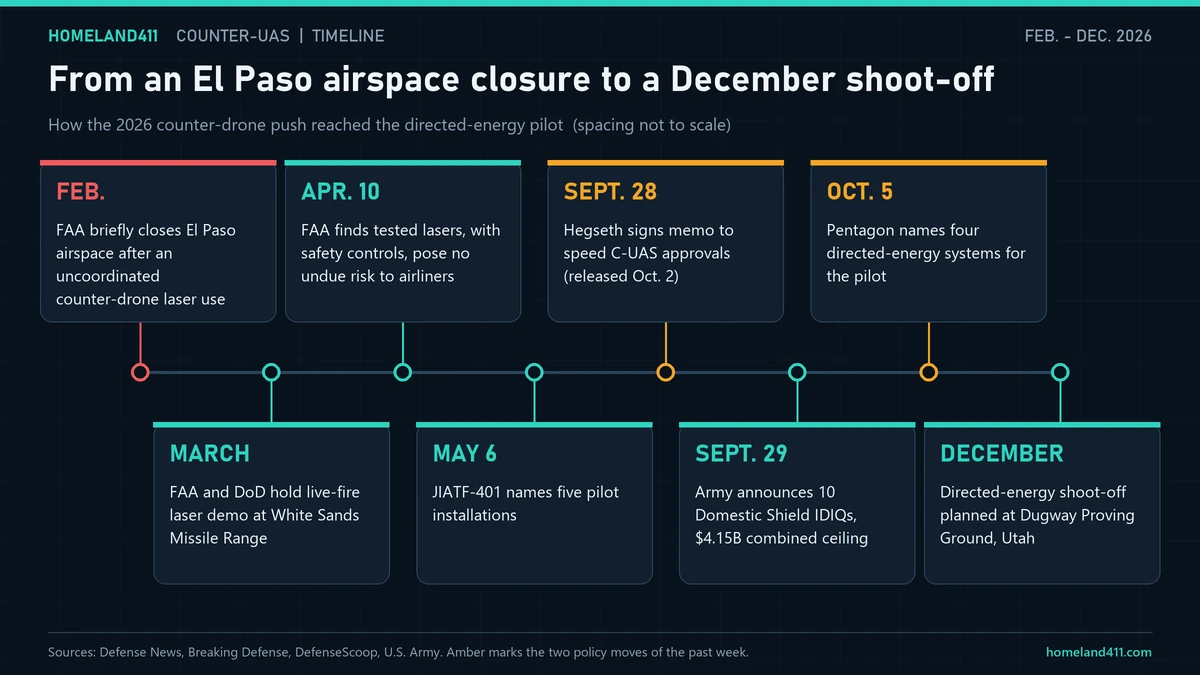
WASHINGTON — The Pentagon on Oct. 5 named the first four directed-energy weapons it will test at U.S. bases under a congressionally ordered counter-drone pilot: three high-energy lasers and one high-powered microwave system. The announcement came three days after the department released a Sept. 28 memorandum in which Defense Secretary Pete Hegseth ordered faster approvals for counter-drone systems at domestic installations.
The Army-led Joint Interagency Task Force 401 (JIATF-401) will run the pilot, which the fiscal 2026 National Defense Authorization Act ordered, at five installations: Fort Huachuca, Arizona; Fort Bliss, Texas; Naval Base Kitsap, Washington; Grand Forks Air Force Base, North Dakota; and Whiteman Air Force Base, Missouri. Army Brig. Gen. Matt Ross, the task force director, said the pilot will “test these capabilities in an operational environment,” according to Breaking Defense.
The Four Systems and What Is Public About Each
The department has not said which system goes to which base, how many units of each it will field, or what the pilot will cost, Defense News reported. What is on the record comes from service contracts and company statements, and the test results below are vendor-reported rather than independently verified.
| System | Type | Procurement record | Reported performance |
|---|---|---|---|
| AeroVironment Palletized High-Energy Laser | Laser | Army awarded $464.8M in September to produce the 30-kilowatt LOCUST X3, which the company called the first production contract for a U.S. directed-energy weapon | Palletized LOCUST defeated target drones aboard the USS George H.W. Bush in an October 2025 live fire (company-reported) |
| Epirus Leonidas | Microwave | Basis for the Army’s IFPC high-power microwave prototype; $66.1M (Dec. 2022) for four prototypes, $43.5M (July 2025) for a second generation | Disabled all 61 targets across five scenarios, including a 49-drone swarm in one burst, at Camp Atterbury, Indiana (company-reported) |
| Kord Firefly | Laser | Palletized, mobile, scalable from 5 to 40 kW; Kord is a KBR subsidiary | Truck-mounted version needs a few seconds on target to down a small drone (company officials, August demo, Alabama) |
| Boeing Compact Laser Weapon System | Laser | Lower-power system; units recently returned from a multiyear Marine Corps deployment overseas | 5-kW version defeated Group 3 drones at the 2024 Red Sands exercise; Boeing cites nearly 500 drones defeated in tests and demonstrations (company-reported) |
Immediate Industry Takeaways
- Pilot length: One year, with service members rather than contractor field representatives operating and maintaining the weapons, according to Ross’s August remarks reported by DefenseScoop.
- Follow-on buying: A December shoot-off at Dugway Proving Ground, Utah, will test additional lasers and microwaves. Ross has said systems that perform well could trigger an immediate purchase order.
- Disclosure gap: Per-base assignments, quantities and pilot funding remain unpublished.
Why the FAA Sets the Pace
The pilot’s hardest constraint is airspace, not firepower. In February the FAA briefly closed airspace around El Paso, Texas, after agencies miscommunicated about a counter-drone laser used by Customs and Border Protection near Fort Bliss. A March live-fire demonstration at White Sands Missile Range followed, and on April 10 the FAA said a safety review found the tested laser systems, with proper safety controls, “do not pose undue risk to passenger aircraft.”
JIATF-401 says it will work in close coordination with the FAA, U.S. Northern Command and the military services. That mirrors the interagency coordination already required of civilian operators: Homeland411 has tracked how the SAFER SKIES rules for state and local counter-drone authority route mitigation through an FAA portal, and how TSA and FAA imposed counter-drone detection requirements at Class-I airports. For a vendor, a documented airspace safety case may now matter as much as beam power.
Hegseth’s Memo Targets the Approval Bottlenecks
The five-page memorandum, dated Sept. 28 and released Oct. 2, identifies two delays that slow counter-drone fielding: radio spectrum authorization and lengthy safety reviews. It directs review and approval authorities to treat delays in handling counter-drone requests as operational risks, DefenseScoop reported.
The tasking is specific. The Defense Department chief information officer has 30 days to review how components submit counter-drone spectrum requests to interdepartmental spectrum authorities and to recommend ways to speed approval. The chief digital and AI officer is to coordinate a single department-wide approval process intended to cut authority-to-operate timelines from months to days or weeks for tested and validated systems. “The Department will take down barriers so our warfighters can take down drones,” Hegseth wrote.
JIATF-401 spokesperson Army Lt. Col. Adam Scher put it more bluntly: the task force “will not accept a slow-moving bureaucracy when faced with a fast-moving threat.” The memo names no bases, but the timing suggests the five pilot sites will be the first real test of whether the faster approval path works for weapons that radiate energy rather than fire projectiles.
Market Reality: A Pilot Beside a $4.15 Billion Buy
The directed-energy pilot is one track in a broader domestic buildout. On Sept. 29 the Army announced that JIATF-401 had awarded 10 indefinite-delivery, indefinite-quantity contracts with a combined base ceiling of $4.15 billion for the Domestic Shield effort, covering smart optical scopes, robotic weapon stations, compact radars and long-range tracking cameras, according to the Army. Recipients include Allen Control Systems, DroneShield, Echodyne, SRC and L3Harris WESCAM. Those are ceilings, not obligated spending, and the covered systems are sensors, optics and gun-based, not lasers or microwaves.
The split shows how the department is layering defenses: sensors and guns on contract vehicles now, directed energy on a one-year trial. Ross said lasers and microwaves are tools that can be “effectively used in a layered drone defense.” The pilot is meant to produce real-time data on performance, cost, and operations and maintenance needs so the services can compare directed energy with conventional defeat methods.
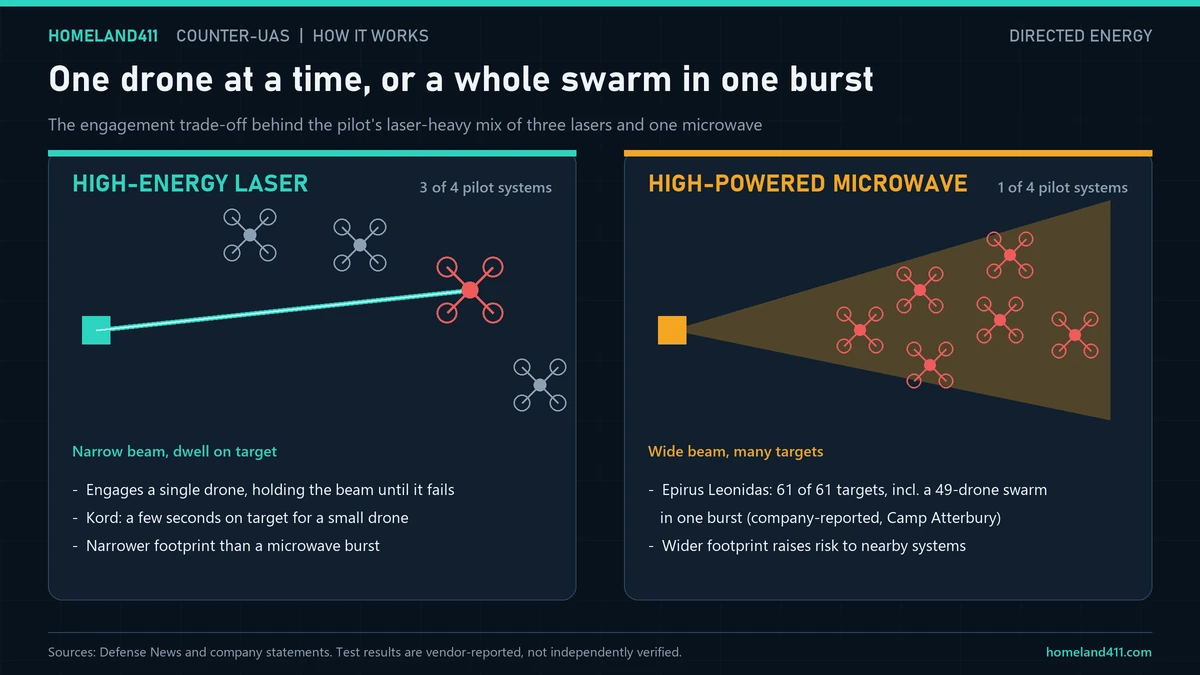
Three details matter to contractors. First, the pilot is laser-heavy: Epirus is the only microwave vendor, so the swarm-defeat claims in the table will be tested through a single supplier. Second, Ross cautioned against judging cost by per-shot figures alone, noting that if a system costs $6 million and fires one shot a year, the per-shot figure does not tell the full story, so utilization data will matter to the cost case. Third, Ross has said the December shoot-off is meant to avoid down-selecting to one or two systems and includes new industry entrants, which leaves room for vendors who missed this round.
The approach is a step beyond earlier work. Homeland411 covered DoD’s 2021 field tests of laser and microwave counter-UAS prototypes for base defense; the new pilot puts production-oriented systems in the hands of service members at five bases for a full year. It also sits in the same fiscal 2026 defense authorization law that created the state and local pathway under SAFER SKIES, so results may inform how far lawmakers extend these tools.
What to Watch
- Deployment plans: Defense News reports plans are being developed with installation commanders over 180 days, with operations expected later in 2026.
- The spectrum review: The 30-day CIO assessment of counter-drone spectrum requests comes due around the end of October.
- December shoot-off: Whether new entrants or a second microwave vendor reach the pilot, and whether a purchase order follows.
- FAA coordination: Whether operations at the five sites proceed without a repeat of the El Paso closure.
The Pentagon’s own announcement gives no dollar figure or delivery schedule, so the first hard numbers are likely to come from the December purchase decisions rather than the pilot itself. Until then, the clearest signal is procedural: the department is clearing approval obstacles before the weapons arrive, not after. More on the domestic drone threat is available in Homeland411’s Defense coverage.
