WASHINGTON — In an unprecedented coordinated warning, the Cybersecurity and Infrastructure Security Agency (CISA), the National Security Agency (NSA), and the Federal Bureau of Investigation (FBI) released a joint cybersecurity advisory warning that foreign state-backed adversaries are conducting industrial-scale knowledge distillation campaigns against American frontier artificial intelligence models.
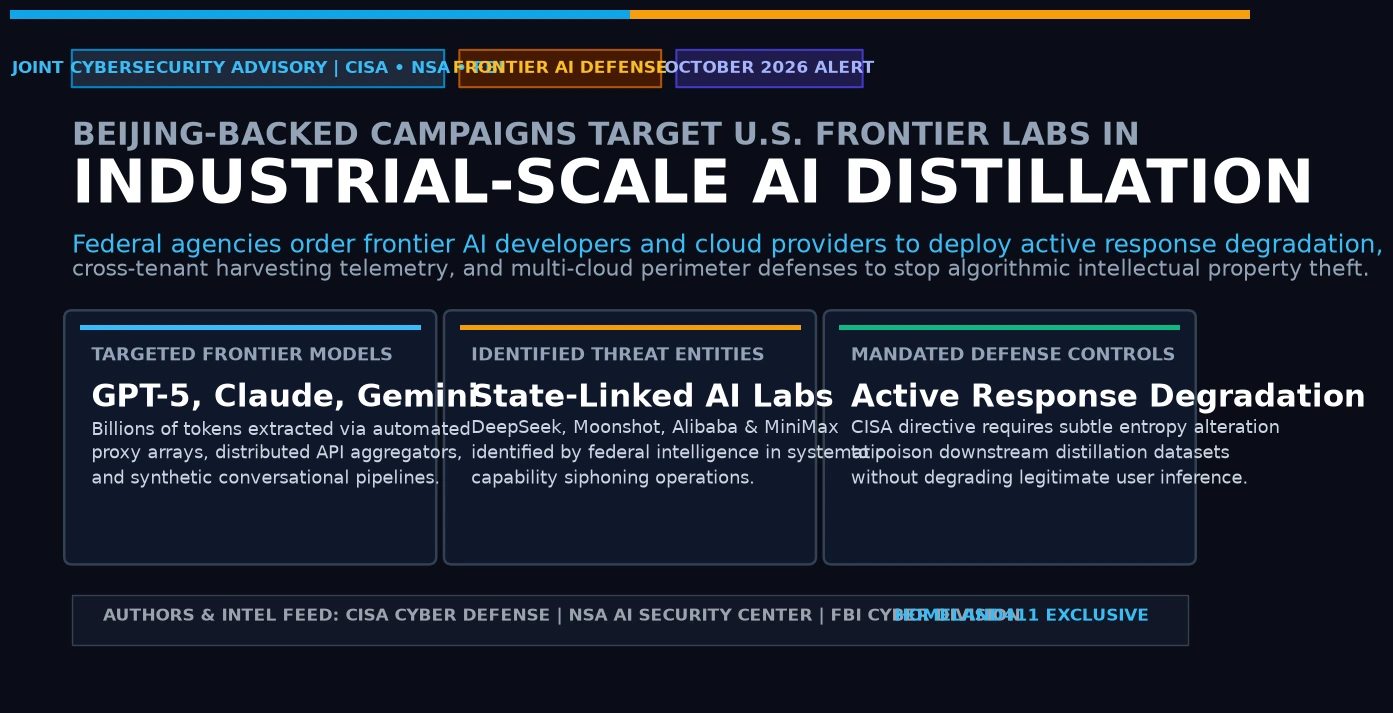
According to federal intelligence officials, foreign entities—principally commercial AI laboratories and defense research institutes operating with the knowledge of the People’s Republic of China (PRC)—have systematically extracted billions of high-entropy reasoning tokens from proprietary American models, including OpenAI’s GPT variants, Anthropic’s Claude, Google’s Gemini, and xAI’s Grok.
The campaign represents a sophisticated strategic bypass of United States export controls. By systematically querying American frontier models through thousands of obfuscated accounts and residential proxy arrays, foreign actors are effectively cloning advanced reasoning architectures and chain-of-thought capabilities into domestic student models at a fraction of the cost, completely circumventing multi-year semiconductor and advanced foundry restrictions.
In response, CISA and the NSA’s Artificial Intelligence Security Center (AISC) have issued emergency guidance directing commercial AI developers and hyperscale cloud providers to deploy active response degradation, logit watermarking, and cross-tenant behavioral telemetry to actively poison and collapse adversarial training runs.
The Strategic Bypass: Weaponizing “Knowledge Distillation”
In conventional machine learning engineering, knowledge distillation is a standard compression technique: a large, compute-heavy “teacher” model trains a smaller, lighter “student” model to replicate its decision logic and task accuracy with significantly lower latency and power consumption. However, the joint advisory warns that foreign actors have industrialized this technique as an asymmetric economic and military espionage vector.
Instead of spending tens of billions of dollars on leading-edge semiconductor clusters—such as NVIDIA H100, H200, or Blackwell B200 systems, which remain strictly restricted under Department of Commerce Bureau of Industry and Security (BIS) export regulations—foreign entities are using American model outputs as synthetic training ground truth.
| Licensing Vector | Adversarial Distillation Practice | Downstream Adversary Advantage |
|---|---|---|
| Commercial API Access | Distributed residential proxy arrays & fraudulent enterprise tenants | Evades enterprise terms-of-service and geographic IP geofencing |
| Compute Infrastructure | Querying multi-billion-dollar Western compute clusters via public endpoints | Circumvents US semiconductor and extreme ultraviolet (EUV) export controls |
| Reasoning Extraction | Programmatic scraping of chain-of-thought, mathematical proofs, and exploit logic | Student models achieve 90%+ frontier reasoning performance at 1/1,000th R&D cost |
| Defense Mandate | Subtle logit perturbation & entropy-degradation watermarking | Triggers mathematical collapse in downstream models without disrupting legitimate users |
“What we are observing is not casual academic benchmarking or developer experimentation,” said a senior federal cyber defense official briefed on the intelligence. “This is a coordinated, state-backed data-mining operation designed to extract the architectural crown jewels of Western frontier laboratories. When a foreign laboratory extracts hundreds of millions of reasoning steps across cyber defense, molecular biology, and automated software engineering, they are closing a five-year technological gap in a matter of months.”
Entities and Tactics: How the Siphoning Operates
Federal investigators identified several Chinese commercial and state-linked artificial intelligence operations that have allegedly participated in large-scale harvesting campaigns since late 2024. The entities referenced in the federal assessment include DeepSeek, Moonshot AI, Alibaba Cloud, MiniMax, StepFun, and Z.AI.
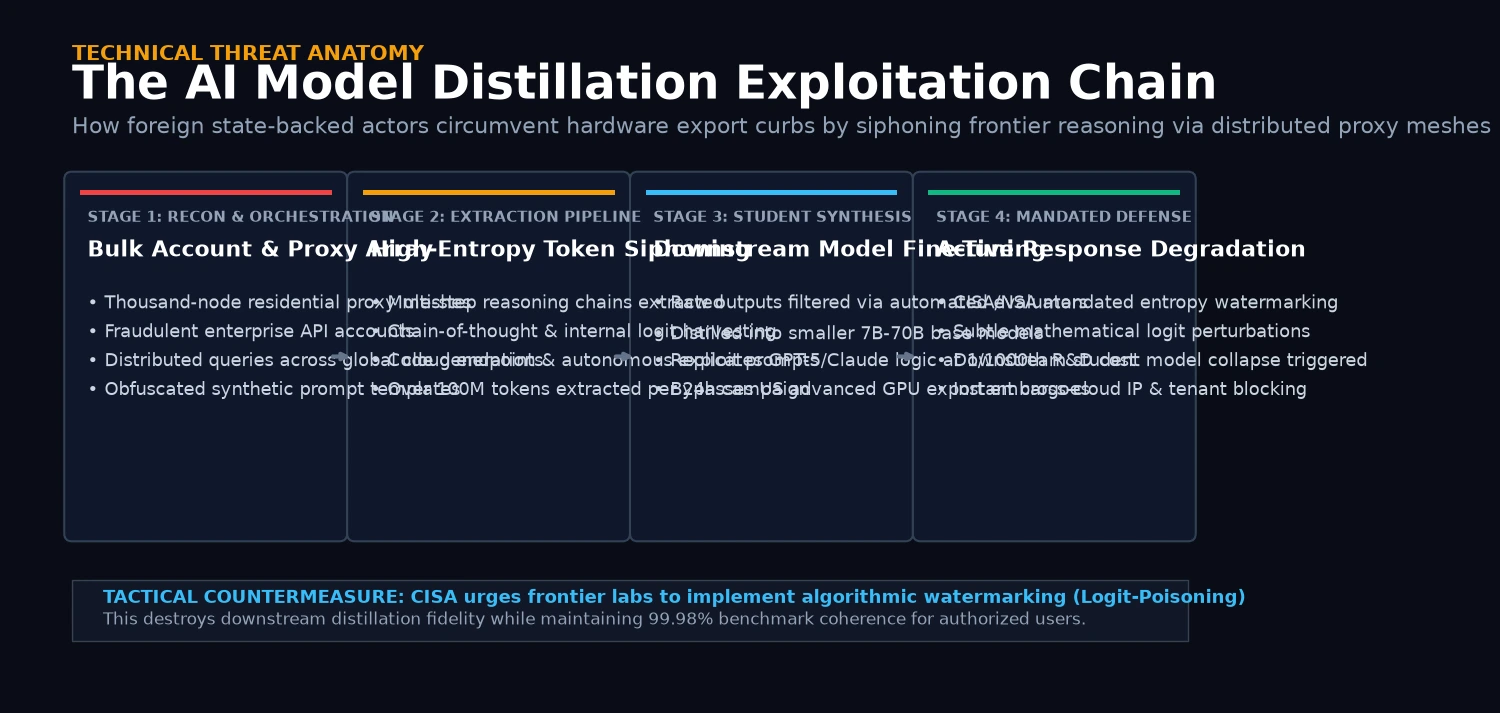
The technical anatomy of the campaigns involves four distinct operational layers:
1. Thousand-Node Residential Proxy Arrays
To evade standard commercial API rate limits and geographic IP filtering, the threat actors route high-volume automated requests through commercial proxy networks (residential IP rotating services). Requests appear as ordinary consumer traffic originating from residential cable and broadband connections across North America, Western Europe, and Southeast Asia.
2. Fraudulent and Compromised Enterprise Tenants
Adversaries leverage compromised corporate credentials and bulk-purchased business subscriptions to bypass basic payment risk scoring. In several documented instances, shell consulting firms registered in offshore jurisdictions were established solely to acquire maximum-tier API throughput allocations from major cloud infrastructure distributors.
3. High-Density Synthetic Prompting
The querying scripts are not human dialogues. Threat actors deploy automated orchestrators that feed hundreds of thousands of structured mathematical, cryptographic, reverse-engineering, and strategic scenario prompts into target models. The orchestrators capture the full chain-of-thought reasoning pathways, parsing out the intermediate logic steps that allow frontier models to solve complex multi-stage tasks.
4. Downstream Student Fine-Tuning
The harvested token datasets are cleaned, filtered through automated quality evaluators, and immediately fed into clusters of domestic, open-weight base models (typically 7-billion to 72-billion parameter architectures). Through targeted Supervised Fine-Tuning (SFT) and Direct Preference Optimization (DPO), the student models acquire near-frontier reasoning performance on sovereign, domestically manufactured hardware.
Mandated Countermeasures: Active Response Degradation
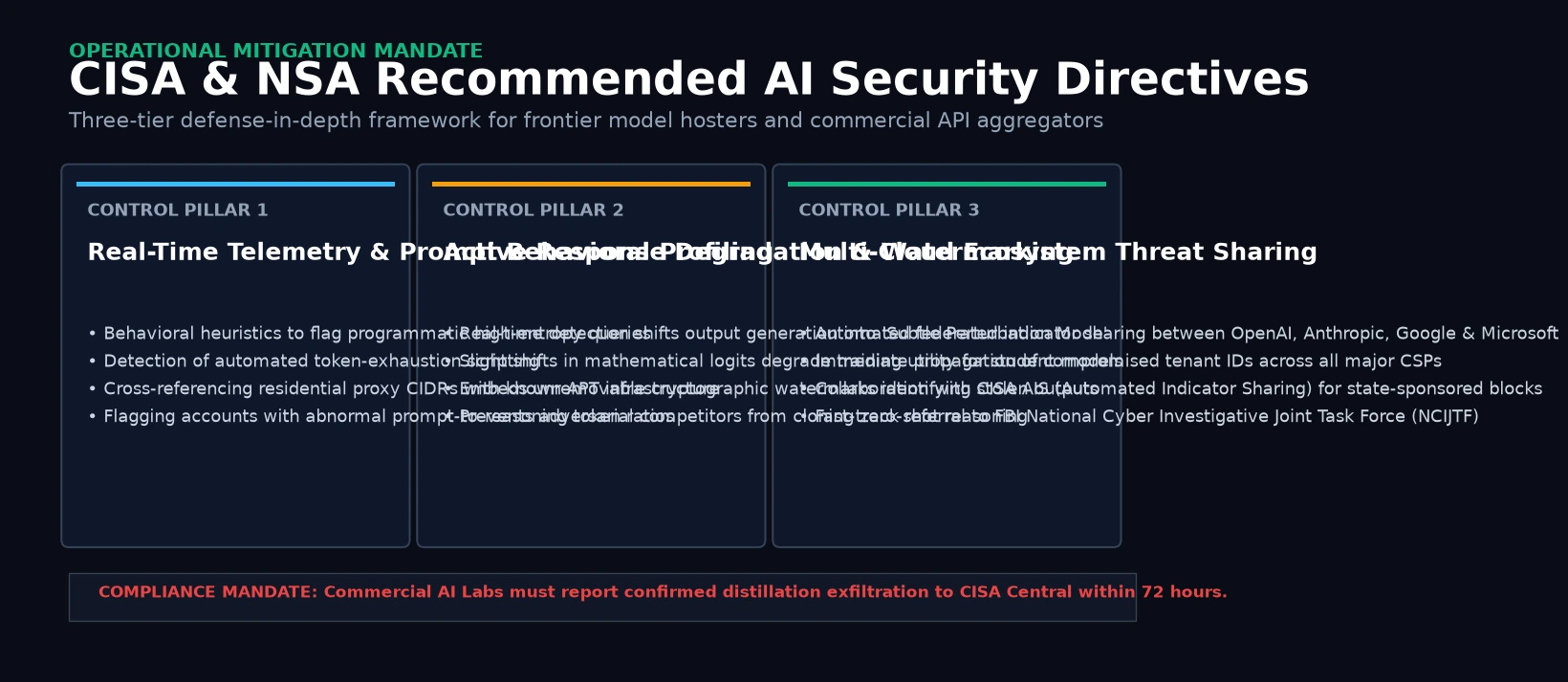
To counter distillation exfiltration without impacting legitimate developers, CISA and the NSA’s Artificial Intelligence Security Center (AISC) have outlined three primary defensive directives:
1. “Active Response Degradation” (Logit Perturbation)
The most significant technical development in the advisory is the recommendation for frontier laboratories to implement real-time defensive response alteration. When automated behavioral telemetry detects an account exhibiting distillation patterns (e.g., continuous high-entropy reasoning requests with zero interactive back-and-forth), the API engine does not terminate the connection. Instead, it subtly shifts generation parameters:
- It injects infinitesimal, statistically imperceptible perturbations into the output token probability distribution (logits).
- To a human reader, the response appears fully coherent and grammatically pristine.
- When ingested as training data by an automated machine learning training run, the poisoned logits induce mathematical instability, leading to downstream model collapse and degraded generalization in the adversary’s student model.
2. Algorithmic and Cryptographic Watermarking
AI providers are urged to deploy unremovable mathematical watermarks within output sequences. By biasing pseudo-random token selection according to a secret cryptographic key, model developers can later test adversary models and prove beyond doubt that a foreign system was trained on stolen synthetic data, opening the door for secondary trade sanctions and export control crackdowns.
3. Federated Cross-Cloud Threat Telemetry
CISA is integrating AI distillation indicators into its Automated Indicator Sharing (AIS) ecosystem. If Anthropic or OpenAI identifies a distributed proxy subnet or fraudulent billing cluster attempting large-scale siphoning, those indicators must propagate within minutes to Microsoft Azure, Google Cloud Platform, Amazon Web Services, and specialized inference hosts to enforce network-wide isolation.
Geopolitical Fallout: Export Controls at the Algorithmic Layer
The joint advisory highlights a fundamental shift in national security doctrine: hardware export bans are no longer sufficient to maintain a technological moat. While the U.S. government has successfully restricted the export of extreme ultraviolet (EUV) photolithography machines and high-bandwidth memory (HBM) chipsets to strategic competitors, frontier model APIs remain globally accessible communication pipes.
If foreign labs can siphon the intellectual property of a $100 billion compute cluster through an API pipeline costing less than $200,000 in monthly tokens, the strategic advantage of domestic hardware dominance is severely eroded.
“Our adversaries recognize that the fastest way to win the AI race is to let American research capital take all the risks and pay all the electrical bills, then download the intelligence via an automated script. This advisory draws the line. The API boundary is now a national security perimeter.”
Congressional national security leaders are already preparing legislative follow-ups. Sources familiar with Capitol Hill discussions indicate that the House Select Committee on the Strategic Competition Between the United States and the Chinese Communist Party is reviewing draft provisions that would categorize massive commercial API distillation by foreign entities as actionable intellectual property theft under the Economic Espionage Act.
