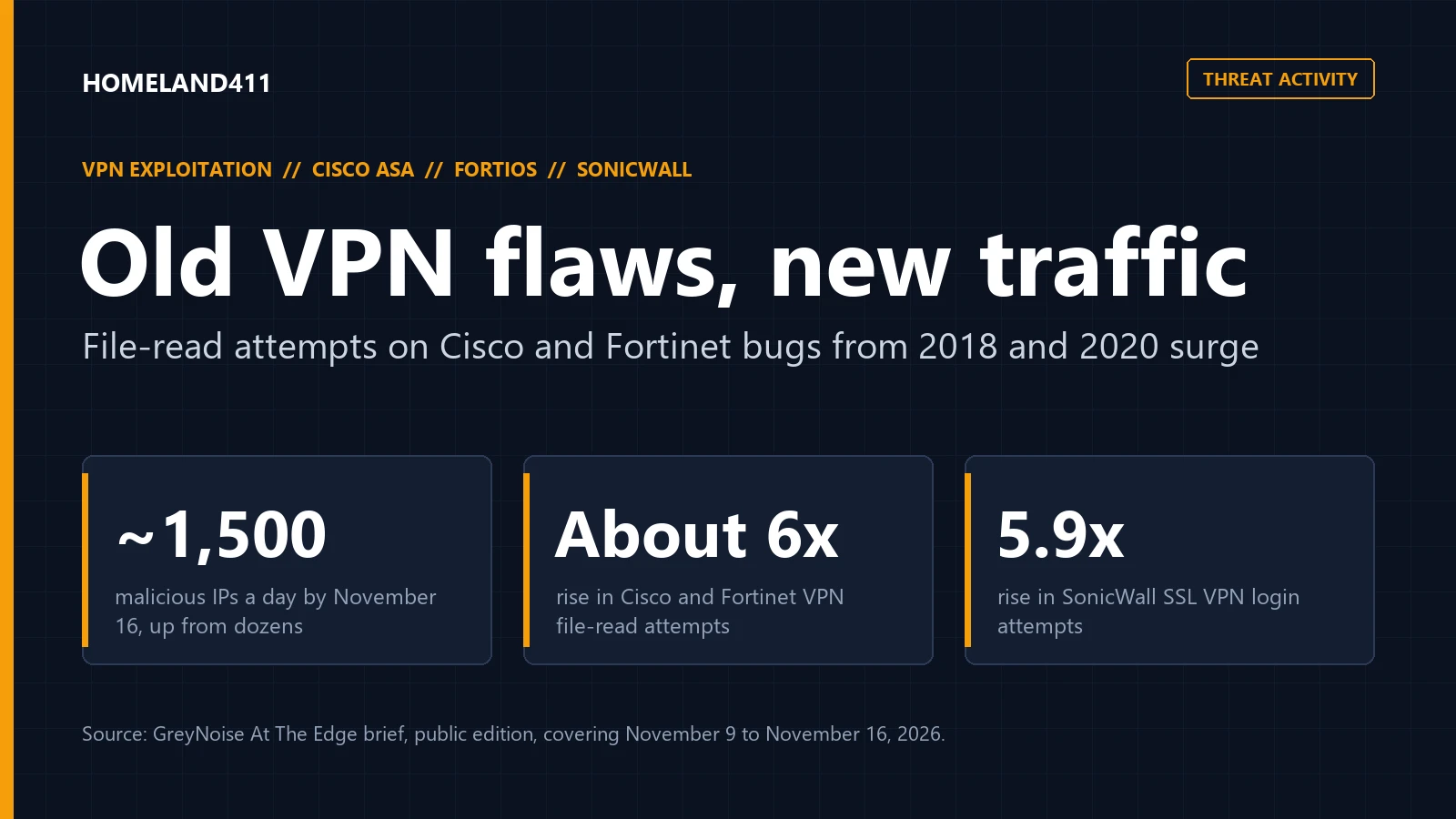
Somewhere around fifteen hundred malicious IP addresses a day were being used by Monday to try to read files off Cisco and Fortinet VPN appliances through two bugs that were patched years ago, up from a few dozen at the start of the period, according to the threat intelligence firm GreyNoise.
The count, which GreyNoise put in a brief posted to Bluesky on Tuesday, was said to amount to roughly a sixfold rise over the period from November 9 to November 16, and it was matched by a 5.9-fold jump in login attempts on SonicWall VPN devices, according to that same brief.
Never Miss An UpdateFollow us on Google News to get our latest security, defense and cyber reporting in your feed. It’s free and takes one tap.
Follow on Google NewsThe brief at issue was the free edition of At The Edge, a weekly report that the company said it otherwise sent only to paying customers along with full lists of indicators and detection guidance, according to the GreyNoise website.
“Adversaries stepped up file-read attempts on Cisco and Fortinet VPN appliances through two flaws known exploited since 2021,” the summary at the top of the brief said, in a document that was marked TLP:CLEAR for public release.
Cisco and Fortinet had fixed both bugs by 2020
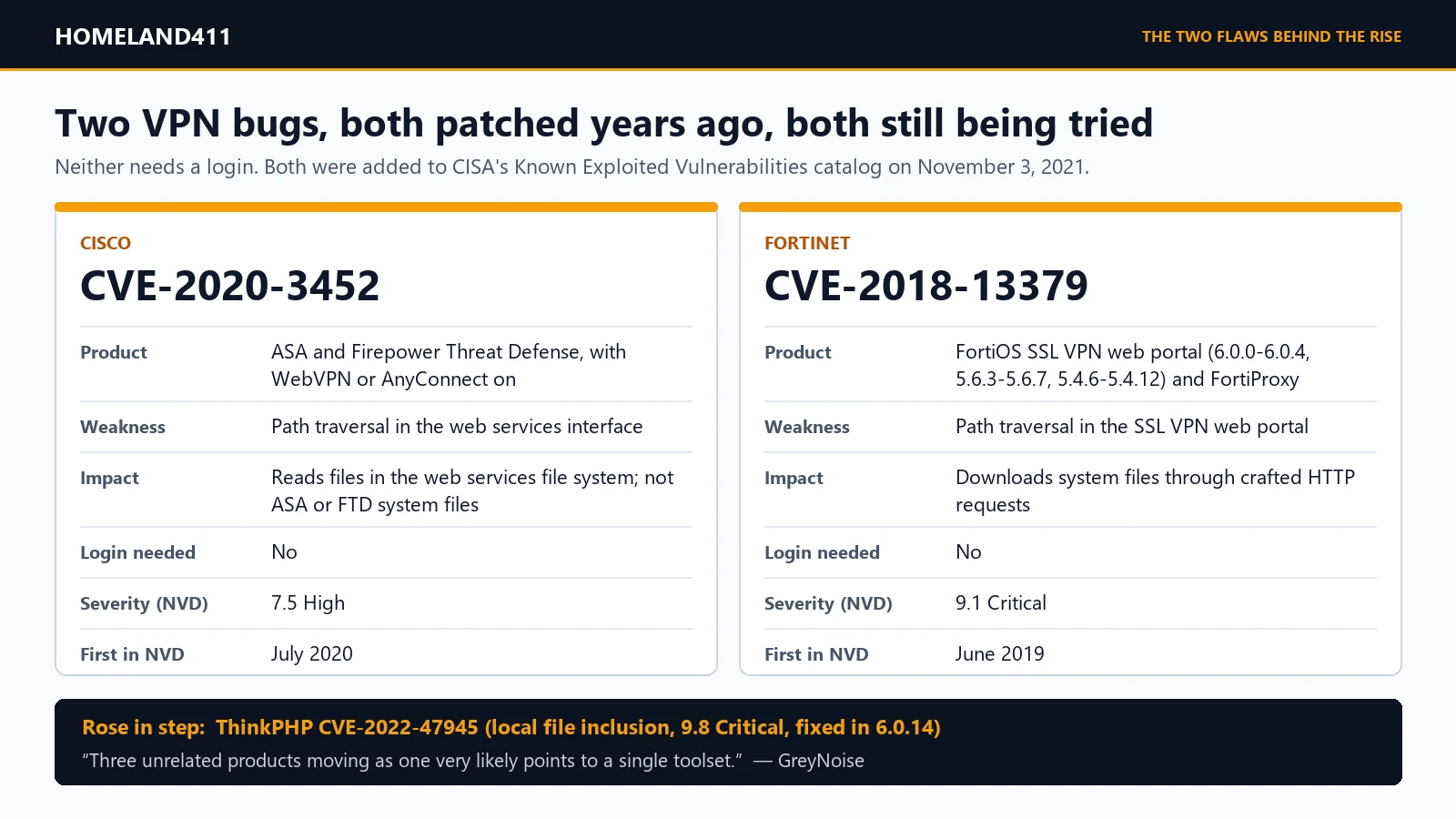
The Cisco bug at issue, CVE-2020-3452, was traced to the web services interface of Cisco’s Adaptive Security Appliance and Firepower Threat Defense software, where an unauthenticated attacker could send an HTTP request laced with directory traversal sequences and read files back, according to its entry in the National Vulnerability Database.
That hole was open only on appliances configured with WebVPN or AnyConnect, was rated 7.5 out of 10, and was said by Cisco to stop short of the ASA and FTD system files, according to the same entry, which was first posted in July 2020.
The Fortinet bug, CVE-2018-13379, was found in the SSL VPN web portal of FortiOS 6.0.0 to 6.0.4, 5.6.3 to 5.6.7 and 5.4.6 to 5.4.12, as well as several FortiProxy releases, and was said to let an attacker who had never logged in download system files, according to the NVD, which gave it a 9.1.
The two bugs were placed on the same day, November 3, 2021, on the list of known exploited vulnerabilities kept by the Cybersecurity and Infrastructure Security Agency, according to the NVD entries for each of them.
Neither of the two flaws was said to require a login, according to GreyNoise, which noted in the brief that both had been known to be exploited since 2021.
A PHP bug rose on the same days
The daily count of IPs going after CVE-2022-47945, a flaw in the ThinkPHP framework that had nothing to do with either VPN product, rose on the same days and by similar amounts as the two VPN bugs, according to the brief.
“Three unrelated products moving as one very likely points to a single toolset,” the company wrote in that same section of the report, without naming the group or the tool it believed was behind the traffic.
The ThinkPHP bug was described in the NVD as a local file inclusion flaw in versions before 6.0.14 that could let a remote attacker run operating system commands when the framework’s language pack feature was turned on.
SonicWall and Remote Desktop traffic also climbed
The login attempts on SonicWall SSL VPN devices were found to have risen 5.9 times over the week, while probes of the SonicOS API went up 11.8 times, according to the brief.
The attempts to trigger overflows in two SonicOS flaws, which were not named in the public version of the report, were said to have risen in bursts on the same days as the Cisco and Fortinet activity, according to GreyNoise.
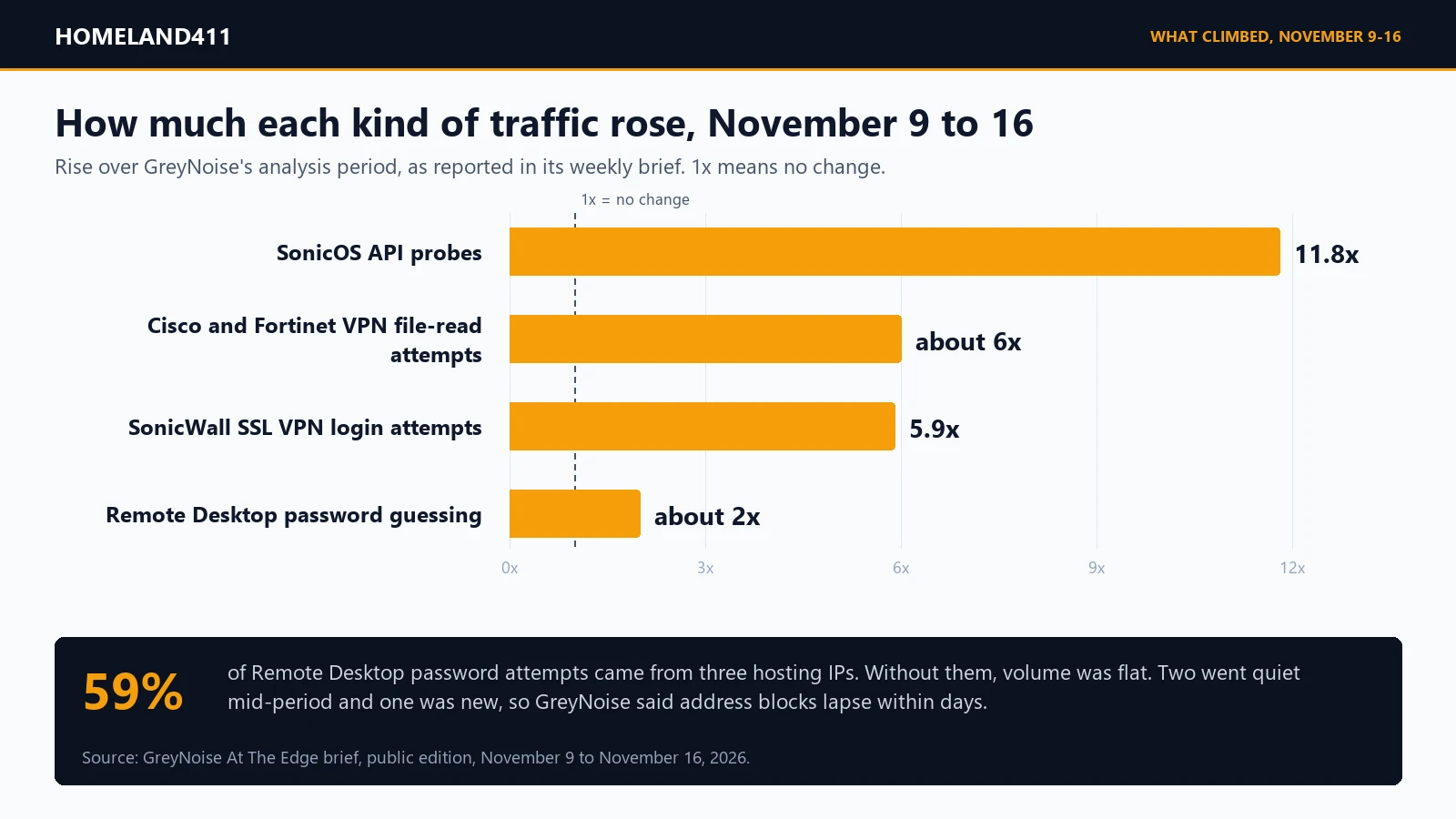
The password guessing aimed at Remote Desktop was roughly doubled by three hosting IPs that accounted for 59% of the RDP brute-force traffic GreyNoise recorded, and the volume was said to have been flat without them, according to the report.
Two of the three hosts were said to have gone quiet halfway through the week and the third was new, a pattern that the company said meant blocks placed on those addresses would lapse within days.
The full list of IP addresses, the infrastructure attribution and the recommendations for defenders were withheld from the public version and were made available only to GreyNoise customers, according to the brief.