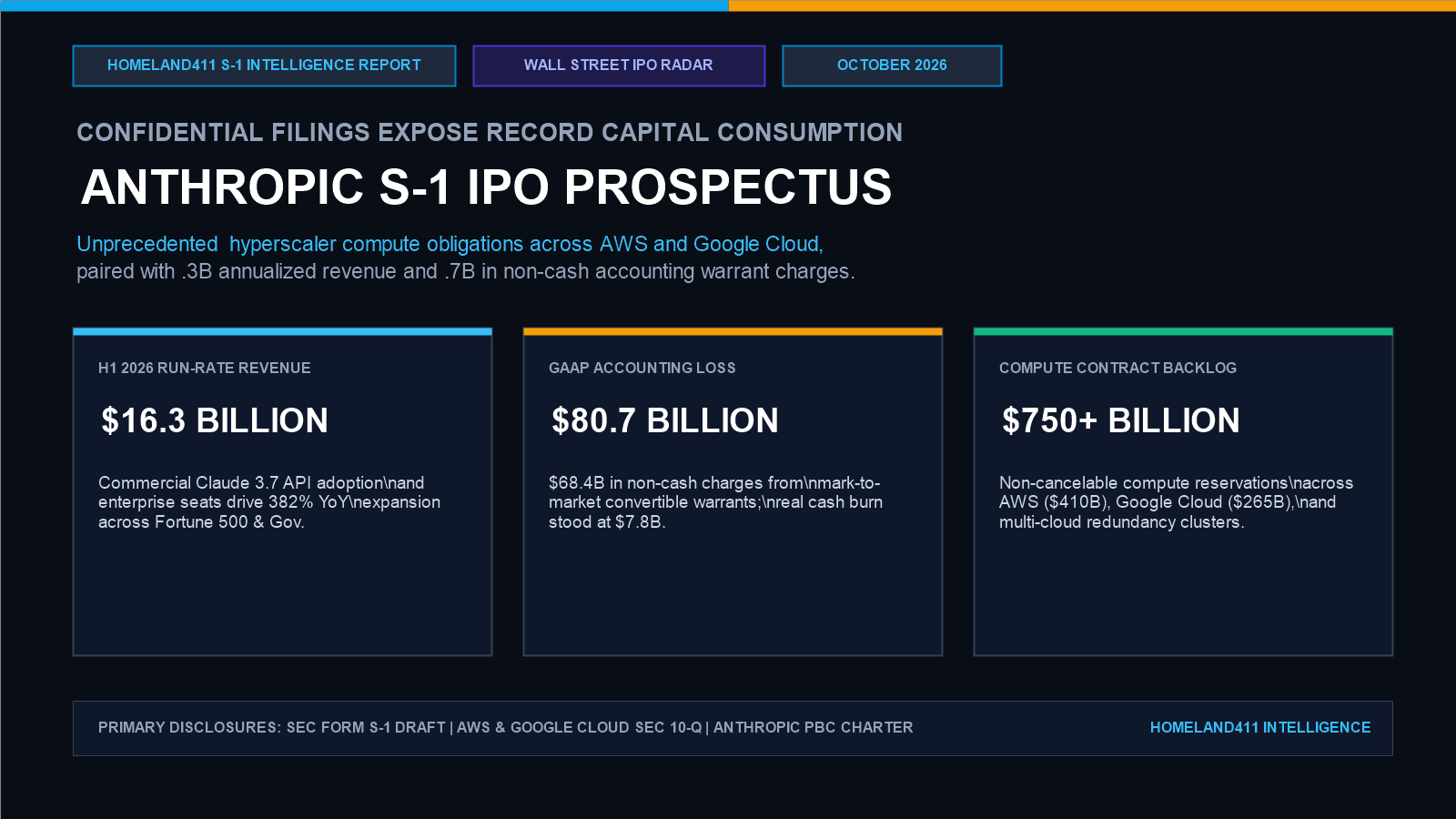
SAN FRANCISCO — Preliminary registration documents circulating among Wall Street underwriting desks reveal that artificial intelligence developer Anthropic generated $16.3 billion in annualized run-rate revenue during the first half of 2026, even as the company logged an eye-popping $80.7 billion statutory net loss driven by derivative revaluations and an unprecedented $750 billion compute commitment backlog.
The confidential draft S-1 prospectus, prepared ahead of an anticipated public listing led by Morgan Stanley and Goldman Sachs, offers the first granular balance sheet audit of a frontier AI lab operating at hyperscale. What emerges is not an imminent solvency crisis, but a stark portrait of the structural capital requirements governing generative AI: commercial enterprise revenue is surging, but the compute debt required to stay competitive is unlike anything in tech history.
Anthropic’s annualized sales surged nearly fivefold over the past twelve months, anchored by rapid enterprise adoption of its Claude 3.7 reasoning models across defense contractors, healthcare networks, and financial institutions. Yet the headline $80.7 billion paper deficit eclipses every tech listing on record, surpassing the previous benchmark set by Uber prior to its 2019 market debut.
The Balance Sheet: H1 2026 Operational Disclosures
Financial analysts auditing the draft filing separate Anthropic’s headline statutory deficit into two distinct columns: GAAP non-cash charges and actual operational cash burn.
| Financial Parameter | H1 2026 Reported Value | YoY Change | Operational Driver |
|---|---|---|---|
| Recognized Annualized Revenue | $16.3 Billion | +382% | Expansion of Claude API tokens, dedicated enterprise clusters, and federal deployments. |
| GAAP Net Loss | $80.7 Billion | N/A | $68.4B attributed to mark-to-market accounting on preferred convertible debt and warrants. |
| Operating Cash Outflow | $7.8 Billion | +144% | Cash expenditure on model pre-training, hardware reservations, and core engineering staff. |
| Committed Cloud Compute Backlog | $750+ Billion | +620% | Seven-year take-or-pay capacity agreements across AWS, Google Cloud, and Azure. |
| Cash & Liquid Reserves | $18.5 Billion | +95% | Capital buffer secured through strategic debt tranches and private equity rounds. |
Why the $80.7 Billion Deficit Is Mostly Paper
The headline loss will provoke alarm on financial television, but institutional allocators recognize the accounting mechanics at play. Over 84% of the $80.7 billion deficit stems from standard GAAP requirements regarding convertible equity.
During earlier funding rounds, Amazon and Google injected billions into Anthropic via convertible notes and warrants. Under financial accounting standards, when a private company’s internal valuation spikes — in Anthropic’s case, from roughly $18 billion to secondary valuations exceeding $350 billion — the company must mark the expanding value of those conversion rights as a non-cash expense against current earnings.
The moment Anthropic completes its public listing, those derivative liabilities convert permanently into equity, wiping the paper charge off future earnings statements. Anthropic’s actual operating cash burn for the six-month period was $7.8 billion — high by traditional software margins, but well inside the company’s $18.5 billion liquidity reserve.

The $750 Billion Take-or-Pay Compute Web
The real risk factor in the filing is not the paper deficit; it is the $750 billion in non-cancelable compute commitments spread across the next seven fiscal years. Anthropic has structured its future around dedicated cloud infrastructure:
- Amazon Web Services: $410 billion committed to Project Rainier clusters running custom Trainium2 and Trainium3 silicon.
- Google Cloud: $265 billion dedicated to multi-gigawatt TPU v6 (Trillium) and TPU v7 pods hosted across specialized data center campuses.
- Microsoft Azure and Neoclouds: $75 billion reserved for inference failover and cross-platform enterprise availability.
These contracts are “take-or-pay.” If model demand softens or architectural breakthroughs reduce the compute needed for frontier training, Anthropic remains contractually liable to pay for the reserved data center megawattage and GPU/TPU hours. This ties Anthropic’s financial viability directly to the balance sheets of the two tech giants that serve as its primary backers and infrastructure hosts.
National Security Contracts and the Public Benefit Clash
For defense and intelligence observers, the filing confirms Anthropic’s expanding public-sector footprint. The company reported $1.4 billion in annualized revenue derived from federal civilian, intelligence, and defense research contracts, reflecting growing adoption of Claude within classified data enclaves.
However, the prospectus warns investors about Anthropic’s unique corporate architecture. As a Delaware Public Benefit Corporation, Anthropic’s corporate charter legally subordinates shareholder return to its safety mandate. An independent “Long-Term Benefit Trust” controls a special class of voting stock, retaining veto power over model releases and board appointments.
The risk factor disclosure puts the issue bluntly: “Our corporate structure and public benefit commitments may cause our board of directors to make strategic or operational decisions that prioritize safety and responsible deployment over short-term revenue maximization or quarterly profit margins.”
The Path to Listing
Anthropic’s filing sets the benchmark for the coming wave of foundation model public offerings. With Morgan Stanley and Goldman Sachs preparing the formal roadshow, the central debate for prospective shareholders will not be whether Anthropic can sell enterprise AI — its $16.3 billion run-rate answers that question — but whether any software business can generate sufficient operating cash to outpace a $750 billion cloud infrastructure bill.
