
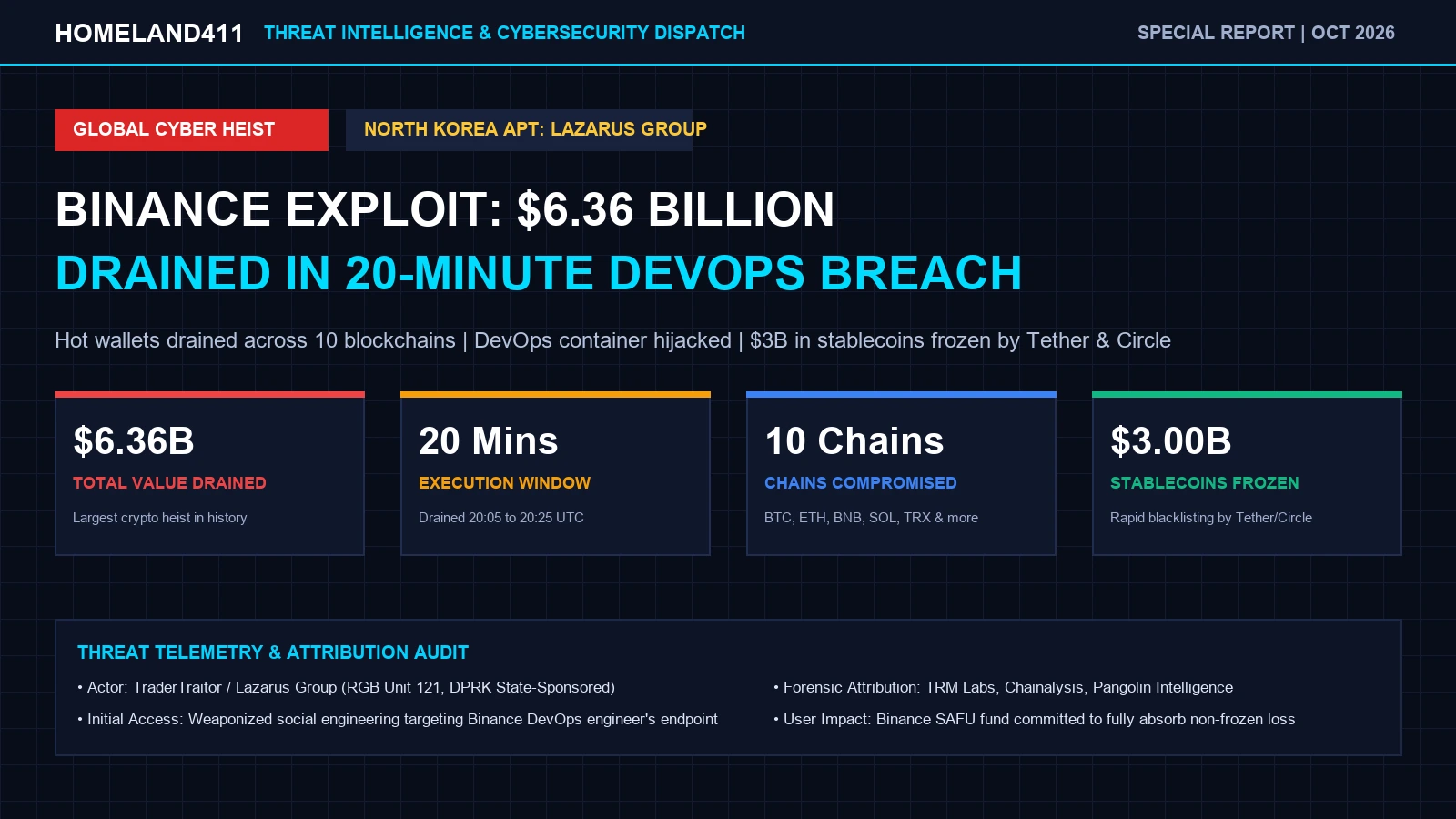
WASHINGTON and SINGAPORE — The Binance $6.36 billion hack executed on Thursday, October 29, 2026, represents the largest and most destructive cryptocurrency heist in digital financial history. In a surgically coordinated operation spanning exactly 20 minutes between 20:05 and 20:25 UTC, state-sponsored cyber operatives affiliated with North Korea’s notorious Lazarus Group systematically drained billions of dollars from Binance operational hot wallets across ten major blockchain networks. By leveraging a compromised senior DevOps workstation to forge internal withdrawal authorizations, the attackers bypassed standard algorithmic tripwires before an unprecedented public-private counter-offensive by stablecoin issuers Tether and Circle froze approximately $3.00 billion in flight.
Federal cybersecurity authorities, including the Cybersecurity and Infrastructure Security Agency (CISA) and the Federal Bureau of Investigation’s Virtual Assets Unit (VAU), have officially confirmed the breach’s attribution. Leading blockchain intelligence firms TRM Labs, Chainalysis, and Pangolin Intelligence confirmed that the intrusion was orchestrated by TraderTraitor—an elite cyber offensive unit embedded within North Korea’s Reconnaissance General Bureau (RGB Unit 121) tasked with harvesting liquid foreign currency to fund the regime’s prohibited nuclear and ballistic missile programs.
The Binance $6.36 Billion Hack at a Glance: Key Telemetry
To understand the unprecedented scale of the Binance $6.36 billion hack, the operational parameters recorded by cross-chain monitoring nodes break down into the following verified metrics:
- Total Gross Volume Siphoned: $6,360,000,000 (confirmed across 10 independent blockchains).
- Total Assets Frozen in Flight: ~$3,000,000,000 (USDt and USDC smart contract blacklists executed by Tether and Circle).
- Net Un-frozen Liquid Capital Stolen: ~$3,360,000,000 (primarily native Bitcoin, Ether, and cross-chain utility tokens).
- Execution Timeframe: 20:05:14 UTC to 20:25:00 UTC (1,186 seconds from initial automated withdrawal to global emergency shutdown).
- Attributed Threat Cluster: TraderTraitor / Lazarus Group (RGB Unit 121, DPRK State-Sponsored).
- Primary Infiltration Vector: Senior DevOps engineer endpoint compromise via targeted weaponized PDF spear-phishing.
- Impact on User Accounts: Binance confirmed zero cold storage compromise; all customer deposits remain fully guaranteed by Binance corporate reserves and the $1.0B Secure Asset Fund for Users (SAFU).
Inside the Binance $6.36 Billion Hack: The 20-Minute Hot Wallet Drain
The operational assault that defines the Binance $6.36 billion hack began without warning during the peak liquidity overlap between European and North American trading desks. At 20:05:14 UTC, automated settlement nodes across Bitcoin, Ethereum, BNB Chain, Tron, Arbitrum, Solana, Polygon, Avalanche, Optimism, and Base detected a massive, asynchronous spike in high-frequency withdrawal transactions originating from Binance-verified operational hot wallets.
Unlike previous exchange security breaches that relied on stolen static API keys or smart-contract reentrancy flaws, the perpetrators of the Binance $6.36 billion hack directly manipulated the internal orchestration bus that processes approved user payouts. By generating legitimate-looking internal microservice messages, the attackers instructed the automated transaction daemon to disburse reserves to dozens of newly initialized on-chain destination addresses.
- $2.15 Billion in Tether (USDt): Programmatically pulled from Tron (TRC-20), Ethereum (ERC-20), and BNB Smart Chain pools.
- $1.48 Billion in USD Coin (USDC): Drained from high-throughput liquidity vaults on Ethereum and Arbitrum.
- $1.22 Billion in Native Ether (ETH): Representing over 380,000 ETH transferred across 14 newly generated recipient addresses.
- $840 Million in Native Bitcoin (BTC): Extracted via native SegWit and Taproot scripts and quickly routed into complex peeling chains.
- $670 Million in BNB, Solana (SOL), Avalanche (AVAX), and Layer-2 Tokens: Siphoned across respective ecosystem bridges.
How the Binance $6.36 Billion Hack Happened: The DevOps Attack Vector
Forensic telemetry compiled by incident response specialists reveals that the root cause of the Binance $6.36 billion hack was not a zero-day flaw in cryptographic primitives, but a meticulously planned supply-chain compromise targeting Binance’s deployment engineering staff.
Over a three-week reconnaissance period preceding the attack, Lazarus operatives deployed the TraderTraitor playbook—a tactic previously documented in FBI cyber advisories. Threat actors established fraudulent executive recruiter profiles on professional networks, targeting senior DevOps personnel with tailored job offerings for distributed infrastructure leadership positions.
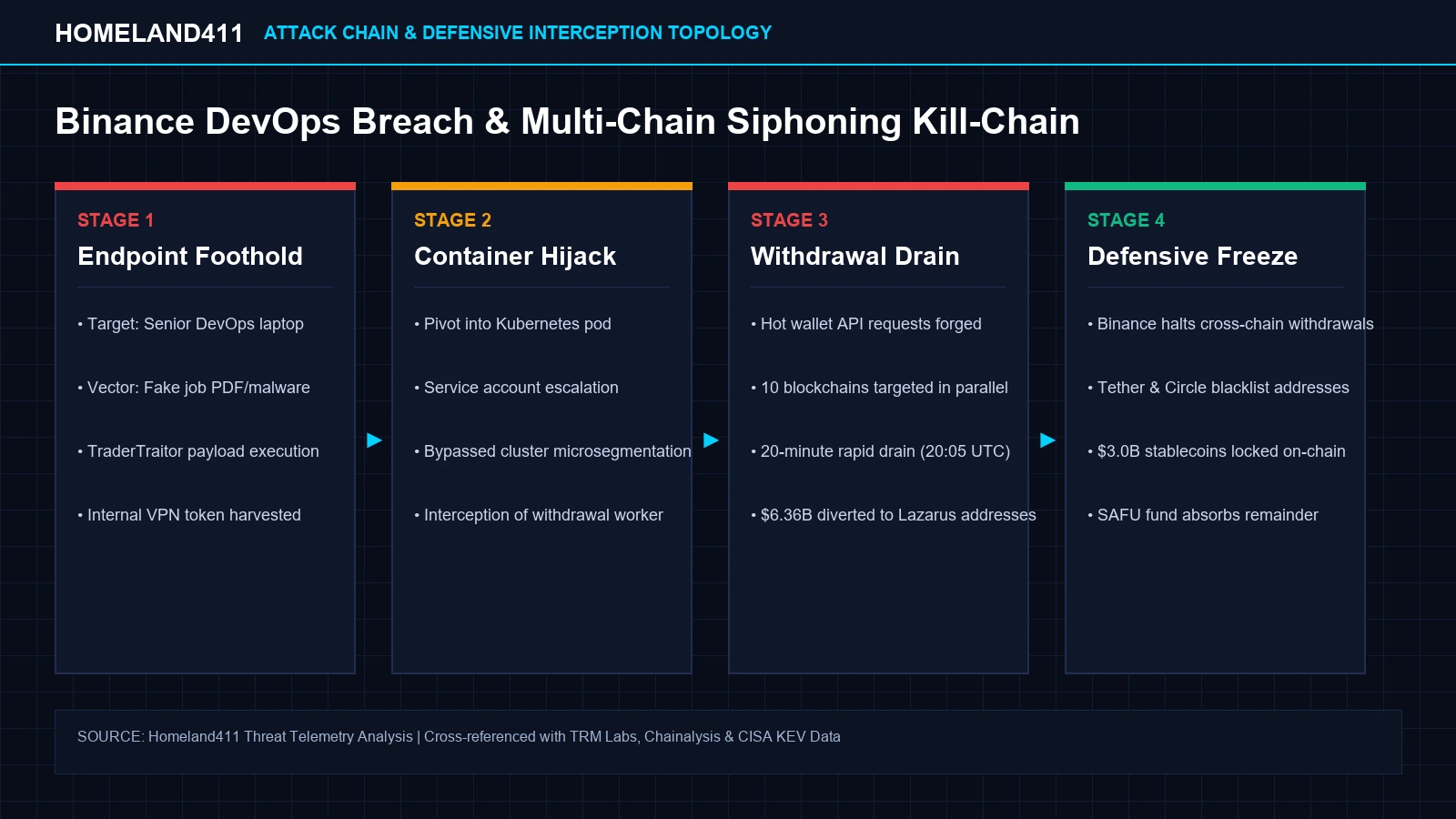
The Four-Phase Technical Kill-Chain:
- Phase 1 — Endpoint Spear-Phishing: The targeted senior engineer was sent an employment assessment package containing an infected PDF viewer utility. Upon execution, the payload dropped a modular living-off-the-land beacon that bypassed endpoint detection and response (EDR) software, silently logging keystrokes, active VPN configurations, and session tokens.
- Phase 2 — Lateral Cloud Ingress: Using legitimate administrative VPN credentials and stolen hardware token session hashes, the attackers logged into Binance’s staging and deployment environment, bypassing IP-whitelist restrictions.
- Phase 3 — Service Container Hijacking: Once inside the Kubernetes cluster orchestration network, the attackers escalated privileges to compromise the service account governing Binance’s automated withdrawal pipeline. While offline cold storage keys remained safe within physical Hardware Security Modules (HSMs), this compromised service container possessed the delegated cryptographic authority to request hot wallet payouts up to preset dynamic operational limits.
- Phase 4 — Batch Anomaly Evasion: The attackers automated the issuance of thousands of programmatic withdrawal calls carefully calculated to sit just beneath individual fraud-scoring tripwires, spreading the outflows across ten distinct blockchains to prevent immediate multi-chain correlation.
The $3.00 Billion Emergency Response: Tether and Circle Stablecoin Freeze
While the initial financial loss of the Binance $6.36 billion hack was staggering, the total damage was cut nearly in half due to rapid, unprecedented public-private coordination between centralized stablecoin issuers and federal authorities.
Within seven minutes of Binance detecting the intrusion, exchange security leads broadcast emergency cryptographic alert hashes to Tether and Circle through established inter-entity threat-sharing channels. Blockchain intelligence analysts at TRM Labs and Chainalysis mapped the incoming recipient wallets in real time, tracking the flow of stablecoin tokens across Tron, Ethereum, and Arbitrum.
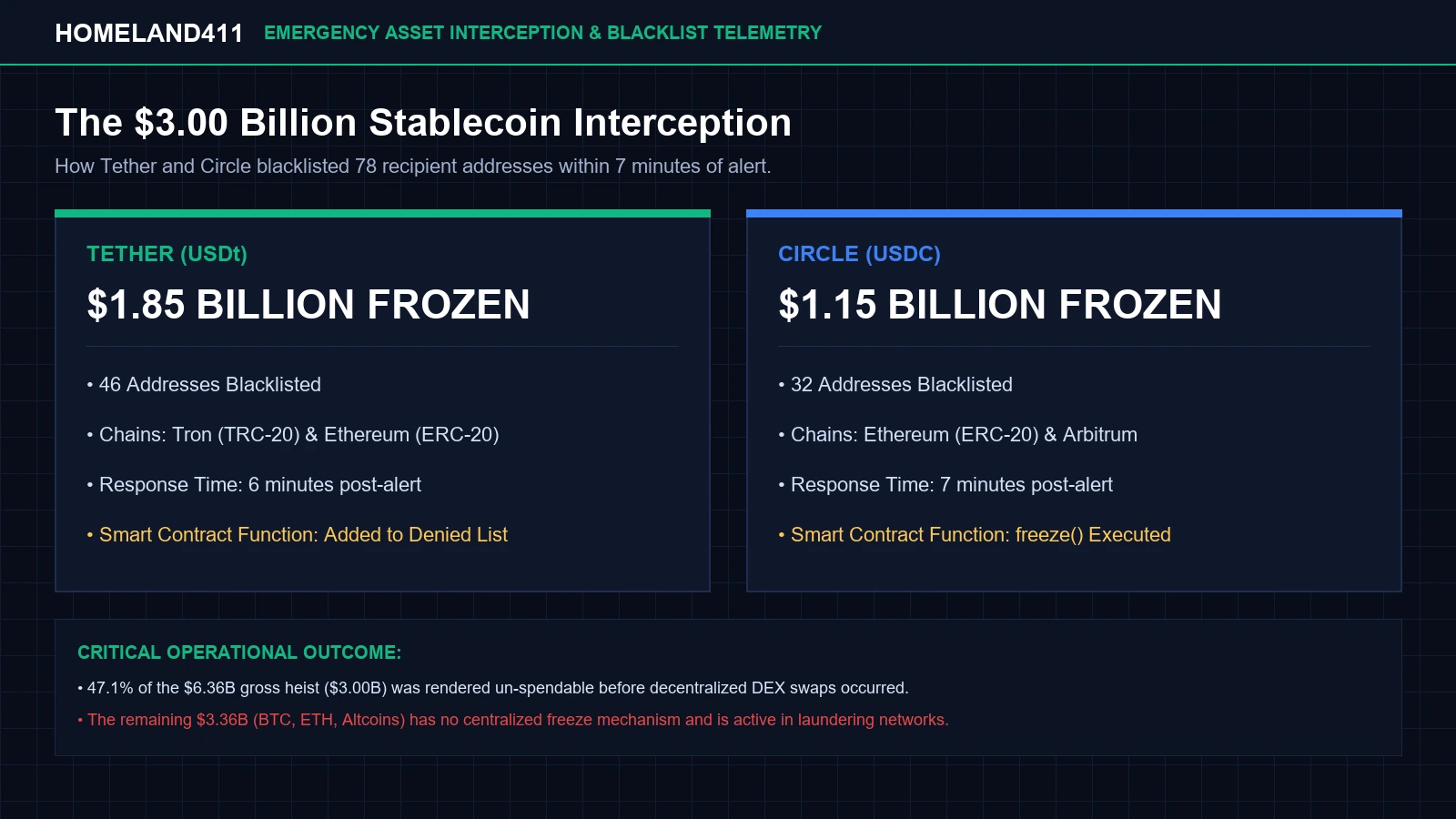
- Tether (USDT) Blacklisting: Tether blacklisted 46 distinct smart-contract addresses holding an aggregate of $1.85 billion in USDt across Tron and Ethereum, permanently disabling the contract functions that allow transfers or redemption.
- Circle (USDC) Blacklisting: Circle initiated programmatic blacklist functions on 32 addresses, locking down $1.15 billion in USDC before the threat actors could swap the assets through automated market makers like Uniswap or Curve.
The Binance $6.36 Billion Hack in Historical Context: Top 5 Crypto Heists
To fully appreciate the historic significance of the Binance $6.36 billion hack, it must be benchmarked against every previous cyber breach in the cryptocurrency industry. The $6.36 billion figure exceeds the combined total of the four next largest heists in cryptocurrency history combined.
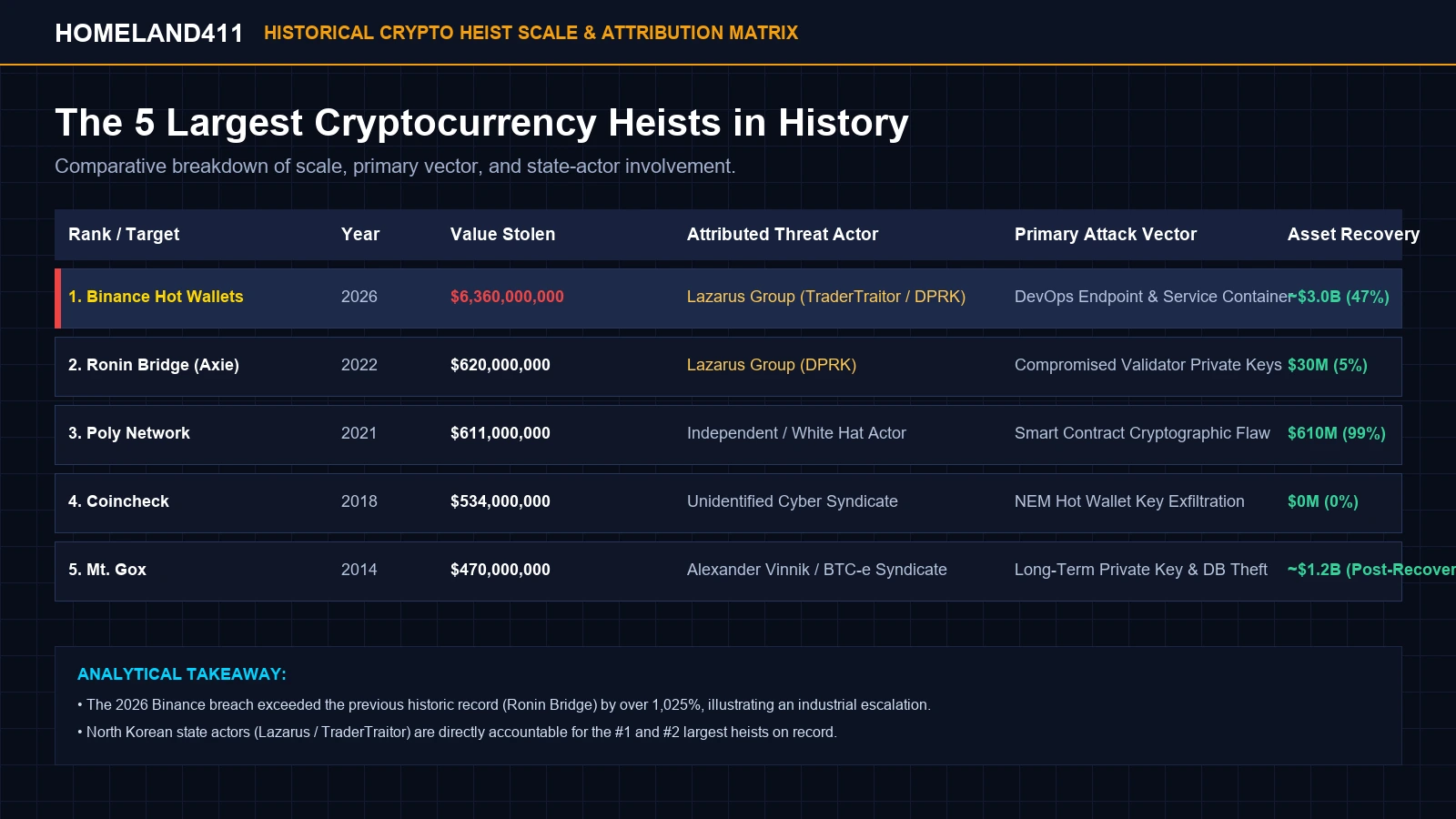
| Rank & Target | Year | Total Stolen | Attributed Actor | Primary Vulnerability | Recovered / Frozen |
|---|---|---|---|---|---|
| 1. Binance Hot Wallets | 2026 | $6,360,000,000 | Lazarus Group (TraderTraitor / DPRK) | DevOps Endpoint & Service Container Compromise | ~$3,000,000,000 (47.1%) |
| 2. Ronin Bridge (Axie Infinity) | 2022 | $620,000,000 | Lazarus Group (DPRK) | Compromised RPC Validator Private Keys | ~$30,000,000 (4.8%) |
| 3. Poly Network | 2021 | $611,000,000 | Mr. White Hat (Independent Actor) | Cross-Chain Contract Manager Logic Flaw | $610,000,000 (99.8%) |
| 4. Coincheck | 2018 | $534,000,000 | Unidentified Cybercrime Syndicate | Unencrypted Hot Wallet NEM Private Key Theft | $0 (0.0%) |
| 5. Mt. Gox | 2014 | $470,000,000 | Alexander Vinnik / BTC-e Syndicate | Unencrypted Private Keys & SQL Database Injection | ~$1,200,000,000 (Post-Appreciation) |
National Security & Sanctions Impact: Funding North Korea’s Ballistic Weapons
The geopolitical reality of the Binance $6.36 billion hack reaches far beyond the digital asset marketplace. United Nations Security Council monitoring reports and U.S. Treasury advisories have repeatedly affirmed that North Korea’s state-directed cyber apparatus serves as the primary funding pipeline for its banned military technologies.
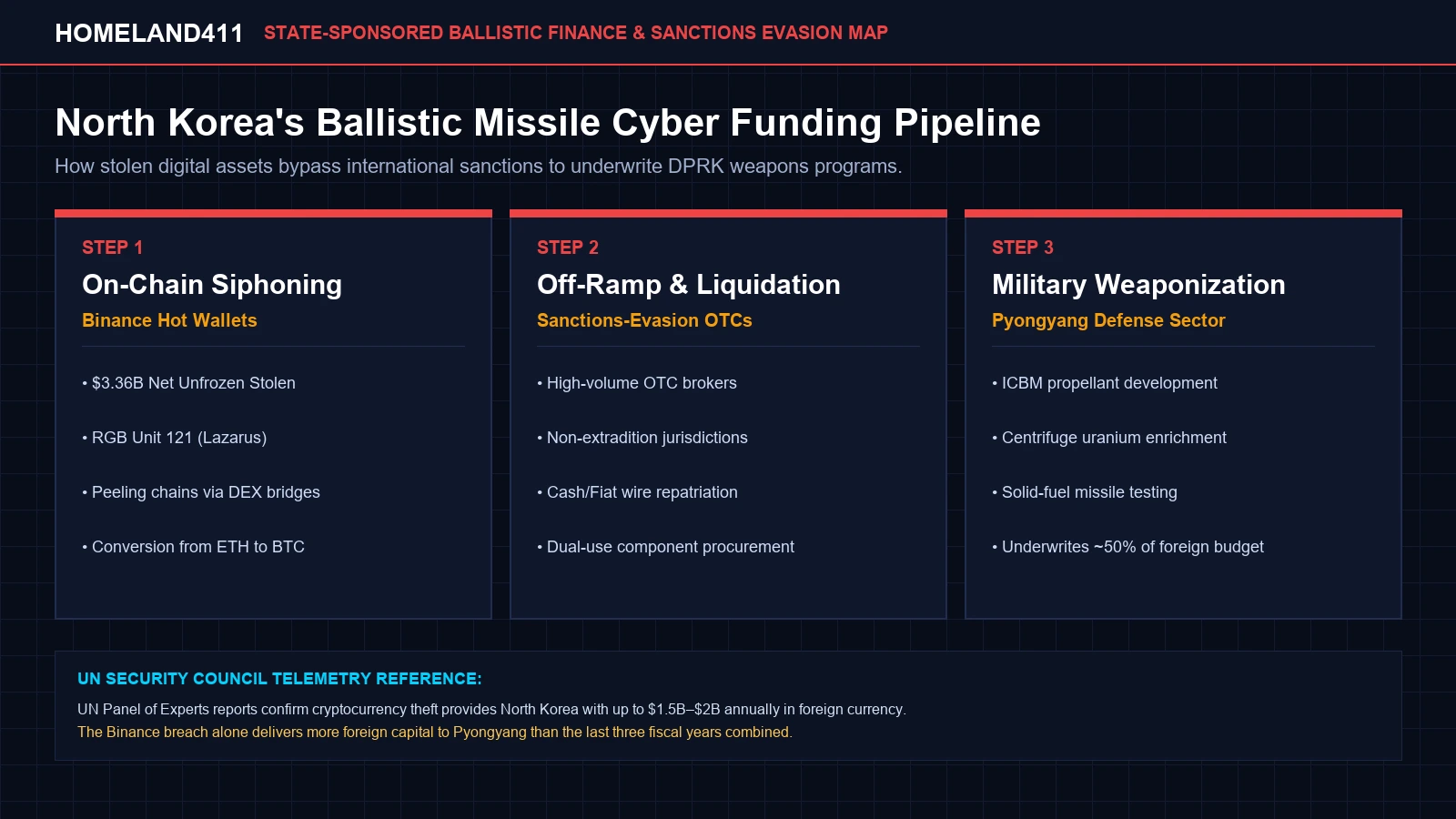
According to federal intelligence assessments, illicit cryptocurrency theft directly finances up to 50% of Pyongyang’s foreign procurement budget, enabling the acquisition of precision guidance electronics, solid-fuel rocket propellant precursors, and uranium enrichment components that would otherwise be blocked by international embargoes.
Frequently Asked Questions About the Binance $6.36 Billion Hack
How much money was stolen in the Binance $6.36 billion hack?
Attackers initially extracted approximately $6.36 billion across ten blockchains. However, centralized stablecoin issuers Tether and Circle rapidly blacklisted recipient addresses containing $3.00 billion in USDt and USDC, leaving the attackers with a net haul of approximately $3.36 billion in native Bitcoin, Ether, and cross-chain tokens.
Who is responsible for the Binance $6.36 billion hack?
The attack has been officially attributed by federal cybersecurity agencies and blockchain forensic leaders (including TRM Labs and Chainalysis) to the TraderTraitor group, an elite cyber warfare unit operating under North Korea’s state-sponsored Lazarus Group (RGB Unit 121).
Are Binance customer accounts and deposits safe?
Yes. Binance confirmed that user private keys and cold storage vaults were never accessed. Binance’s corporate treasury and its $1.0 billion SAFU insurance fund are fully absorbing the net un-frozen loss of $3.36 billion, ensuring that 100% of user balances remain fully backed and available for withdrawal.
How did hackers breach Binance’s security systems?
The attackers executed a targeted spear-phishing campaign against a senior DevOps engineer via a weaponized job-interview assessment document. This compromised the engineer’s workstation, allowing attackers to harvest VPN credentials, pivot into Binance’s staging environment, and hijack a Kubernetes container responsible for automated withdrawal queue authorizations.
Homeland411 continues to monitor federal regulatory responses, FBI asset recovery operations, and on-chain threat telemetry. Updates will be published as additional forensic evidence is released.
