
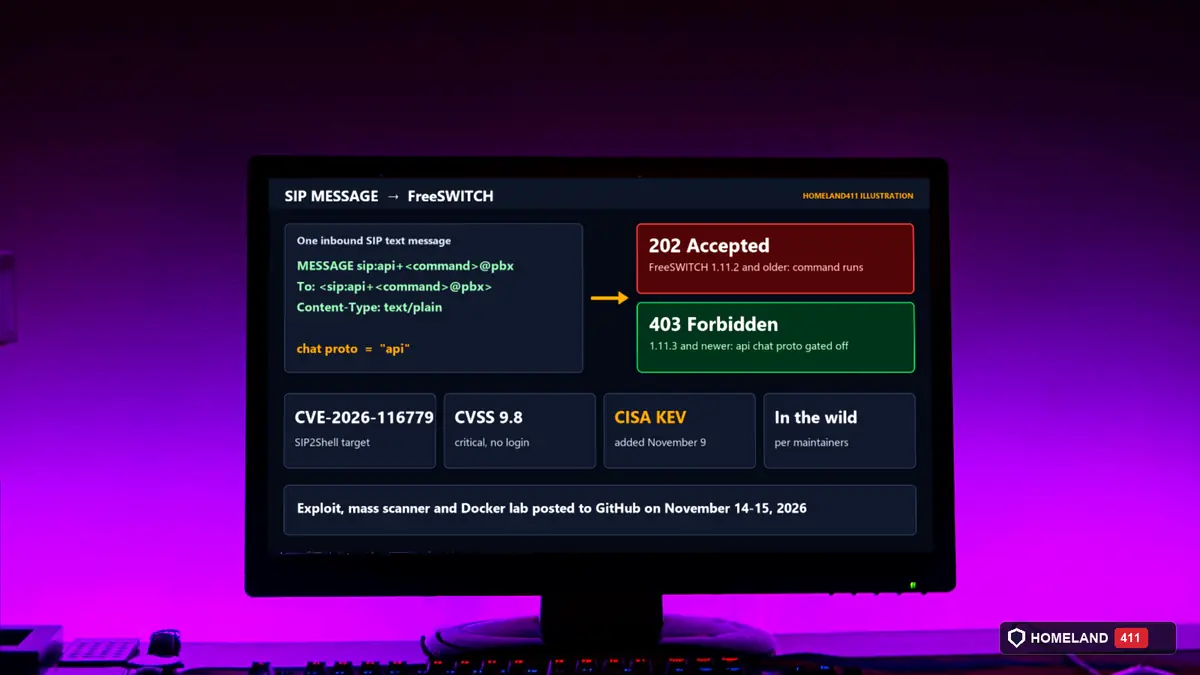
The apparent exploit kit posted last weekend on GitHub for a critical flaw in the FreeSWITCH phone server software was built to take over a vulnerable server with a single SIP text message and to hunt for others in bulk, according to the README file that accompanies it.
The flaw at issue, CVE-2026-116779, was added on November 9 to the catalog of bugs that CISA says are being used in attacks, and federal civilian agencies were given until November 12 to deal with it, according to the agency’s Known Exploited Vulnerabilities list.
“FreeSWITCH will run a command for you if you ask it in a text message,” the author wrote in the README, in a repository called SIP2Shell that was created at 23:44 UTC on Saturday, according to GitHub’s records.
The kit was said to have been packed in part into one Python file that needs nothing else installed, and it was shipped with a lab made from real vulnerable and patched copies of the server software, which the author said were run with no mock server in the loop, according to the README.
The repository had been starred by about 50 GitHub users and copied, or forked, 16 times when it was checked on Friday morning, according to the counts shown on the site.
A missing allow-list on a chat protocol name
The bug was caused in part by the way FreeSWITCH’s SIP module split the To address of an incoming MESSAGE at the first plus sign and treated the left half as the name of a chat protocol, which let a message addressed to api plus a command reach the same function that runs commands from the administrator’s console, according to an advisory the FreeSWITCH maintainers published on October 28.
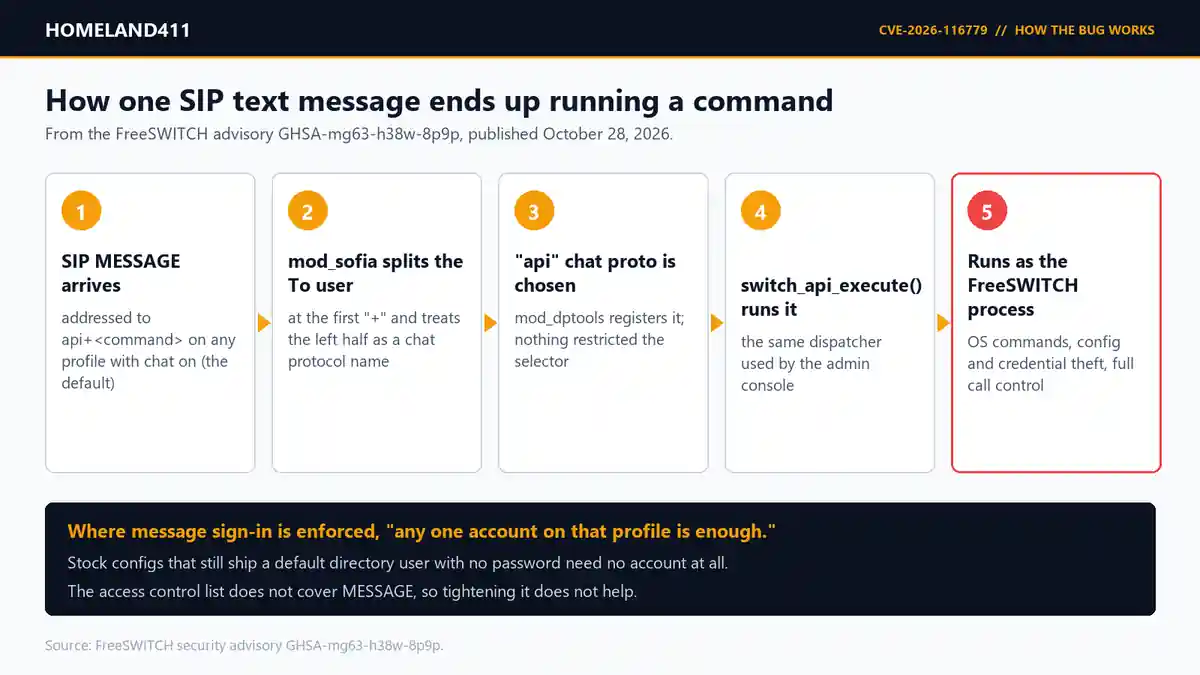
The author described the flaw in the README as “not a memory corruption” but “a missing allow-list on a chat protocol name,” and said that was why “a single UDP packet is enough,” according to the document.
The impact was described by the maintainers as “command execution with the privileges of the FreeSWITCH process,” which they said took in “arbitrary OS commands, disclosure of configuration and credentials, and full call control,” according to that same advisory.
The advisory also said that “exploitation of this path has been observed in the wild,” and the chat feature at issue was said to be switched on by default for both of the stock profiles, the internal one and the external one, according to the maintainers.
Where messages had to be signed in, “any one account on that profile is enough,” the maintainers wrote, whether it was “an extension, a handset, or a trunk peer,” and installations still carrying a default user with no password were said to need no account at all, according to the advisory.
Patched in August, disclosed in October
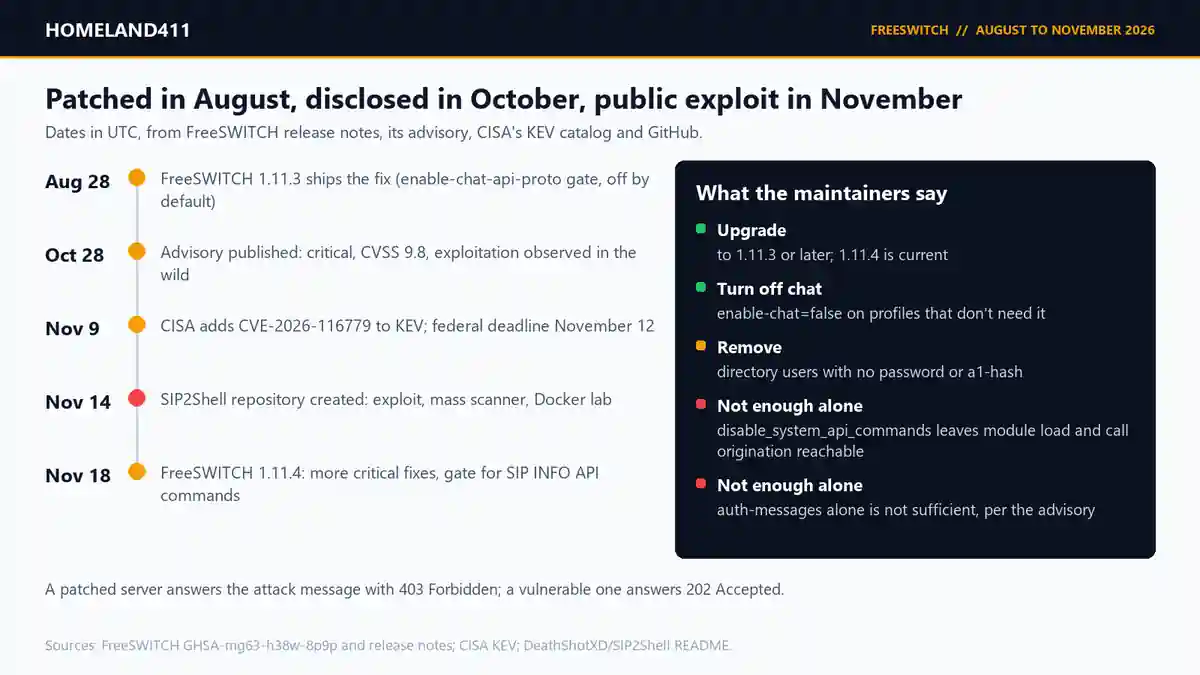
The fix was shipped in FreeSWITCH 1.11.3 on August 28, in a release that the maintainers said contained “critical security fixes” and urged all users to install “as soon as possible,” some two months before the flaw itself was made public, according to the release notes on GitHub.
The release added a switch called enable-chat-api-proto that was left off unless an administrator turned it on, and a patched 1.11.3 server was said to have answered the attack message with a 403 Forbidden reply instead of running it, according to the advisory and the README.
Somewhere around 13,600 FreeSWITCH servers were said to be reachable from the internet this month, most of them still on versions older than the fix, in figures that the README credited to the security firm Bitsight and that Homeland411 was unable to confirm on its own.
The stopgaps suggested by the maintainers for those who cannot upgrade were said to include turning off inbound chat on any profile that does not need it, though removing the system command alone was said to leave module loading and call origination in reach, according to the advisory.
A newer version, 1.11.4, was released on Wednesday with what were described as critical security fixes, one of which added a similar gate for API commands carried in SIP INFO requests, according to the notes that came with it.
That same flaw was the subject of at least one other proof-of-concept, posted by a different GitHub account, according to the listings kept by the exploit search site Sploitus.
The kit was one of at least two pieces of exploit code for serious bugs to turn up on GitHub that weekend, after proof-of-concept code for a high-severity flaw in Google Chrome’s V8 engine was posted early on Sunday, according to an earlier Homeland411 report.
The kit was posted in a month in which CISA had already added an actively exploited flaw in Cisco’s BroadWorks calling platform to the same catalog, the PHP2Shell bug had been used in destructive attacks on Check Point gateways and attempts to exploit Cisco and Fortinet VPN flaws had surged, as Homeland411 reported at the time.