
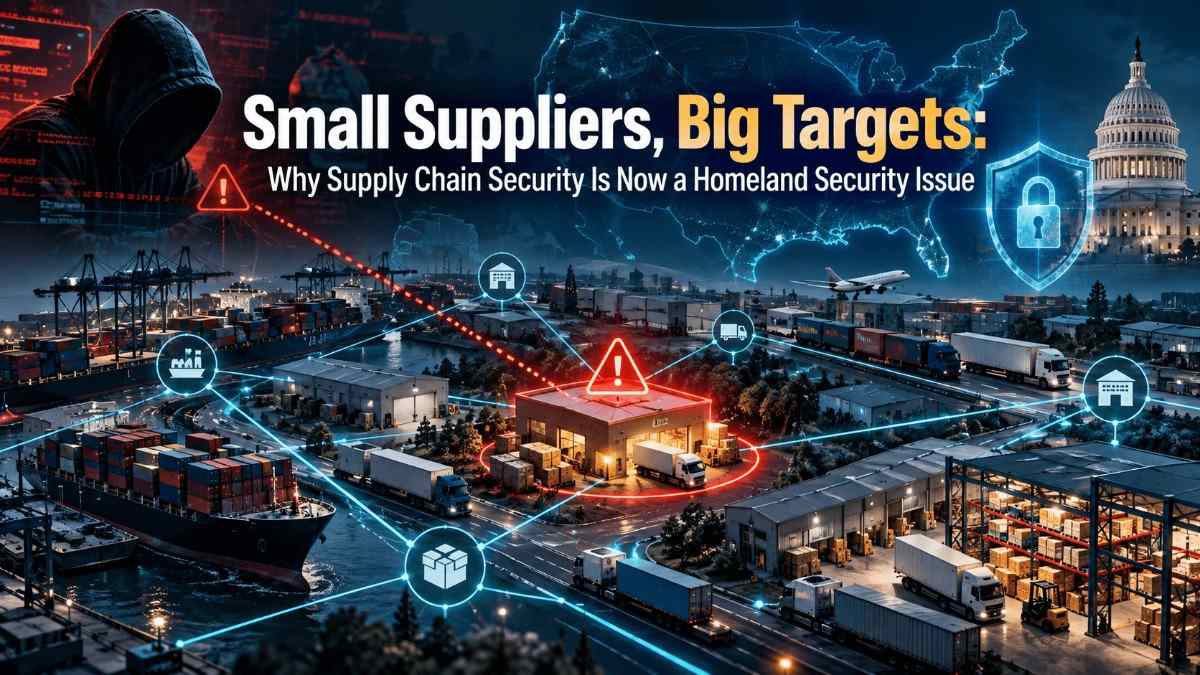
When people picture an attack on critical infrastructure, they tend to imagine a direct strike on a power grid, a water utility or a federal network. In practice, many of the most damaging intrusions of the past decade started somewhere far less obvious: a small vendor, a software update, or a contractor with remote access and weak passwords.
For homeland security planners, that shift matters. The front line is no longer only the agency or the utility itself. It is every business that touches it.
The weakest link is often outside the fence
Large organizations have spent heavily on firewalls, monitoring and incident response teams. Attackers know this, so they look for a way around. A regional IT provider, an HVAC maintenance firm with network access, or a payroll software vendor can offer a quieter route into a much bigger target.
These smaller firms usually have fewer staff, tighter budgets and less time to think about security. Many do not have a dedicated security lead at all. Yet they may hold credentials, data or software access that gives an attacker a direct path into systems that matter to public safety.
Why software updates became a favored route
Software supply chain attacks work because they exploit trust. When a customer installs an update from a known vendor, it rarely gets the same scrutiny as an unknown email attachment. If an attacker can compromise the vendor’s build process, a single malicious update can reach thousands of organizations at once.
This is one reason federal agencies have pushed the idea of “secure by design” software, where vendors take responsibility for building security in from the start rather than leaving customers to patch problems later. It is also why software bills of materials, which list the components inside a product, have moved from a niche idea to a mainstream procurement question.
What smaller businesses can realistically do
The good news is that most supply chain risk can be reduced with basic, affordable steps. None of them require a large security team.
Turn on multi-factor authentication everywhere. Stolen passwords remain one of the most common ways in. Requiring a second factor for email, remote access and admin accounts closes a large share of easy openings.
Know who has access. Keep a simple list of which vendors and contractors can reach your systems, what they can reach, and when that access was last reviewed. Remove anything that is no longer needed.
Patch quickly, especially internet-facing systems. Firewalls, VPNs, email servers and content management systems are frequent targets. Applying security updates promptly, and prioritizing anything listed as actively exploited, makes a measurable difference.
Keep offline backups and test them. Ransomware groups often target suppliers because downtime puts pressure on the customer too. Backups that cannot be reached from the main network, and that have actually been restored in a test, turn a crisis into an inconvenience.
Ask your own suppliers the same questions. Security is only as strong as the next link in the chain. A short questionnaire about authentication, patching and backups is a reasonable request in any contract.
The Cybersecurity and Infrastructure Security Agency publishes free, plain-language guidance aimed at exactly this audience. Its Cyber Essentials resources are a practical starting point for leaders who are not security specialists.
The business case is stronger than ever
For many small firms, security can feel like a cost with no visible return. That view is changing. Larger customers, especially those in regulated or government-facing sectors, increasingly ask suppliers to show evidence of basic controls before signing or renewing a contract. A business that can answer those questions clearly has an advantage over one that cannot.
There is also the cost of getting it wrong. Beyond ransom demands, an incident can mean lost contracts, legal exposure and lasting damage to reputation. For owners weighing where to spend a limited budget, coverage of small business finance and risk increasingly treats cyber resilience as a core part of protecting the business, not an IT side project.
A shared responsibility
Supply chain security will not be solved by large organizations alone, and it will not be solved by regulation alone. It depends on thousands of smaller companies taking a handful of sensible steps and expecting the same from the firms they work with. For homeland security, that is the real lesson. Protecting critical systems now means paying attention to the businesses around them, because that is where attackers are already looking.
