
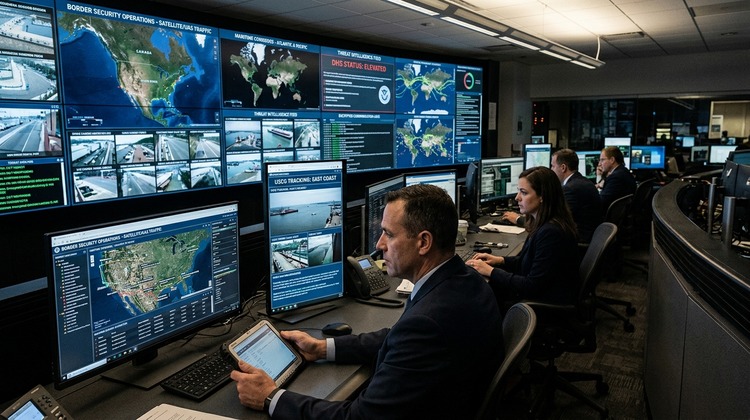
WASHINGTON — Twenty-five years following the cataclysmic attacks of September 11, 2001- the foundational doctrines of American homeland security have fundamentally transformed from physical counter-terrorism into multi-domain resilience against distributed, asymmetric warfare.
WASHINGTON — A quarter-century after nineteen hijackers weaponized commercial airliners to strike the World Trade Center and the Pentagon, the institutional landscape of the American homeland security enterprise has expanded far beyond the counterterrorism mission that catalyzed its creation.
The creation of the Department of Homeland Security in 2002—the largest reorganization of the federal government since the National Security Act of 1947—united 22 disparate agencies under a single operational umbrella. For the first decade of its existence, the department’s energy and budget were dominated by a singular imperative: preventing another catastrophic, foreign-directed terrorist attack on American soil.
The Diffusion of the Terrorist Threat Vector
Twenty-five years later, that primary threat vector has fundamentally mutated. While foreign terrorist organizations like al-Qaeda and ISIS retain ideological appeal, extensive interagency intelligence sharing, watchlisting, and forward military pressure dismantled their capacity to orchestrate complex transnational conspiracies inside the homeland.
Instead, the counterterrorism mission shifted toward countering decentralized, internet-radicalized lone actors and domestic violent extremists inspired by online conspiracy theories and accelerationist doctrines. The weapon of choice is no longer an aircraft or a sophisticated bomb, but an assault rifle, a commercial rental truck, or an improvised drone targeting crowded public venues or regional electrical substations.
The Convergence of Cyber and Kinetic Warfare
Perhaps the most consequential evolution over the past 25 years is the complete breakdown of the geographic barrier that once shielded the continental United States. For two centuries, two vast oceans and peaceful neighbors provided natural defense against foreign attack. Today, fiber-optic cables, satellite links, and digital supply chains have completely eliminated that geographic insulation.
State-sponsored cyber actors—from Moscow’s Sandworm and Cozy Bear to Beijing’s Volt Typhoon—demonstrated that an adversary can penetrate deep into municipal water systems, regional electric grids, and maritime logistics backbones from halfway across the globe. National security is no longer decided strictly at the border perimeter; it is contested every second across enterprise cloud fabrics and industrial control networks.
Strategic Principles for the Next Quarter-Century
As homeland security planners look ahead to the next 25 years, defense strategists emphasize four enduring operational imperatives:
- Total Public-Private Synchronization: Because more than 85 percent of American critical infrastructure is privately owned and operated, national defense is impossible without deep, real-time operational co-defense models like the Joint Cyber Defense Collaborative.
- Systemic Resilience Over Fortress Defense: Acknowledging that not every cyber intrusion, rogue drone, or extreme weather event can be stopped at the perimeter; systems must be engineered with redundant manual backups to fail gracefully and recover rapidly.
- Technological Agility at the Edge: Rapidly fielding dual-use commercial technologies—including artificial intelligence anomaly detection, autonomous robotic sentinels, and post-quantum cryptography—to outpace agile adversary innovation.
- Preserving Democratic Liberties: Ensuring that the vital expansion of intelligence gathering, biometric screening, and digital surveillance remains rigorously bound by constitutional safeguards and transparent civil liberties protections.
“Homeland security is not a fixed destination that can be permanently achieved,” concluded Dr. Alexander. “It is a continuous, dynamic discipline of vigilance and adaptation. The threats confronting our nation in 2026 would be unrecognizable to the planners of 2001, but the core mission remains immutable: preserving our open, democratic society in an increasingly dangerous and interconnected world.”
Credit: BBC