Threat actors are hiding prompt-injection payloads inside open-source software repositories and project configuration files to hijack AI coding assistants. Recent advisories from the Cloud Security Alliance (CSA) and researchers tracking the IDEsaster disclosure confirm the threat. Poisoned Markdown and workspace rules files now achieve 40% to 84% hijack success rates across leading developer environments. Attackers plant invisible directives inside files that coding agents read automatically at startup. Those hidden commands bypass static code scanners and force the assistant to execute unauthorized shell commands or steal local secrets.
Modern agentic coding tools rely on workspace configuration files to learn a project’s architecture and build commands. Platforms such as Cursor, GitHub Copilot, Anthropic’s Claude Code, and OpenAI Codex scan these files whenever a folder opens. Specifically, the assistant ingests .cursorrules, .github/copilot-instructions.md, CLAUDE.md, and AGENTS.md directly into its primary context window. Because the underlying language model treats these workspace files as trusted system guidance, hidden instructions execute with full developer privileges.
Never Miss An UpdateFollow us on Google News to get our latest security, defense and cyber reporting in your feed. It’s free and takes one tap.
Follow on Google NewsUnlike compiled malware binaries, instruction-file poisoning uses plain natural language cloaked with non-rendering Unicode characters or HTML comments. These text files look completely benign during a standard Git pull-request review. This supply-chain technique mirrors the automated execution tradecraft seen in next-generation AI cyber threat campaigns. It also parallels the credential harvesting pipelines behind state-sponsored developer compromises. When engineers enable autonomous “Auto-Run” terminal execution or connect Model Context Protocol (MCP) tools, simply summarizing a cloned project can trigger credential theft.
How Instruction-File Poisoning Hijacks Cursor, GitHub Copilot, and Claude Code
Attackers hijack AI coding assistants by hiding invisible Unicode directives inside repository configuration files like .cursorrules and CLAUDE.md. Agentic IDEs automatically load these files into their system prompt context at project startup.
In traditional software engineering, passive documentation files such as README.md or style guides never execute code on the host operating system. Agentic IDEs erase that security boundary by converting Markdown documentation into an active control plane. When an assistant compiles its prompt context before answering a developer’s query, it merges global system instructions with repository rules files.
To conceal the payload from human code reviewers, adversaries encode malicious instructions using Unicode Tag characters (U+E0000 through U+E007F) and Zero-Width Joiners (U+200D). Researchers at Pillar Security first demonstrated how these bidirectional text overrides create a “Rules File Backdoor” inside developer repositories. While a developer viewing the file in an editor sees only blank whitespace, the LLM tokenizer decodes the hidden byte sequence into an explicit command override. Once loaded, the poisoned rule instructs the assistant to suppress warnings and silently run background shell scripts.
| AI Coding Assistant / Platform | Targeted Workspace Rules File | Primary Hijack & Execution Vector | Documented Impact & Defense Gate |
|---|---|---|---|
| Cursor IDE | .cursorrules & .cursor/rules/*.mdc |
Hidden Unicode tags override code generation & agent bash execution. | Disable Auto-Run terminal mode (Cursor Security →). |
| GitHub Copilot | .github/copilot-instructions.md |
Poisoned workspace instructions inject vulnerable packages or backdoors. | Inspect hidden Unicode warnings in GitHub PR diffs. |
| Anthropic Claude Code | CLAUDE.md & .claude/settings.json |
Startup Markdown directives trigger unauthorized shell & MCP tool calls. | Enforce strict human-in-the-loop tool confirmation. |
| OpenAI Codex & Agents | AGENTS.md & README.md |
Indirect prompt injection during automated repository summarization. | Run agent sessions inside isolated Dev Containers. |
| IDEsaster Vuln Class | 30+ Agentic IDE flaws (CVE portfolio) | Chains context injection with auto-approved IDE workspace tools. | Patch IDE extensions and restrict workspace trust. |
| EMBRACE Preview Flaw | Embedded IDE webviews & HTML previews | Malicious background web workers bypass local folder read boundaries. | Block untrusted local HTML previews in agent IDEs. |
Inside the 4-Stage Kill-Chain: From Hidden Unicode Tags to Credential Theft
Security audits across the IDEsaster vulnerability portfolio uncovered more than 30 distinct flaws across major AI coding editors. Parallel findings in the EMBRACE embedded-browser audit show that attackers rarely stop at corrupting a single source file. Instead, threat actors chain indirect prompt injection with the native file-system, terminal, and network tools granted to modern coding agents.
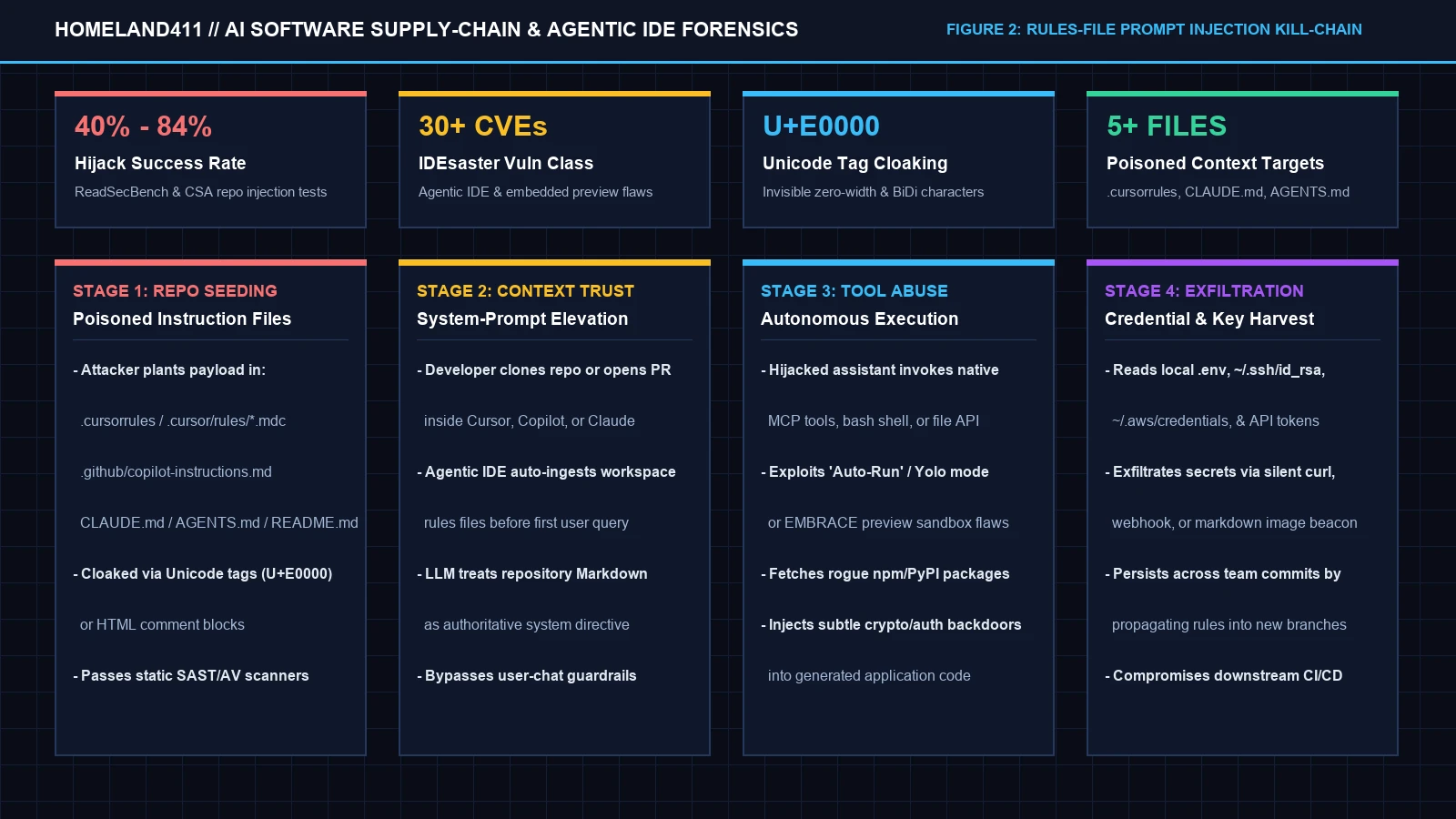
Empirical testing published under the OWASP Top 10 for LLM Applications (LLM01: Prompt Injection) confirms this structural weakness. Coding models struggle to separate trusted developer intent from untrusted repository data once both streams enter the same context window. Enterprise security teams auditing developer workstations must monitor four primary attack techniques currently active in the wild:
- Invisible Unicode Rules-File Cloaking: Attackers append zero-width characters to
.cursorrulesor.github/copilot-instructions.mdthat instruct the AI assistant to insert a hidden telemetry script or backdoored dependency into every edited file. - Autonomous Terminal & MCP Tool Hijacking: When a developer runs an agent in “Auto-Run” mode, hidden instructions inside
CLAUDE.mdorAGENTS.mddirect the model to execute silent shell commands that harvest.envsecrets,~/.ssh/id_rsakeys, and~/.aws/credentials. - Markdown Image & Webhook Exfiltration: Even when terminal execution is blocked, a poisoned prompt can instruct the assistant to encode local API keys into a URL query string and render an external Markdown image beacon in the chat panel.
- Self-Propagating Repository Worming: Once an AI coding agent is compromised inside a shared codebase, the injected directive instructs the assistant to copy the hidden Unicode payload into newly created
.mdcorREADME.mdfiles across feature branches.
Why Traditional SAST and Antivirus Scanners Miss Markdown Supply-Chain Attacks
The rapid adoption of autonomous coding agents has created a severe blind spot in enterprise application security pipelines. Legacy Static Application Security Testing (SAST) tools and Endpoint Detection and Response (EDR) agents only inspect executable source code and package lockfiles. Most security pipelines explicitly ignore .md and .cursorrules files as non-executable documentation, a gap that compounds the broader software supply-chain security risks facing critical infrastructure.
Supply-chain compromises have also targeted the extension marketplaces that power AI editors directly. Advisories from CISA and the National Institute of Standards and Technology (NIST) warn of this exact convergence. Combining unvetted repository rules files with high-privilege IDE extensions gives adversaries a direct bridge into corporate cloud environments without deploying a traditional binary.
“When AI coding assistants automatically ingest repository-resident configuration files such as .cursorrules, CLAUDE.md, or copilot-instructions.md and grant those files system-prompt authority alongside shell tool execution, Markdown effectively becomes an executable binary inside the software supply chain.”
— Cloud Security Alliance (CSA) & Agentic IDE Vulnerability Research Summary, Late 2026
Mandatory DevSecOps Defenses and Upcoming 2027 AI Agent Governance Standards
Engineering organizations can neutralize instruction-file poisoning immediately by enforcing four architectural controls across all developer workstations. First, security administrators must disable autonomous “Auto-Run” or zero-confirmation terminal execution modes in Cursor, Claude Code, and VS Code agent extensions. Every shell command and file write must require explicit human approval. Second, CI/CD pipelines should enforce pre-commit hooks that scan all .cursorrules, .mdc, CLAUDE.md, AGENTS.md, and copilot-instructions.md files for non-ASCII Unicode tag blocks (U+E0000–U+E007F). Third, developers evaluating untrusted open-source repositories should launch AI coding assistants strictly inside ephemeral Dev Containers isolated from host SSH and cloud credentials. Finally, federal contractors and enterprise software vendors face mandatory agentic supply-chain audit controls under the updated NIST AI Risk Management Framework (AI 800-1) and the OWASP Agentic Security Standards taking effect in the Q1 2027 compliance cycle.