Last autumn, a mid-sized healthcare network in the American Midwest watched their entire diagnostic imaging archive lock up over a quiet Sunday evening. By the time the on-call incident response team assembled on an emergency conference bridge at 6:15 Monday morning, the operational damage was complete. There was no ransom note printed across network thermal printers, no theatrical hacker desktop wallpaper, and none of the days-long reconnaissance chatter that enterprise security analysts had spent years training to detect.
In the post-incident debriefing, forensic engineers discovered something far more unsettling than an exotic zero-day exploit. The attackers had not deployed a mythical, self-aware computer virus from science fiction. What hit the hospital was an automated, model-assisted execution pipeline. From the moment an affiliate threat actor used an AI-cloned voice to convince an outsourced help desk technician to reset an administrative multi-factor authentication token, automated scripts took over the wheel. Reconnaissance tools mapped domain trust hierarchies, evaluated Active Directory permissions, identified the organization’s primary Veeam backup repositories, and initiated partial cryptographic locking across forty-two virtual hosts. The entire operational sequence—moving from initial credential handover to catastrophic data encryption—concluded in fifty-eight minutes.
Never Miss Important UpdatesFollow us on Google News to get our latest security, defense and cyber reporting in your feed. It’s free and takes one tap.
Follow on Google NewsAcross the cybersecurity industry, the conversation surrounding artificial intelligence and ransomware is frequently clouded by vendor marketing rhetoric and alarmist headlines. Commercial security vendors routinely promise that autonomous defense algorithms will neutralize threats at machine speed, while speculative warnings suggest that fully independent neural networks are writing and executing malicious code in the wild. The reality uncovered by frontline incident responders, federal cyber investigators, and threat analysts is both more nuanced and considerably more dangerous: cybercriminal syndicates are not building sentient malware; they are systematically industrializing their operational pipelines.
Dismantling the Autonomous Payload Myth
To understand how modern ransomware operations are actually shifting, one must first separate technical reality from speculative theater. A prevailing misconception in corporate executive boardrooms is that threat actors are compiling massive neural networks directly into local executable files and dropping them onto target endpoints.
In practical offensive tradecraft, that concept is an engineering non-starter. A functional large language model capable of autonomous decision-making requires gigabytes of memory, specialized tensor processing, and heavy compute overhead. Dropping an eight-gigabyte binary onto an enterprise workstation would immediately trigger every endpoint detection and response (EDR) threshold on the network, choke local memory buses, and alert system administrators before a single file could be opened.
What threat actors have actually engineered is far leaner and vastly more effective: API-orchestrated automation and local heuristic decision tooling. Rather than embedding AI directly into the malicious payload, modern ransomware syndicates—including affiliates aligned with groups like BlackCat (ALPHV), Akira, and the sprawling network of English-speaking social engineers tracked by Mandiant and federal agencies as Scattered Spider (UNC3944 / Octo Tempest)—use machine learning where it delivers the highest return on investment: eliminating the friction points that historically slowed down human operators.
The Social Engineering Pipeline: Identity as the Primary Attack Surface
The earliest and most pronounced impact of machine-assisted tooling has emerged not in binary compilation, but across identity and access control architectures. For years, enterprise cybersecurity training instructed employees to watch for telltale signs of phishing: poor grammar, odd syntax, misaligned corporate logos, and awkward phrasing. That defensive heuristic is effectively dead.
Today, threat actors feed scraped corporate profiles, LinkedIn job postings, and corporate SEC filings into language models to generate highly personalized, grammatically flawless spear-phishing campaigns tailored to specific operational units. In corporate environments where multi-factor authentication (MFA) was widely believed to solve the credential problem, attackers have pivoted aggressively to voice synthesis and help desk deception.
Federal cyber advisories published by the Cybersecurity and Infrastructure Security Agency (CISA) and the FBI highlight an alarming pattern: attackers scrape public audio recordings of corporate executives or IT managers from YouTube webinars, podcast appearances, and quarterly earnings calls. With as little as thirty seconds of clean audio, generative voice models produce convincing clones that threat actors use in live telephone calls (vishing) directed at internal IT help desks. Posing as a traveling executive or a stressed regional director locked out of their workstation, the caller convinces level-one support staff to reset passwords, bypass MFA push notifications, or register a new hardware authenticator.
Once that identity is compromised, the intrusion shifts from an external perimeter problem into an internal trust disaster. The attackers do not need to break encryption or discover novel memory-corruption flaws; they simply log in with legitimate credentials.
Collapsing the Dwell Time: From Weeks to Minutes
Historically, the defender’s greatest operational advantage was the dwell time—the window between an attacker’s initial breach and the eventual deployment of ransomware. In 2019 and 2020, industry telemetry from firms like CrowdStrike frequently documented median dwell times exceeding seven to ten days. During that window, human intruders moved cautiously. They mapped subnet ranges, queried domain controllers, and manually exfiltrated sensitive databases over several nights. Alert security teams had opportunities to catch abnormal network traffic, spot lateral movement, and isolate infected nodes before catastrophic encryption.
That defensive buffer has compressed dramatically. According to recent telemetry from Sophos’s Active Adversary reports and federal incident post-mortems, median ransomware dwell times across 2024 and 2025 dropped to approximately two days, with aggressive smash-and-grab intrusions executing in less than two hours.
This compression is driven by automated reconnaissance and lateral traversal tooling. Once inside a network perimeter, threat actors execute automated scripts that interface with tools like BloodHound and SharpHound. These tools ingest Active Directory access control lists, analyze Kerberos ticket structures, and automatically map the shortest mathematical path to domain administration or cloud identity control. What previously required an operator several hours of manual command-line interrogation is now resolved in seconds through automated graph analytics.
The Weaponization of Legitimate Tools and Kernel-Level Evasion
When security analysts examine the modern ransomware kill chain mapped against the MITRE ATT&CK framework, they rarely encounter exotic custom exploits. Instead, they see a deadly convergence of automated scripting and Living-off-the-Land Binaries (LOLBins)—legitimate administrative utilities already present on Windows and Linux servers.
Attackers routinely orchestrate utilities like certutil, bitsadmin, PowerShell, and Windows Management Instrumentation (WMI) through lightweight automation frameworks. Because these executables are digitally signed by Microsoft and used daily by enterprise system administrators, behavioral security sensors struggle to differentiate between genuine maintenance routines and malicious orchestration.
To defeat modern EDR solutions, threat actors have popularized Bring Your Own Vulnerable Driver (BYOVD) tactics. Rather than attacking the EDR’s user-mode software directly, automated loaders drop legitimate, cryptographically signed third-party drivers—often old, vulnerable hardware utility drivers or anti-cheat modules from vendors like ASUS, Gigabyte, or Micro-Star International. Once loaded with administrator privileges, these signed drivers grant the attacker ring-0 kernel access. The malware then directly terminates the EDR’s kernel callbacks and process-monitoring threads, effectively blinding the defense without triggering traditional antivirus alarms.
The Extortion Engine: Automated Data Classification and Intermittent Encryption
The fundamental economics of ransomware underwent a permanent shift with the rise of double and triple extortion. In modern enterprise campaigns, the threat of public data leakage often eclipses the business impact of encrypted drives.
In earlier years, exfiltrating large volumes of corporate data created operational friction for cybercriminals. Sifting through multiple terabytes of unstructured file dumps to identify high-leverage extortion material—such as secret patent applications, pending litigation disclosures, regulatory non-compliance audits, or customer financial records—required significant manual review. Today, syndicates employ automated categorization pipelines. Exfiltrated files are routed through local text-extraction engines and natural language classifiers that instantly tag sensitive documents, calculate optimal extortion demands, and generate tailored extortion dossiers before enterprise executives even realize a breach has occurred.
When it comes to the encryption phase itself, groups like BlackCat (ALPHV) and LockBit pioneered an engineering technique known as intermittent encryption. Rather than encrypting an entire multi-terabyte virtual disk or SQL database—a process that generates massive disk I/O spikes, drives processor temperatures higher, and trips behavioral heuristic sensors—the encryptor alternates between encrypting and skipping byte blocks. By encrypting only the file headers, metadata tables, or alternating sixteen-byte segments, the ransomware renders the underlying files completely unreadable and structurally corrupt while cutting the time required to lock a storage array by up to eighty percent. Automated snapshot mechanisms and emergency storage cutoffs are frequently rendered useless because the corruption occurs faster than automated backup routines can trigger.
The Systemic Vulnerability: Supply Chains and Identity Fabrics
The technical reality of modern ransomware cannot be separated from broader structural weaknesses in enterprise IT architecture. Organizations do not operate in isolated bubbles; they exist within intricate webs of third-party SaaS integrations, managed service providers (MSPs), and interconnected supply chains.
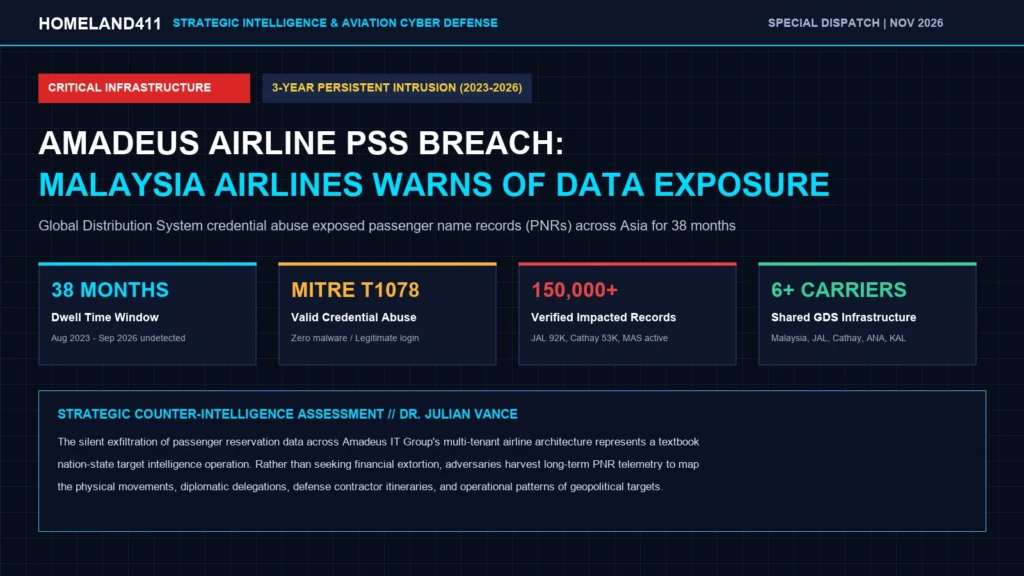
As demonstrated in recent high-profile supply chain compromises—including the cascading disruptions documented in Homeland411’s investigation into the Amadeus airline reservation system breach—threat actors frequently avoid heavily fortified corporate headquarters perimeters entirely. Instead, they compromise regional suppliers, third-party billing vendors, or outsourced IT service desks with lower defensive maturity. Once an attacker obtains valid credentials or API keys belonging to a trusted vendor, they ride existing administrative tunnels directly into enterprise networks.
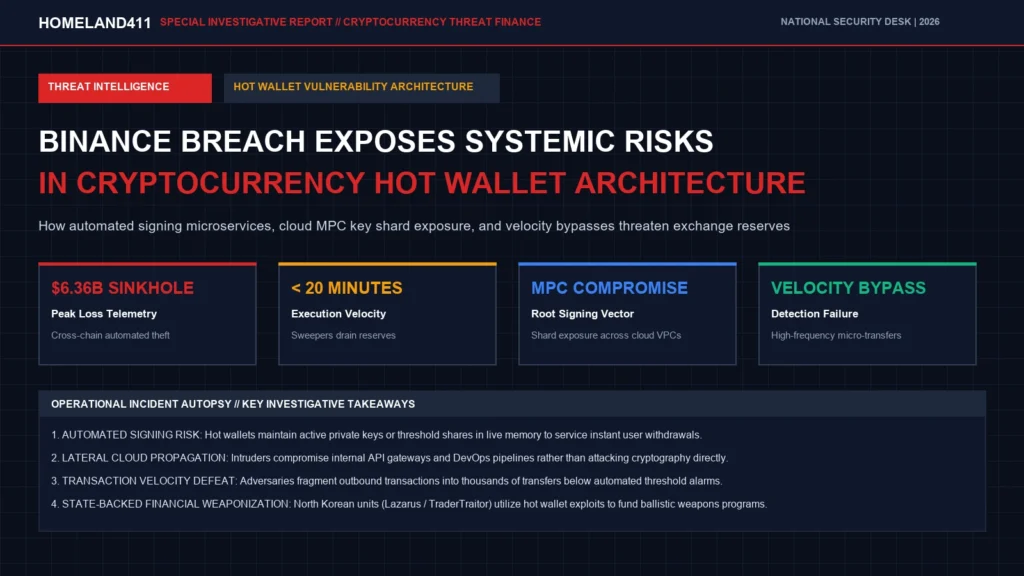
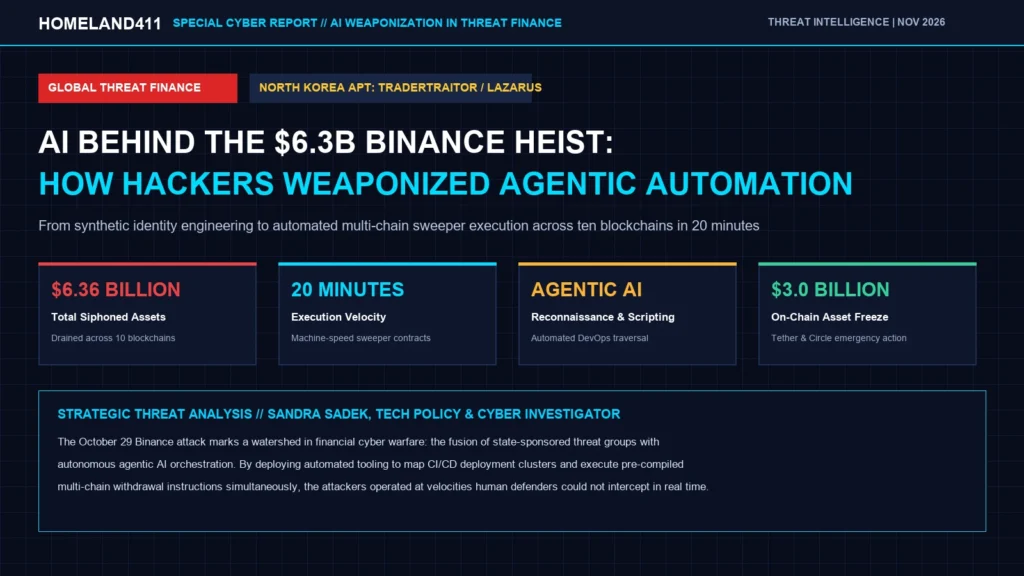
Similarly, the methods used to monetize these intrusions reflect the industrialized sophistication of modern threat finance. As analyzed in Homeland411’s forensic report on the Binance Lazarus cryptocurrency heist, state-sponsored actors and cybercriminal syndicates maintain elaborate money-laundering pipelines capable of hopping across multiple blockchain protocols and automated mixing services to cash out ransom proceeds before federal asset-freezing orders can take effect.
Building Defenses Against Machine-Speed Extortion
Faced with adversaries who leverage automation to compress intrusion timelines, traditional annual compliance audits and perimeter firewalls are profoundly insufficient. Aligning defense with standards like NIST SP 800-207 Zero Trust Architecture requires structural, identity-centric reforms:
First, organizations must eliminate vulnerable multi-factor authentication methods—such as SMS verification and mobile app push notifications susceptible to MFA fatigue attacks—in favor of hardware-bound FIDO2 credentials like YubiKeys. Separately, IT help desk workflows must be strictly decoupled from verbal or chat-based password resets, requiring out-of-band managerial verification before credentials or MFA devices are re-enrolled.
Second, enterprise systems must enforce Hypervisor-Protected Code Integrity (HVCI) and maintain up-to-date Microsoft Vulnerable Driver Blocklists. Preventing the unauthorized execution of signed vulnerable third-party drivers eliminates the primary mechanism attackers use to blind EDR agents from ring 0.
Third, backups cannot merely be automated; they must be cryptographically immutable and logically segmented through Write Once, Read Many (WORM) storage protocols. When an attacker achieves domain administrative compromise, any backup repository reachable via standard Active Directory domain credentials will be erased or encrypted first.
Fourth, because modern ransomware operators prioritize identity theft over malware deployment, security operations centers must monitor for abnormal identity behavior—such as unexpected privilege escalation, unusual Kerberos ticket requests, and anomalous cloud API token usage—rather than waiting for traditional malware hash alerts.
Finally, under the Cybersecurity and Infrastructure Security Agency’s (CISA) Cyber Incident Reporting for Critical Infrastructure Act (CIRCIA), covered entities face strict reporting timelines for substantial cyber incidents and ransom payments. Meeting these obligations requires enterprise leaders to maintain real-time visibility into internal telemetry, ensuring that forensic data is preserved even in the midst of an active extortion crisis.
The Road Ahead: Strategic Implications for Defenders
The emergence of machine-assisted ransomware does not signal an era of unbeatable, autonomous malware overlords. What it represents is the ruthless industrialization of cybercrime. Attackers have recognized that the weakest link in modern defense is not a flawed cryptographic algorithm or an exotic kernel zero-day, but the gap between human decision cycles and automated execution. For enterprise leaders, national security strategists, and IT defenders, surviving the next generation of cyber threats requires meeting that reality head-on—closing the identity loopholes, hardening the kernel, and designing networks to withstand an adversary who operates at the speed of code.