
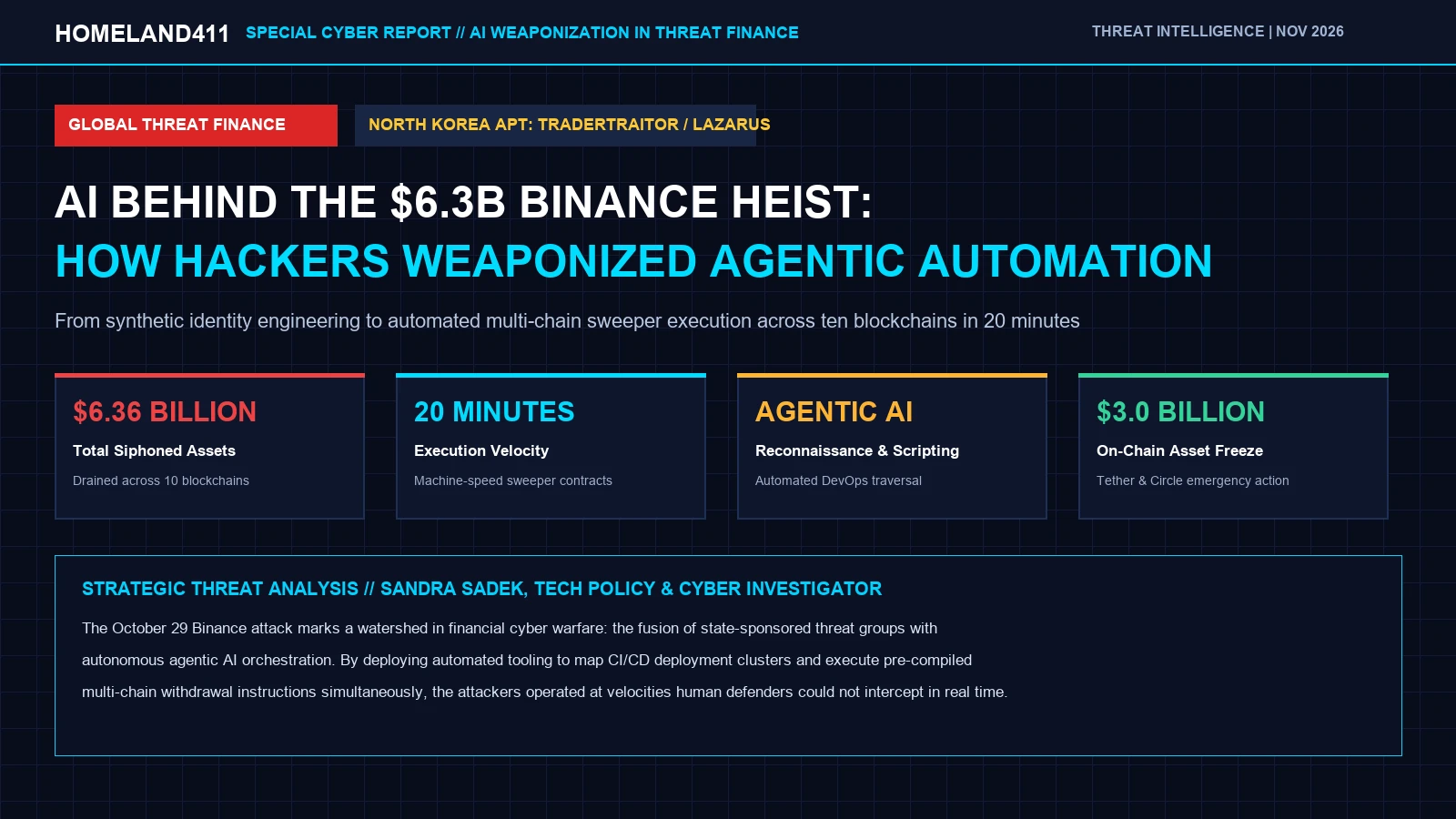
WASHINGTON — When attackers drained an unprecedented $6.36 billion from Binance hot wallets across ten blockchains on October 29, 2026, the entire operational phase took less than twenty minutes. Human incident responders never had a chance to react before the initial funds were gone. The speed was the weapon. The assault was propelled by machine-speed agentic automation.
Independent forensic autopsies released by blockchain threat intelligence firms TRM Labs, Chainalysis, and Elliptic have attributed the intrusion with high confidence to TraderTraitor, an elite cyber warfare unit operating under North Korea’s state-sponsored Lazarus Group. The FBI’s Cyber Division confirmed the attribution in parallel advisories, linking the infrastructure to historical state-backed digital asset heists.
While early reports framed the incident as a conventional exchange hack, technical disclosures reveal a far more concerning shift in the threat environment. The operation marks the first documented instance where state-sponsored operators paired deepfake synthetic personas with autonomous agentic scripts to conduct reconnaissance, bypass internal approval controls, and execute multi-chain asset siphoning concurrently across disparate blockchain protocols.
Synthetic Personas and the Initial Foothold
The intrusion did not begin with brute-force attacks against exchange firewalls or zero-day exploits aimed at core trading engines. It began with human engineering amplified by generative artificial intelligence.
According to investigative reporting by Forbes and SecurityWeek, the initial breach occurred on the personal development workstation of a senior DevOps engineer. To establish contact without raising suspicion, the attackers engineered synthetic developer identities using generative language models and cloned voice audio.
The operatives spent weeks building professional rapport through developer discussion communities on Telegram and technical networking forums on LinkedIn. By deploying conversational agents fine-tuned on specialized software engineering terminology, the attackers delivered what appeared to be an ordinary open-source debugging utility for testing cross-chain node connectivity. In reality, the package concealed an obfuscated staging loader. Once the engineer ran the utility within their local development setup, the software opened an out-of-band reverse proxy tunnel, giving attackers remote access to the engineer’s authenticated session state.
Autonomous Container Traversal and Machine Reconnaissance
In traditional network intrusions, human operators spend days or weeks manually probing internal subnets, scanning open ports, and mapping privileges. That slow, manual trial-and-error approach generates anomalous log spikes that security operations centers typically detect.
In the Binance breach, the threat actors automated the discovery phase using specialized agentic scripts. Operating entirely in memory within the compromised workstation’s access boundaries, these autonomous tools parsed Kubernetes configuration manifests, traced CI/CD deployment pipelines, and analyzed internal API gateway documentation without triggering volumetric alerts.
Binance leadership emphasized that master private keys for cold storage vaults were never touched. Instead, the automated scripts identified an operational pathway between internal development environments and the automated withdrawal workers responsible for processing routine customer cash-outs. The scripts determined the precise velocity limits, batch-signing parameters, and API communication intervals governing the exchange’s hot wallet infrastructure across multiple distinct networks.
The Twenty-Minute Drain: Concurrent Multi-Chain Sweepers
The defining technical signature of the heist was its concurrency. Human operators cannot calculate gas fees, sign cryptographic payloads, and interact with ten fundamentally different smart contract architectures at the same instant.
Forensic telemetry documented by Chainalysis shows the attackers deployed pre-compiled automated sweeper programs. Utilizing account delegation capabilities similar to EIP-7702 style authorization logic, the attackers converted target hot wallets into automated routing contracts. When withdrawal authorization tokens were activated, the automated scripts initiated batch withdrawal commands across all targeted networks simultaneously.
The outflows tore across the cryptocurrency ecosystem with mathematical precision. On Ethereum, the sweepers siphoned approximately $2.45 billion in ether and ERC-20 tokens, immediately routing transactions through automated decentralized exchange liquidity pools. On BNB Chain, another $1.85 billion was swept into cross-contract routing pipelines before validators could coordinate an emergency network pause.
The damage extended across the broader market. Solana wallets shed roughly $820 million through parallel program account withdrawals. Bitcoin holdings saw $640 million extracted in automated multi-output transaction batches that fractured balances across hundreds of unspent outputs. Simultaneously, Layer-2 networks including Arbitrum and Optimism lost an estimated $410 million through fast-exit bridge calls.
Algorithmic Laundering and the Stablecoin Blacklist Counter-Strike
Once assets cleared the exchange’s hot wallets, the attackers faced an immediate laundering barrier: how to move billions in stolen digital assets before forensic surveillance systems could flag the destination addresses. Conventional cybercrime networks rely on manual over-the-counter brokers or slow, manual mixer deposits.
The Lazarus operators deployed algorithmic routing engines that fractured large balances into thousands of micro-transactions. The automated scripts routed funds across decentralized cross-chain bridges, automated market makers (AMMs), and decentralized exchanges, dynamically tuning swap volumes to remain beneath anti-money laundering (AML) heuristic detection thresholds.
However, the automation ran into a decisive countermeasure. Coordinated intervention by centralized stablecoin issuers successfully intercepted nearly half of the siphoned assets. Working in close coordination with exchange security engineers and federal law enforcement, Tether and Circle initiated emergency smart-contract blacklist functions, freezing roughly $3.0 billion worth of USDT and USDC before the attackers could convert the stablecoins into unhosted native cryptocurrency.
Binance confirmed that its corporate balance sheet and Secure Asset Fund for Users (SAFU) will fully cover remaining customer losses, ensuring all user balances remain backed 1:1. But the underlying vulnerability exposed by the incident remains an open question across the digital asset industry.
How Automated Sweepers Defeated Multisig Latency
In standard institutional custody models, multi-party computation (MPC) and multi-signature security require cryptographic key shards distributed among distinct geographic signing services. Large transaction requests typically trigger secondary threshold validation routines, introducing brief deliberate settlement latencies of 30 to 90 seconds to allow risk-scoring algorithms to inspect transaction payloads.
The attackers defeated this timing buffer by exploiting pre-authenticated service roles within Binance’s internal API gateways. Rather than attempting to break cryptographic keys, the automated sweeper scripts fed transactions into legitimate, high-frequency settlement channels designed for market-making rebalancing. By disguising the siphoned transactions as routine cross-chain liquidity rebalancing calls, the automated scripts maintained valid internal signatures, allowing parallel transactions to clear before compliance anomaly flags were aggregated across all ten networks.
To avoid tripping automated rate-limiting thresholds on internal node clusters, the attackers’ agentic tooling calculated dynamic fee parameters across each blockchain mempool in real time. The timing was deliberate. Rather than submitting uniform transactions that would trigger heuristic bot filters, the scripts varied gas tips and serialized nonces across dozens of distributed RPC endpoints. This synthetic jitter mimicked natural network congestion, delaying automated intrusion alarms until the assets had already bridged into secondary liquidity pools.
Federal Regulatory and Sanctions Repercussions
The scale of the Binance heist has triggered immediate regulatory responses across Washington. The U.S. Department of the Treasury’s Office of Foreign Assets Control (OFAC) has initiated emergency blacklisting coordination with global crypto exchanges, adding newly identified laundering destination addresses to the Specially Designated Nationals (SDN) registry.
Concurrently, the Cybersecurity and Infrastructure Security Agency (CISA) and the Federal Bureau of Investigation (FBI) are compiling a joint Cybersecurity Advisory detailing the agentic scripts and container traversal signatures observed during the incident. Federal intelligence assessments indicate that proceeds from state-sponsored cyber operations are directly routed into North Korea’s ballistic missile and military modernization programs, elevating exchange security from a private commercial matter into an urgent national security priority.
The Strategic Lesson: Moving Beyond Human-Paced Incident Response
The Binance breach follows a broader surge in cyber warfare documented in Homeland411’s reporting on the initial multi-chain Lazarus attack and recent supply-chain failures across centralized aviation reservation infrastructure. When nation-state threat actors integrate agentic automation into offensive pipelines, legacy security architectures fail in three fundamental ways:
1. Social Engineering at Scale: Generative artificial intelligence has weakened traditional email security and human suspicion. Attackers can create convincing synthetic personas with verified work histories, authentic technical speech, and interactive dialogue, targeting multiple engineers across an organization simultaneously.
2. In-Memory Decision Velocity: Automated enumeration tools eliminate the dwell time that defenders historically relied upon to detect intrusions. When an attacker can discover credentials, map network routes, and execute withdrawal routines in minutes, mean-time-to-detect must shift to automated prevention rather than post-intrusion investigation.
3. Autonomous Circuit Breakers: Centralized exchanges and decentralized protocols must implement programmatic safety mechanisms. Multi-chain transactions that exceed normal volumetric baselines by several orders of magnitude must trigger automated protocol pauses, multi-party computation hardware locks, and mandatory delayed settlement windows that cannot be bypassed by automated scripts.
