
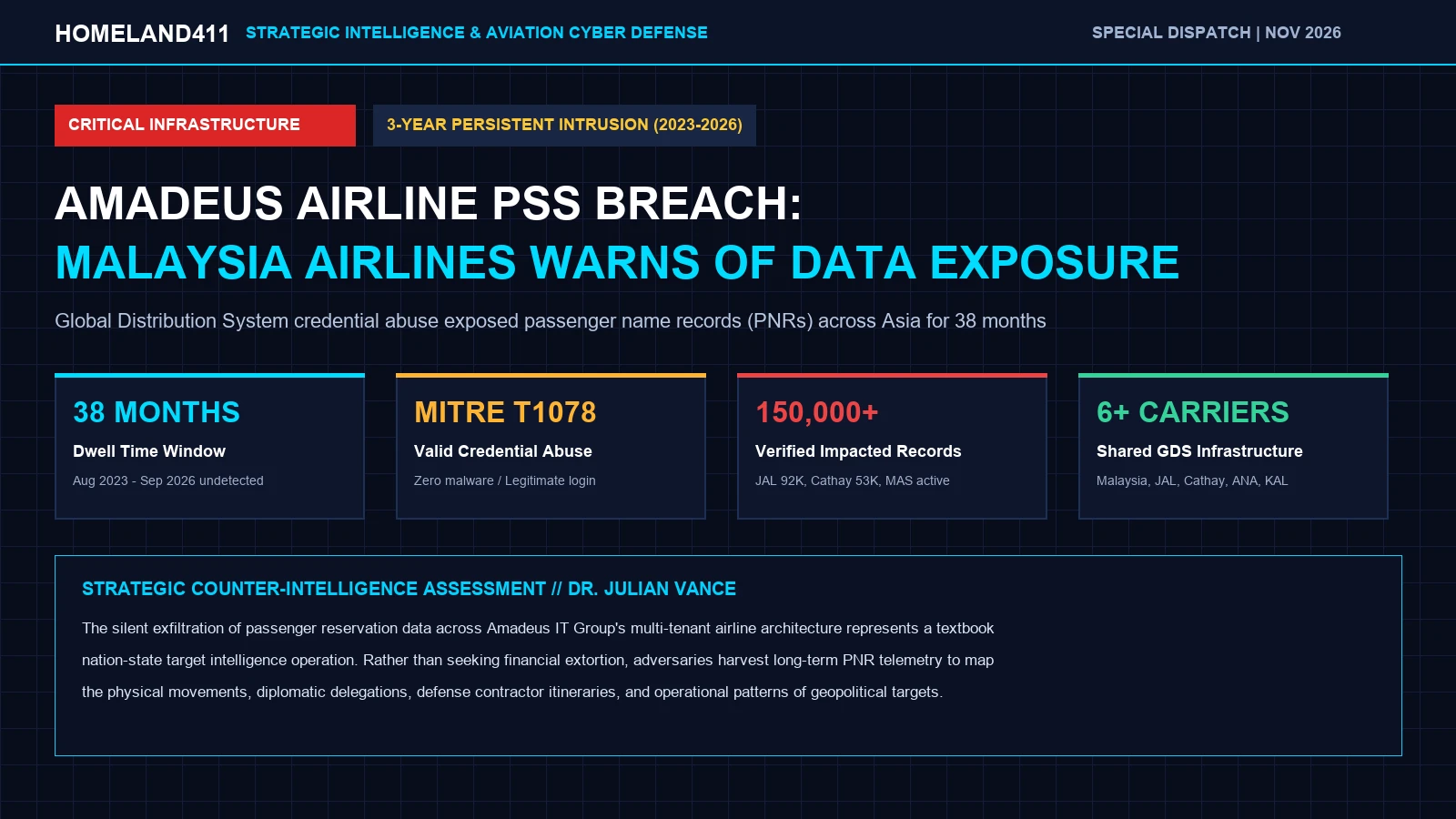
Malaysia Airlines has warned that customer information processed through Amadeus, its third-party reservation technology provider, may have been exposed in a cybersecurity incident affecting travel records between August 10, 2023, and September 23, 2026. In an official advisory issued on October 31, 2026, the carrier stated that its own internal IT systems remained uncompromised and that there is currently no evidence indicating financial or payment card data was accessed.
The disclosure follows verified breach notifications released over the past week by Japan Airlines (JAL), All Nippon Airways (ANA), Cathay Pacific, and other regional carriers. The incident centers on unauthorized access to Amadeus IT Group’s shared global reservation platform, raising serious supply-chain security concerns across the commercial aviation industry.
Malaysia Airlines has not publicly confirmed the exact number of impacted passengers or the specific data fields accessed in its reservation pool. However, the carrier urged its customer base to remain vigilant against suspicious or unsolicited communications, warning that exposed booking references and contact details could be leveraged in targeted spear-phishing attempts.
The Intrusion Vector: Credential Abuse in Shared Reservation Infrastructure
Public disclosures from affected airlines indicate the breach did not involve ransomware deployment or the compromise of local airline networks. Flight operations and aircraft safety systems were completely unaffected.
Instead, technical statements from carriers such as Cathay Pacific and Korean Air point to valid account credential abuse (MITRE ATT&CK Technique T1078). Unauthorized actors obtained valid login authentication credentials assigned to a system account within Amadeus’s Passenger Service System (PSS). This authorized access allowed the intruder to query passenger databases directly without having to bypass perimeter firewalls or deploy malware binaries.
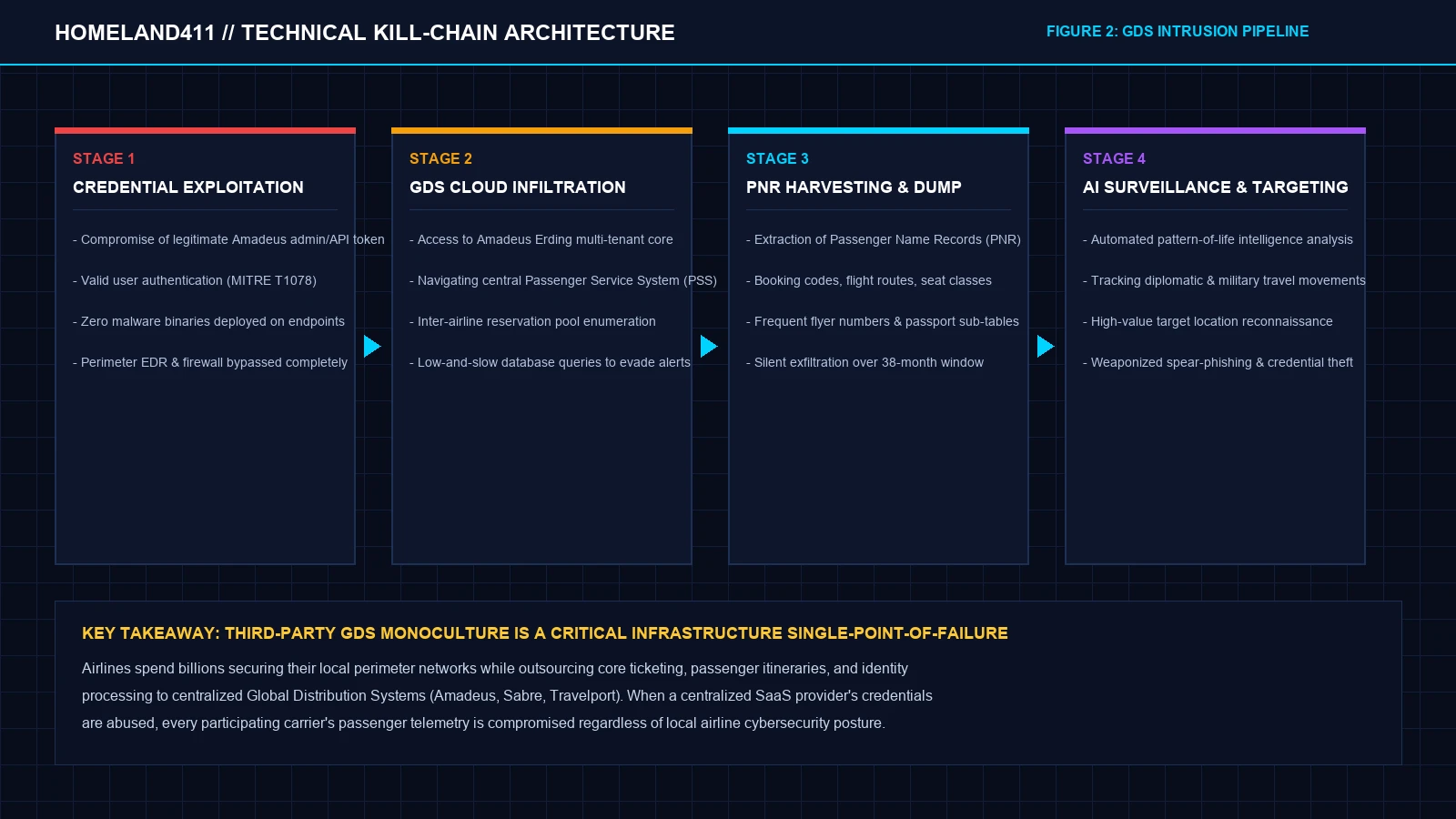
Amadeus serves as one of the primary Global Distribution Systems (GDS) worldwide, handling flight schedules, seat inventory, and passenger bookings for hundreds of international airlines. Because multiple carriers utilize shared cloud databases to synchronize interline ticketing and alliance bookings, credential abuse within a central provider can expose customer records across multiple unaffiliated airlines simultaneously.
Amadeus confirmed to impacted airlines that it took containment actions upon discovering the unauthorized activity, including invalidating the compromised credentials, enforcing password resets, and deploying enhanced monitoring controls across its reservation infrastructure.
Verified Multi-Carrier Impact Breakdown
The scale of compromised records varies significantly by carrier, reflecting different disclosure timelines and system architectures. Homeland411 has cross-referenced official airline notices to compile verified figures as of November 1, 2026:
| Airline Carrier | Confirmed Impact Volume | Disclosed Data Types | Current Status & Airline Notice |
|---|---|---|---|
| Japan Airlines (JAL) & JTA | ~92,000 customers | Names, PNR reservation codes, flight details. (~2,000 had passports, emails, or frequent flyer numbers exposed). | Notified Oct 23, 2026; direct customer notices dispatched. [JAL Notice] |
| All Nippon Airways (ANA) | ~37,800 customers | ~36,100 basic booking data (names, flight numbers); ~1,700 with passport/contact information. | Official notice issued; no financial data or passwords accessed. [ANA Notice] |
| Cathay Pacific | ~53,000 bookings | Booking references, passenger names, flight itineraries; small subset of contact information. | Disclosed late October 2026; confirmed no passwords or payment cards exposed. |
| Malaysia Airlines | Not disclosed | Customer data processed via Amadeus; specific fields still being evaluated. | Advisory issued Oct 31, 2026; customers urged to watch for phishing. [Coverage] |
| Korean Air & Asiana | Not disclosed | Ticketing references and booking reservation data processed through shared platform. | Confirmed unauthorized credential access; systems actively monitored. |
| Star Flyer | Subset of customer records | Reservation information processed through shared reservation infrastructure. | Direct customer notifications dispatched. |
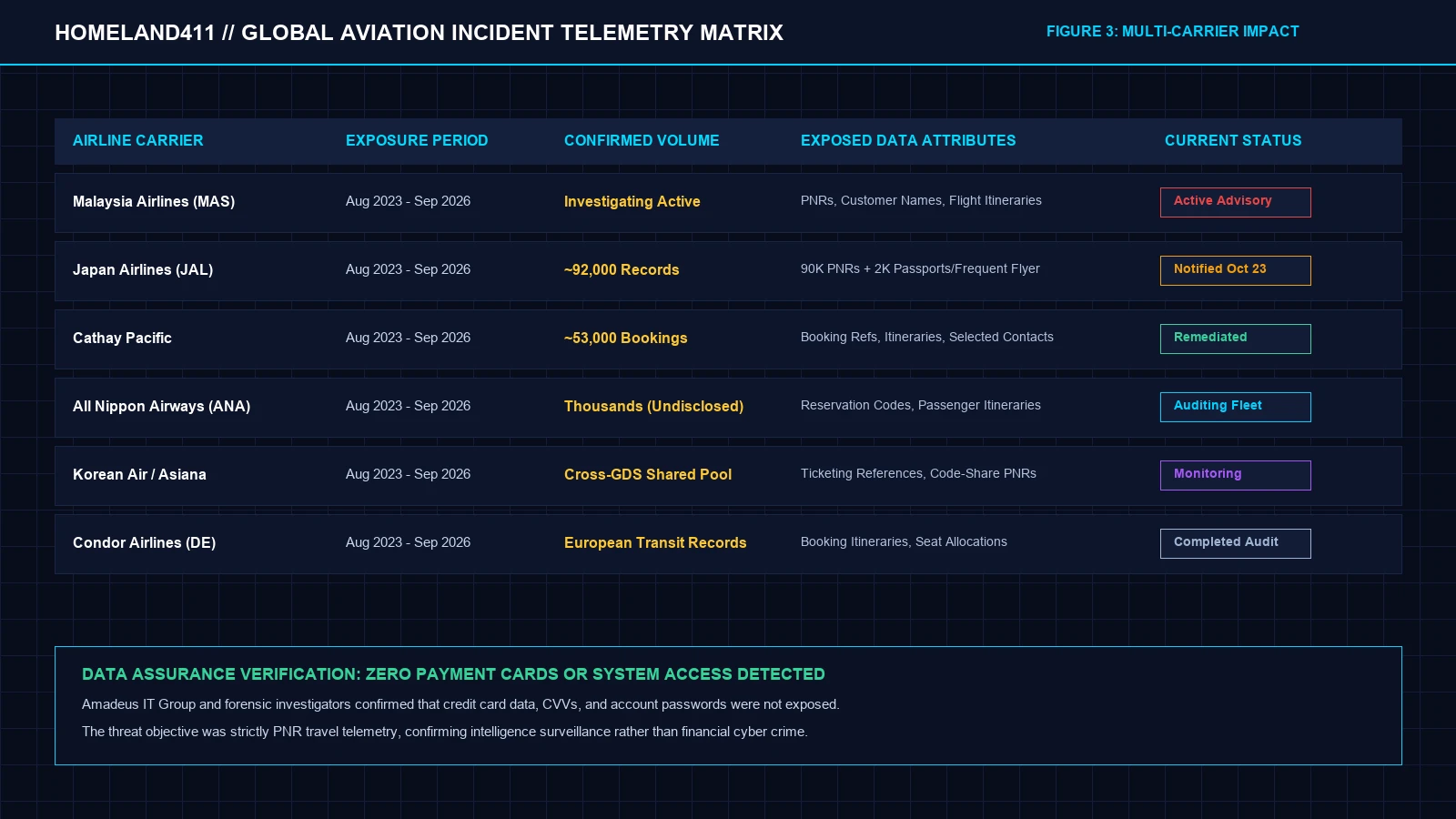
Note on unrelated European disclosures: In a separate, unrelated incident reported by German technology publication Heise Online, European carriers including Condor and Lufthansa experienced exposed passenger records due to an unsecured memory heap dump. That exposure was technically distinct from the Amadeus credential abuse incident affecting Asian carriers.
Why PNR Data Carries Strategic and Counter-Intelligence Value
While mainstream coverage has focused on consumer identity-theft risks, homeland security analysts view prolonged access to Passenger Name Records (PNRs) as a substantial counter-intelligence vulnerability.
A Passenger Name Record is not merely a ticket receipt. In international aviation, a PNR file is an operational record containing a traveler’s complete movement profile:
- Itinerary Timelines: Flight numbers, departure and arrival dates, connecting layover hubs, and return legs.
- Travel Companionship: Multi-passenger booking locators reveal who is traveling together, highlighting official delegations or corporate teams.
- Frequent Flyer Profiles: Elite tier loyalty numbers often correlate with senior government officials, corporate executives, and technical specialists.
- Special Service Requests (SSR): Operational notations that can include dietary choices, medical assistance, or diplomatic protocol handling.
When threat actors maintain prolonged access to reservation data across multiple carriers, they can assemble pattern-of-life dossiers on international travelers. Unlike financial cyber heists—such as North Korea’s recent $6.36 billion Binance multi-chain attack where criminals moved quickly to launder funds—espionage-oriented intrusions often focus on quiet, sustained collection. Access to flight manifests allows foreign intelligence entities to track diplomatic personnel, defense procurement specialists, and corporate executives moving across critical Indo-Pacific transit corridors.
U.S. Homeland Security Exposure & Supply Chain Oversight
For U.S. homeland security officials, the Amadeus breach highlights acute vulnerabilities in cross-border aviation data exchanges. Under federal aviation regulations enforced by the Department of Homeland Security (DHS), foreign commercial carriers operating international routes to, from, or transiting over the United States must transmit passenger manifests to U.S. Customs and Border Protection (CBP) through the Advance Passenger Information System (APIS) and the Transportation Security Administration’s (TSA) Secure Flight program.
Major U.S. carriers maintain extensive reciprocal code-sharing alliances with the impacted Asian airlines. American Airlines maintains active transpacific codeshare partnerships with Malaysia Airlines, Japan Airlines, and Cathay Pacific under the oneworld alliance. United Airlines maintains daily joint-venture operations with All Nippon Airways through the Star Alliance network. When an American traveler books an interline itinerary connecting through Tokyo Narita, Hong Kong, or Kuala Lumpur, their Passenger Name Record is routed across shared third-party GDS message brokers.
This cross-system data exchange means unauthorized access to Amadeus’s central reservation pool creates secondary exposure for U.S. defense contractors, diplomatic personnel, and commercial executives traveling on alliance itineraries. While CBP and TSA government databases operate behind strict federal boundaries, the commercial PNR data generated during the commercial reservation process resides within the vendor’s cloud environment.
The incident reflects ongoing warnings issued by the Cybersecurity and Infrastructure Security Agency (CISA) regarding enterprise software supply chains. As outlined in Homeland411’s analysis of critical infrastructure supplier vulnerabilities, modern critical infrastructure operators frequently maintain robust local defensive perimeters while remaining exposed to concentrated SaaS monopolies that service entire industrial sectors.
Regulatory Scrutiny and Future Architecture Directives
International aviation oversight bodies and national data privacy regulators are intensifying oversight of legacy Global Distribution Systems. The European Union Aviation Safety Agency (EASA) and the International Civil Aviation Organization (ICAO) have initiated reviews into multi-tenant credential governance across airline reservation platforms.
Industry cybersecurity analysts emphasize that commercial aviation must transition toward zero-trust data architectures. Key technical reforms currently under review by global carriers include:
- End-to-End PNR Tokenization: Ensuring that passenger identity fields are cryptographically hashed and decrypted only at authorized airline check-in gates, preventing cleartext extraction during central reservation queries.
- Session-Level Behavioral Anomaly revoking: Automatically terminating administrative credentials that exhibit atypical cross-carrier query patterns across unrelated passenger databases.
- Mandatory FIDO2 Hardware Keys: Enforcing hardware-backed multi-factor authentication for all vendor and third-party administrative system access, neutralizing standard credential theft.
Recommended Protective Measures for Airline Passengers
Airlines have advised travelers who flew on affected carriers during the 2023–2026 window to exercise heightened vigilance:
- Verify Booking Communications: Beware of unsolicited emails or text messages claiming to provide flight refunds, schedule changes, or baggage compensation that cite real reservation numbers.
- Do Not Provide Credentials via Links: Never input frequent-flyer passwords or personal data through links embedded in unexpected emails. Navigate directly to the airline’s verified website or mobile application.
- Monitor Loyalty Accounts: Regularly inspect frequent flyer accounts for unauthorized profile modifications or point transfers.
Frequently Asked Questions
Were credit card numbers or passwords stolen in the Malaysia Airlines Amadeus incident?
Malaysia Airlines stated in its October 31 advisory that there is currently no evidence indicating financial or payment card information was accessed. Airline passwords were also not reported compromised, as financial transactions reside on segregated, tokenized systems.
How many Malaysia Airlines customers were affected by the breach?
Malaysia Airlines has not yet publicly disclosed the specific number of affected passengers. By comparison, Japan Airlines reported approximately 92,000 impacted customers, All Nippon Airways reported roughly 37,800, and Cathay Pacific confirmed approximately 53,000 affected bookings.
Were flight safety and aircraft control systems compromised?
No. Commercial airlines and civil aviation authorities confirmed that flight operations, aircraft maintenance systems, and flight controls operate on completely isolated networks and were never at risk.
