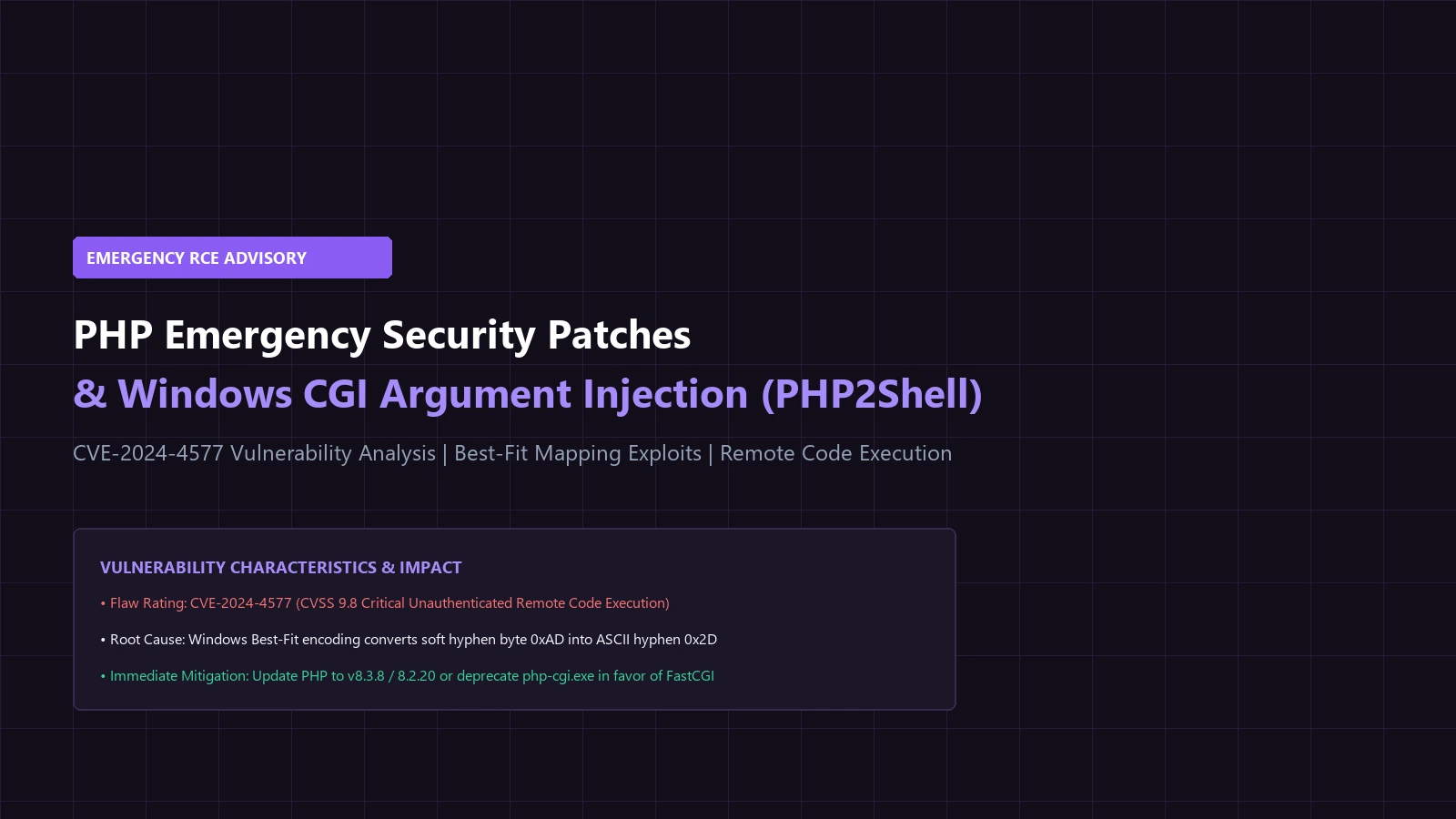
Systems administrators, web hosting providers, and enterprise cloud engineers are executing emergency software updates following the disclosure of a critical remote code execution vulnerability impacting the PHP runtime engine. The vulnerability, cataloged under national vulnerability registries as CVE-2024-4577 with a CVSS severity score of 9.8, enables unauthenticated remote attackers to execute arbitrary system commands on Windows servers operating PHP in CGI mode. Automated scanning engines and ransomware syndicates weaponized the flaw within twenty-four hours of disclosure, establishing persistent webshell backdoors across thousands of exposed enterprise servers. Software teams are halting routine maintenance windows to apply emergency vendor updates. Production servers faced immediate automated exploitation. Corporate perimeters suffered instant compromise. The incident demonstrates the persistent operational risks introduced by subtle character encoding conversions inside legacy operating system interfaces.
The technical root cause behind CVE-2024-4577 stems from an unexpected interaction between PHP argument handling logic and a Windows character conversion feature known as Best-Fit mapping. When web servers such as Apache or Internet Information Services forward incoming HTTP query strings to the underlying PHP-CGI binary, the operating system converts Unicode characters into local ANSI codepages. Security researchers discovered that Windows locales for Traditional Chinese, Simplified Chinese, and Japanese convert the Unicode soft hyphen character into a standard ASCII hyphen. Adversaries bypass existing input filters by transmitting specially crafted byte sequences that transform into command-line arguments. Single query strings triggered instant remote code execution.
Never Miss An UpdateFollow us on Google News to get our latest security, defense and cyber reporting in your feed. It’s free and takes one tap.
Follow on Google NewsOnce an adversary injects command-line arguments into the PHP-CGI executable, the attacker activates built-in configuration directives such as auto_prepend_file. By pairing this directive with the standard input stream wrapper, the attacker forces the PHP engine to execute arbitrary code supplied directly within the HTTP POST request body. Attackers deploy interactive webshells, dump database passwords, and initiate lateral reconnaissance across Windows Active Directory networks. Remediating this critical flaw demands immediate software patching and runtime architectural modernization.
Windows Best-Fit Character Mapping and PHP-CGI Argument Injection
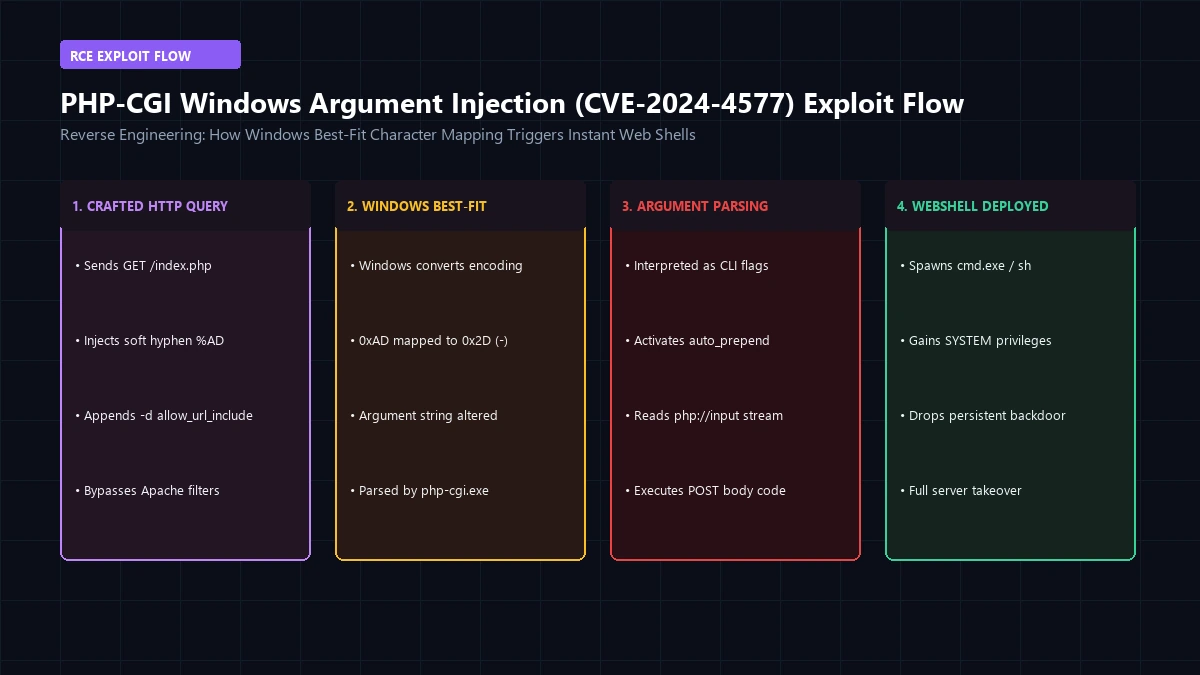
Understanding the mechanics of CVE-2024-4577 requires analyzing historical vulnerability mitigation patterns. Over a decade ago, security researchers identified CVE-2012-1823, a flaw that allowed attackers to inject command-line flags into PHP-CGI scripts. In response, PHP maintainers deployed input validation checks designed to strip incoming query strings beginning with a hyphen character, neutralizing direct flag injection.
The discovery of CVE-2024-4577 bypasses those historical filters by exploiting character encoding conversion layers executing beneath the PHP runtime. When an attacker sends an HTTP request containing the byte sequence %ADd, the web server security filters evaluate the string as safe because the byte 0xAD represents a soft hyphen rather than a literal ASCII hyphen (0x2D). However, when the Windows operating system passes the command-line argument to php-cgi.exe, the Windows Best-Fit mapping algorithm converts the soft hyphen into an ASCII hyphen, recreating the dangerous -d command-line flag inside the runtime context.
| PHP Runtime Branch | Vulnerability Exposure | Underlying Operating System | Mandatory Remediation Release |
|---|---|---|---|
| PHP 8.3.x (Prior to 8.3.8) | Vulnerable (CVSS 9.8 Critical RCE) | Windows (All Locales in CGI Mode) | Upgrade Immediately to PHP 8.3.8+ |
| PHP 8.2.x (Prior to 8.2.20) | Vulnerable (CVSS 9.8 Critical RCE) | Windows (All Locales in CGI Mode) | Upgrade Immediately to PHP 8.2.20+ |
| PHP 8.1.x (Prior to 8.1.29) | Vulnerable (CVSS 9.8 Critical RCE) | Windows (All Locales in CGI Mode) | Upgrade Immediately to PHP 8.1.29+ |
| PHP 8.0 / 7.x / 5.x (Legacy) | Inherently Vulnerable (EOL) | Windows (CGI Mode Enabled) | Migrate to Supported Supported Version |
| Linux / Unix PHP Instances | Not Vulnerable (No Best-Fit) | Linux (FastCGI / PHP-FPM) | Verify Proper CGI Configuration |
Production Server Hardening and FastCGI Runtime Migration
Remediating vulnerable enterprise web servers requires deploying official PHP security patches immediately. The PHP development team released emergency maintenance releases across all supported branches: PHP 8.3.8, PHP 8.2.20, and PHP 8.1.29. Systems engineers managing Windows hosting environments must upgrade runtime binaries and restart dependent web server services.
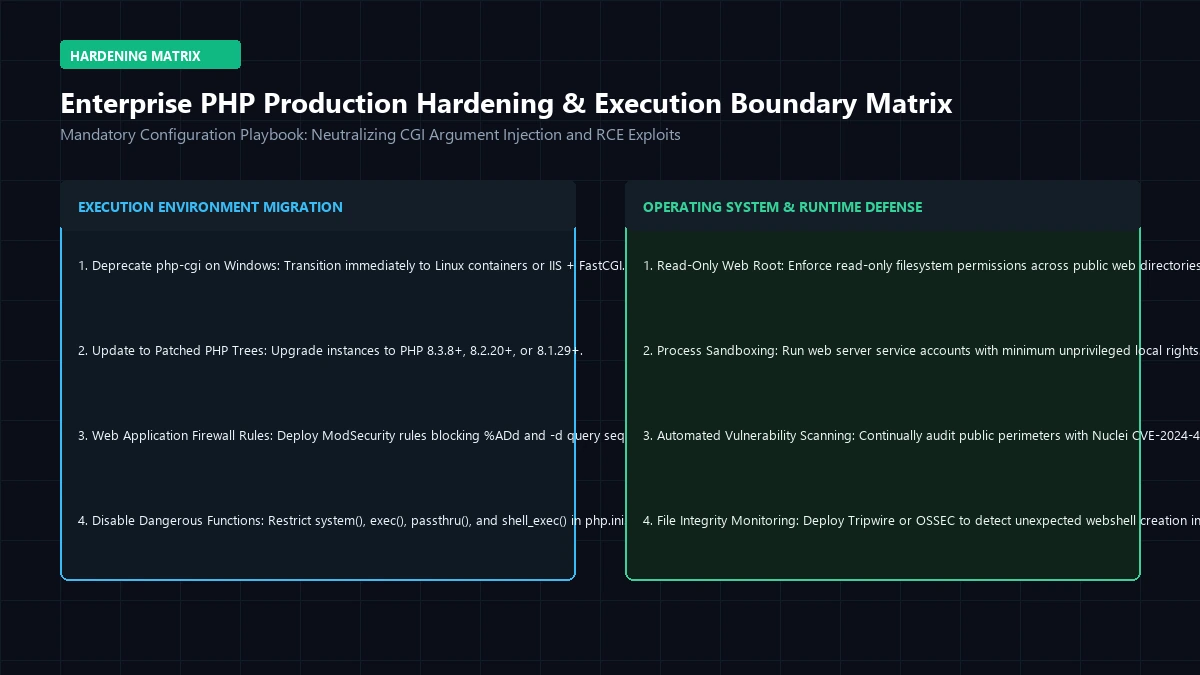
Beyond applying software patches, systems architects should modernize legacy execution architectures. Running PHP under direct CGI mode represents an obsolete operational model that introduces severe performance overhead and expanded attack surfaces. Organizations must migrate Windows hosting workloads toward secure execution handlers such as FastCGI or containerized Linux environments running PHP-FPM.
- Execute Immediate PHP Binary Updates: Upgrade all Windows PHP installations to patched releases (8.3.8+, 8.2.20+, or 8.1.29+) immediately.
- Deprecate Legacy CGI Handlers: Transition web server configurations from direct php-cgi.exe execution to hardened FastCGI handlers.
- Deploy Web Application Firewall Rules: Configure ModSecurity or cloud WAF filters to inspect query strings and block %AD sequences targeting PHP endpoints.
- Enforce Minimum Service Privileges: Run web server service accounts under restricted local user contexts, prohibiting access to administrative system utilities.
Adversary Campaign Telemetry and Threat Hunting Directives
Threat intelligence teams tracking post-disclosure exploitation report widespread automated attacks distributing botnet malware and ransomware droppers. Threat actors systematically query public IP ranges using automated HTTP POST requests containing Base64-encoded webshell payloads. Once an unpatched server executes the payload, the adversary establishes permanent persistence via scheduled Windows tasks.
Security operations centers must execute immediate threat hunting sweeps across web server access logs. Analysts should search for web requests targeting common PHP scripts that include query parameters containing %ADd or suspicious allow_url_include strings. In parallel, endpoint detection agents must audit web server processes spawning cmd.exe, powershell.exe, or certutil.exe. Prompt forensic detection isolates compromised servers before attackers execute lateral network moves.
The Forward Horizon
The rediscovery of command injection vulnerabilities inside decades-old web protocols highlights the persistent risk of architectural technical debt across modern enterprise infrastructure. While developer tooling and programming paradigms evolve rapidly, underlying operating system abstractions retain legacy compatibility quirks that introduce unexpected security exposures. Eliminating software supply chain vulnerabilities requires continuous architectural auditing and rigorous runtime modernization. Engineering teams that enforce aggressive patch management, decommission obsolete execution models, and deploy defense-in-depth monitoring will secure corporate web assets, maintaining operational resilience across an unpredictable cyber domain.