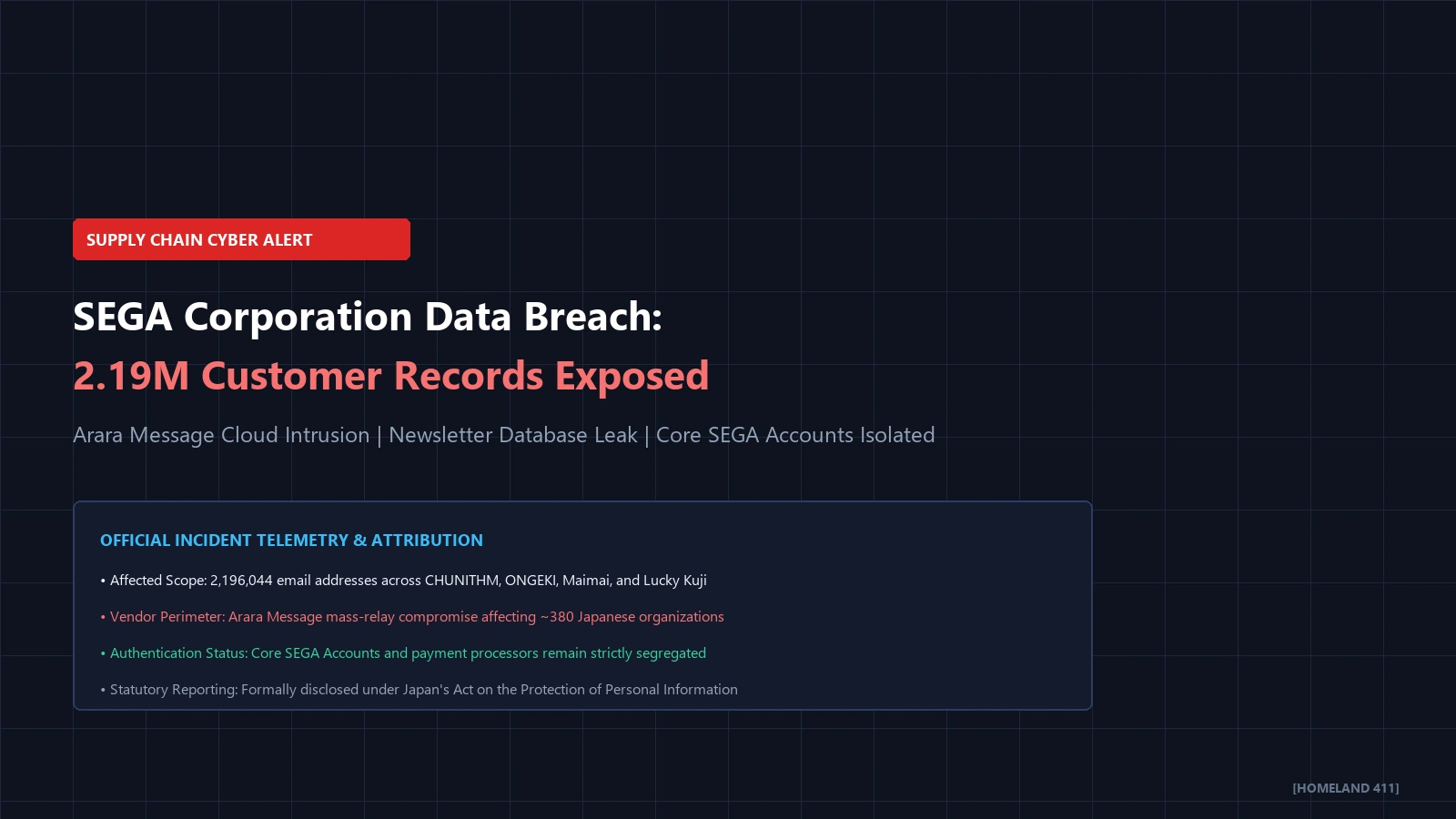
SEGA Corporation disclosed Monday that unauthorized actors infiltrated third-party email platform Arara Message, compromising 2,196,044 customer email addresses across Japan. The Tokyo-based gaming publisher confirmed that exfiltrated records originated from marketing newsletters distributed between July 2 and October 28, 2026. Forensic teams determined that an additional 92,273 database entries contained email distribution attributes and campaign metadata. Following vendor incidents analyzed in Homeland411’s enterprise data breach tracker and notification ledger, regulators received formal notification under statutory reporting protocols. Compromised files expose subscribers to targeted credential harvesting and brand-impersonation phishing campaigns.
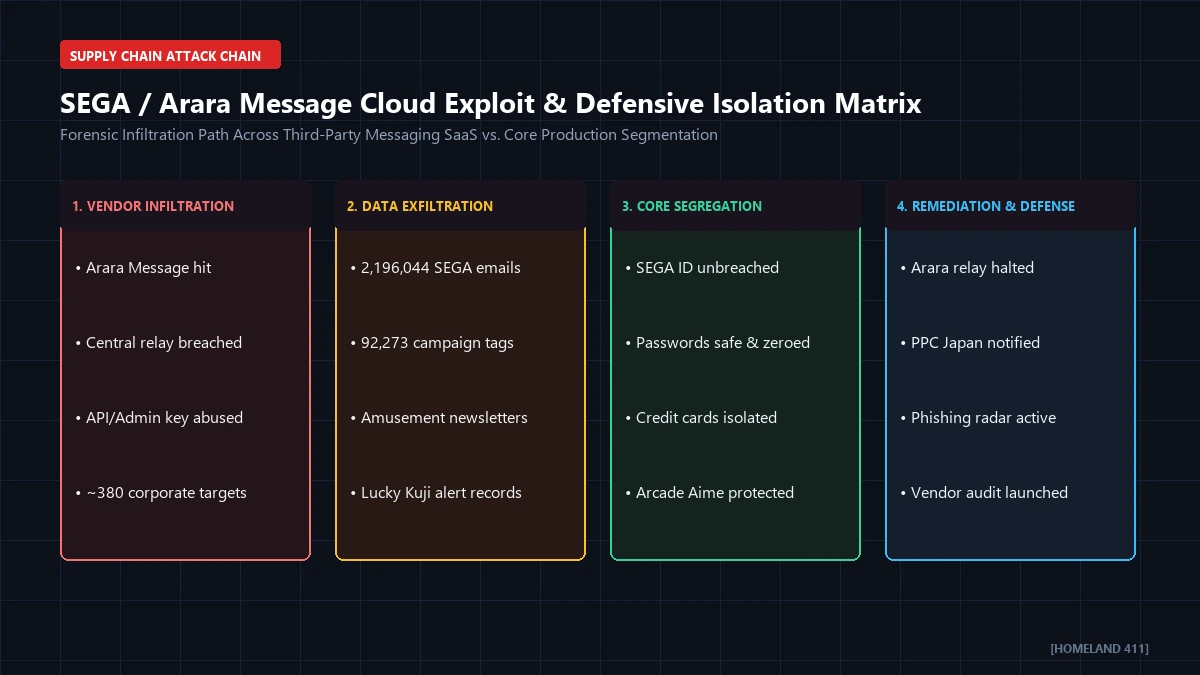
The vendor breach stems from a systemic intrusion targeting Arara Message, a mass-messaging cloud software suite operated by Tokyo-listed Paycloud Holdings. Threat actors compromised central relay infrastructure, exposing corporate newsletters across roughly 380 Japanese enterprises and 77 million distribution records. Attackers subsequently leveraged trusted Simple Mail Transfer Protocol (SMTP) relays to broadcast fraudulent notices. SEGA halted all outbound transmissions through Arara immediately upon discovering the incident. The firm engaged external incident responders to audit third-party service connections and isolate compromised distribution pipes.
Never Miss An UpdateFollow us on Google News to get our latest security, defense and cyber reporting in your feed. It’s free and takes one tap.
Follow on Google NewsGaming community security researchers observed that core gaming identities remained insulated from the cloud delivery compromise. SEGA Accounts that manage authentication across Steam, PlayStation, and Xbox consoles operate on independent server clusters. Crucially, the compromised Arara repository contained no player passwords, residential addresses, telephone numbers, birth dates, or credit card numbers. Similar segmentation boundaries were documented in Homeland411’s analysis of credential dumps and authentication risk defense. Threat actors nevertheless captured verified customer lists across multiple flagship amusement franchises.
Japanese threat intelligence analysts noted the incident coincided with concurrent server disruptions affecting SEGA FAVE arcade operations. Network engineers were already addressing infrastructure issues across ALL.Net and Aime contactless card services when the email vendor breach surfaced. Although SEGA confirmed the arcade network anomalies involved separate internal infrastructure, the simultaneous incidents placed substantial pressure on corporate response teams. Forensic investigators moved quickly to verify that threat actors had not established lateral persistence between cloud messaging systems and core production environments.
SEGA Customer Records, Distribution Scope, and Arara Vendor Compromise Ledger
Corporate disclosures filed with Japan’s Personal Information Protection Commission (PPC) map the perimeter of the exfiltration event. Compromised marketing newsletters supported arcade rhythm games, digital prize lotteries, and convention exhibitions. The incident occurred while SEGA FAVE separately managed an unrelated server outage across ALL.Net arcade payment networks. The table below outlines compromised distribution lists, exfiltrated data categories, and verification status across corporate assets:
| Service Asset / Affected Franchise | Exposed Record Volume | Compromised Data Fields | Authentication Security Status |
|---|---|---|---|
| Amusement Newsletters (CHUNITHM, ONGEKI, Maimai) | 1,842,500 Addresses | Email addresses, delivery logs, newsletter campaign tags | Unaffected; arcade Aime cards operate on isolated networks (JPCERT Alert →) |
| SEGA Lucky Kuji Online Lottery | 261,271 Records | Email addresses, transaction alert delivery timestamps | Unaffected; payment card details processed via external gateways |
| Tokyo Game Show 2026 Exhibition Alerts | 92,273 Records | Email addresses, booth registration metadata, distribution IDs | Public event list; no personal identification or passwords held |
| Core SEGA Account Infrastructure | 0 Records (Isolated) | Zero account credentials, passwords, or hashes exposed | Secure; proprietary authentication cluster bypassed vendor systems |
Phishing Mitigation and Player Defense Protocols for Compromised Email Lists
Threat actors who acquire verified customer lists frequently launch spear-phishing campaigns masquerading as official customer support desks. Attackers weaponize leaked email addresses by crafting fraudulent prize redemption claims and urgent password-reset notices. The Federal Trade Commission phishing guidance warns that high-trust gaming brands face aggressive impersonation following credential leaks. Subscribers who registered for SEGA amusement newsletters should execute four protective defenses:
- Verify Email Header Sender Domains: Inspect raw email headers to confirm sender domains match official @sega.com or @sega.jp infrastructure rather than rogue third-party relays.
- Disregard Urgent Account Verification Links: Delete unsolicited messages directing players to external login forms requesting SEGA IDs, passwords, or payment cards.
- Activate Multi-Factor Authentication: Enforce authenticator-app verification on primary email accounts and gaming portals to defeat automated credential-stuffing passes.
- Audit Linked Secondary Accounts: Review authentication logs across linked social accounts for unauthorized access tokens as recommended in Homeland411’s credential and mail infrastructure security advisory.
Third-Party SaaS Relay Vulnerabilities and Japanese Regulatory Oversight
The Arara Message intrusion exposes acute operational vulnerabilities inherent in outsourced enterprise communications. When commercial organizations contract third-party software-as-a-service vendors for bulk email delivery, they grant external servers access to proprietary subscriber lists. Intruders bypass direct corporate firewalls by compromising downstream vendors who maintain weaker security postures. Technical advisories from Japan’s Information-technology Promotion Agency (IPA) emphasize that supply-chain dependencies represent the primary threat vector for enterprise data leakage.
“We deeply apologize for the significant concern and inconvenience caused to our customers and related parties. We will strengthen our supervision of outsourced contractors and work to prevent any recurrence.”
— SEGA Corporation, Official Data Breach Incident Disclosure Notification
Under Japan’s Act on the Protection of Personal Information (APPI), commercial enterprises must notify supervisory authorities within five business days of confirming a major data leak. The Personal Information Protection Commission enforces rigorous compliance audits when third-party compromises expose customer databases. Arara’s parent company, Paycloud Holdings, faces expanding regulatory inquiries as hundreds of impacted enterprise clients submit independent exposure reports. Cybersecurity authorities coordinated with CISA cross-sector supply chain resilience directives to inspect software dependencies across critical digital services.
SEGA Corporation confirmed that internal security teams disconnected all automated communication pipelines linked to Arara Message. Forensic investigators continue auditing relational database logs to detect potential secondary pivot attempts against peripheral game web applications. Neither SEGA nor Japanese regulatory agencies have identified verified dark-web auctions offering the exfiltrated newsletter lists as of November 2026, leaving remediation teams focused on ongoing phishing monitoring and vendor risk re-evaluations.