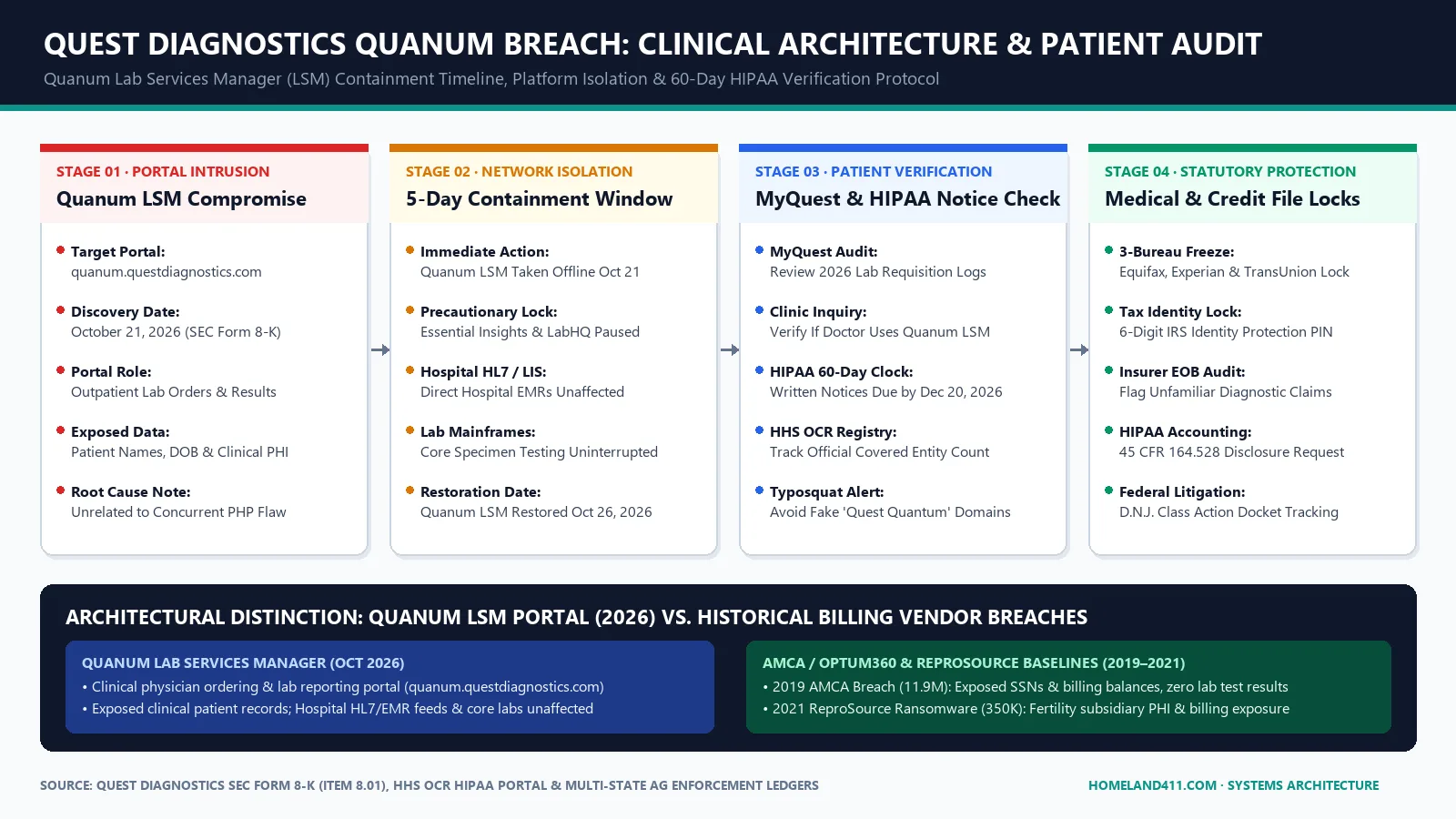
Quest Diagnostics Incorporated disclosed in a federal securities filing that an unauthorized party breached its Quanum Lab Services Manager platform on October 21, 2026. The intrusion exposed protected patient records stored inside the clinical ordering system. Patients and physician practices using the quanum.questdiagnostics portal can verify their exposure status through official HIPAA notices, MyQuest activity logs, and federal breach registries. Following healthcare cybersecurity incidents tracked in Homeland411’s guide on how to check passport leak and airline PNR breach exposure data, disclosures filed with the Securities and Exchange Commission on Form 8-K confirm that federal law enforcement is investigating. Compromised records include patient names, birthdates, laboratory test requisitions, and diagnostic result metadata.
Quanum Lab Services Manager operates as Quest’s cloud-based clinical portal for outpatient physicians, clinics, and medical office staff. Providers use the platform to submit pathology orders and retrieve laboratory test results. Patients searching online for “Quanum Quest” or “Quest Quantum” after receiving clinic alerts are encountering fallout from the five-day portal outage. Quest immediately took the Quanum clinical portal offline on October 21 to contain the intrusion. The company also suspended access to its Essential Insights and LabHQ analytics tools as a precaution. Engineers restored Quanum Lab Services Manager access for healthcare providers on October 26, 2026.
Never Miss An UpdateFollow us on Google News to get our latest security, defense and cyber reporting in your feed. It’s free and takes one tap.
Follow on Google NewsIn its regulatory filing, Quest stated that direct Electronic Medical Record and Laboratory Information System interfaces used by major hospitals remained operational. Core diagnostic testing laboratories continued processing patient specimens without interruption. However, outpatient clinics rely on Quanum to transmit bloodwork requisitions, patient demographic profiles, and insurance billing codes. Any compromise of that clinical portal creates persistent medical identity risk for patients. This exposure mirrors the healthcare back-office fallout documented in Homeland411’s investigation of the Conduent data breach affecting 25 million Americans and Kroll notices. Stolen diagnostic histories and health plan subscriber numbers cannot be rotated like standard passwords.
Quest Diagnostics Quanum Breach Scope and Historical Exposure Ledger
Federal securities disclosures, class-action complaints filed in New Jersey federal court, and state attorney general settlements illustrate how clinical portals differ from billing collectors. The 2019 American Medical Collection Agency breach exposed financial and Social Security records without touching laboratory test results. In contrast, the October 2026 Quanum intrusion directly hit an active clinical test-ordering system. The table below maps confirmed Quest Diagnostics security incidents, affected platforms, and official patient verification channels:
| Platform / Incident | Discovery & Status | Exposed Patient Data Fields | Official Verification Channel |
|---|---|---|---|
| Quanum Lab Services Manager | Oct 21, 2026 (Restored Oct 26) | Patient names, DOB, lab test orders, clinical PHI records | Form 8-K Item 8.01 & HIPAA mail (HHS OCR Portal →) |
| Essential Insights & LabHQ | Oct 21, 2026 Precautionary Lock | Provider analytics and clinical workflow dashboards | Isolated during Quanum containment (MyQuest Portal →) |
| ReproSource Fertility Subsidiary | Aug 2021 Ransomware (350K) | Names, SSNs, CPT billing codes, fertility test data | $1.25M federal class settlement (HIPAA Notice Rule →) |
| AMCA / Optum360 Billing Vendor | May 2019 Collector Breach (11.9M) | SSNs, payment card data, medical balance records | $21M 41-state AG enforcement (NY AG Order →) |
How Patients and Clinics Can Check Quanum Breach Exposure Step by Step
Patients whose physicians ordered bloodwork or pathology testing through Quest Diagnostics should complete four verification steps to protect their records:
- Audit MyQuest Requisition History: Log directly into your patient account to review recent laboratory test requisitions, ordering physician names, and specimen collection dates from 2026.
- Confirm Provider Quanum LSM Usage: Ask your outpatient clinic whether staff submit lab orders through the web-based Quanum Lab Services Manager portal rather than hospital HL7 interfaces.
- Monitor Written HIPAA Breach Notices: Watch your physical mail for statutory breach letters issued under the 60-day HIPAA notification window detailing specific compromised data fields.
- Enforce Federal Credit and Tax Locks: Activate free three-bureau freezes under FTC credit freeze guidelines and secure an IRS Identity Protection PIN.
How Quanum Lab Services Manager Differs from MyQuest and Hospital EMRs
Confusion surrounding the breach stems from Quest operating separate digital platforms for physician practices and consumers. Patients use the MyQuest mobile app to view personal lab results at home. Meanwhile, independent physician offices use the Quanum suite—including Quanum Lab Services Manager, Quanum EHR, and Quanum eLabs—to order diagnostic panels and manage clinical charts. Because users frequently misspell “Quanum” as “Quantum” when searching for login portals, scammers regularly register typosquatted domains targeting patients seeking breach updates.
“While the full scope of unauthorized access remains under investigation, at this time the Company believes that an unauthorized party accessed certain patient records.”
— Quest Diagnostics Incorporated, Form 8-K Item 8.01 Regulatory Disclosure
In its SEC disclosure, Quest confirmed that the October 21 intrusion did not stem from the widespread PHP vulnerability disclosed during the same week. Forensic engineers severed external access to Quanum Lab Services Manager, Essential Insights, and LabHQ for five days. That rapid isolation prevented lateral movement into Quest’s core laboratory testing mainframes. These network containment measures align with healthcare infrastructure defenses analyzed in Homeland411’s reporting on FBI and CISA hospital cybersecurity advisories.
HIPAA 60-Day Notification Deadlines and Federal Class-Action Litigation
Under the federal HIPAA Breach Notification Rule at 45 C.F.R. §§ 164.400-414, covered entities must notify affected individuals in writing without unreasonable delay. Federal law sets a strict outer deadline of 60 calendar days after breach discovery. Based on the October 21, 2026 discovery date reported to the SEC, Quest’s statutory 60-day notification clock runs through December 20, 2026. Patients should scrutinize every Explanation of Benefits statement from their health insurer for unfamiliar diagnostic lab billings during this window.
Legal scrutiny escalated within days of the Form 8-K filing as patients lodged federal class-action complaints. Early filings include Giga Romero v. Quest Diagnostics Incorporated in the U.S. District Court for the District of New Jersey. The lawsuits allege failure to safeguard sensitive diagnostic records and seek court-supervised identity monitoring and statutory damages. Neither Quest Diagnostics nor the Department of Health and Human Services Office for Civil Rights has published a final patient headcount for the Quanum Lab Services Manager intrusion as of November 2026, pending completion of forensic file indexing.