
WASHINGTON — DreamHost has confirmed a data breach in which hackers exploited a software flaw in its web-based File Manager to steal FTP and SFTP usernames and passwords. The intrusion also reached webmail login data for a limited number of customers. The Los Angeles-based web hosting provider disclosed that the breach began in August 2026 and ran until engineers terminated the access on October 23, 2026. DreamHost filed a formal breach notification with the California Attorney General on November 2. Affected users are receiving one year of credit monitoring through Equifax.
The DreamHost intrusion marks a significant credential exposure at one of the longest-running shared WordPress hosting providers on the web. The company initially forced password resets across customer accounts on October 23 without disclosing the cause. Six days later, it published an official October security incident notice confirming that credentials had been stolen. Security teams tracking the Harvard alumni database breach and the @cosme customer data leak warn that stolen hosting credentials create immediate downstream risk.
Never Miss An UpdateFollow us on Google News to get our latest security, defense and cyber reporting in your feed. It’s free and takes one tap.
Follow on Google NewsHow the DreamHost Web File Manager Intrusion Exposed FTP and Webmail
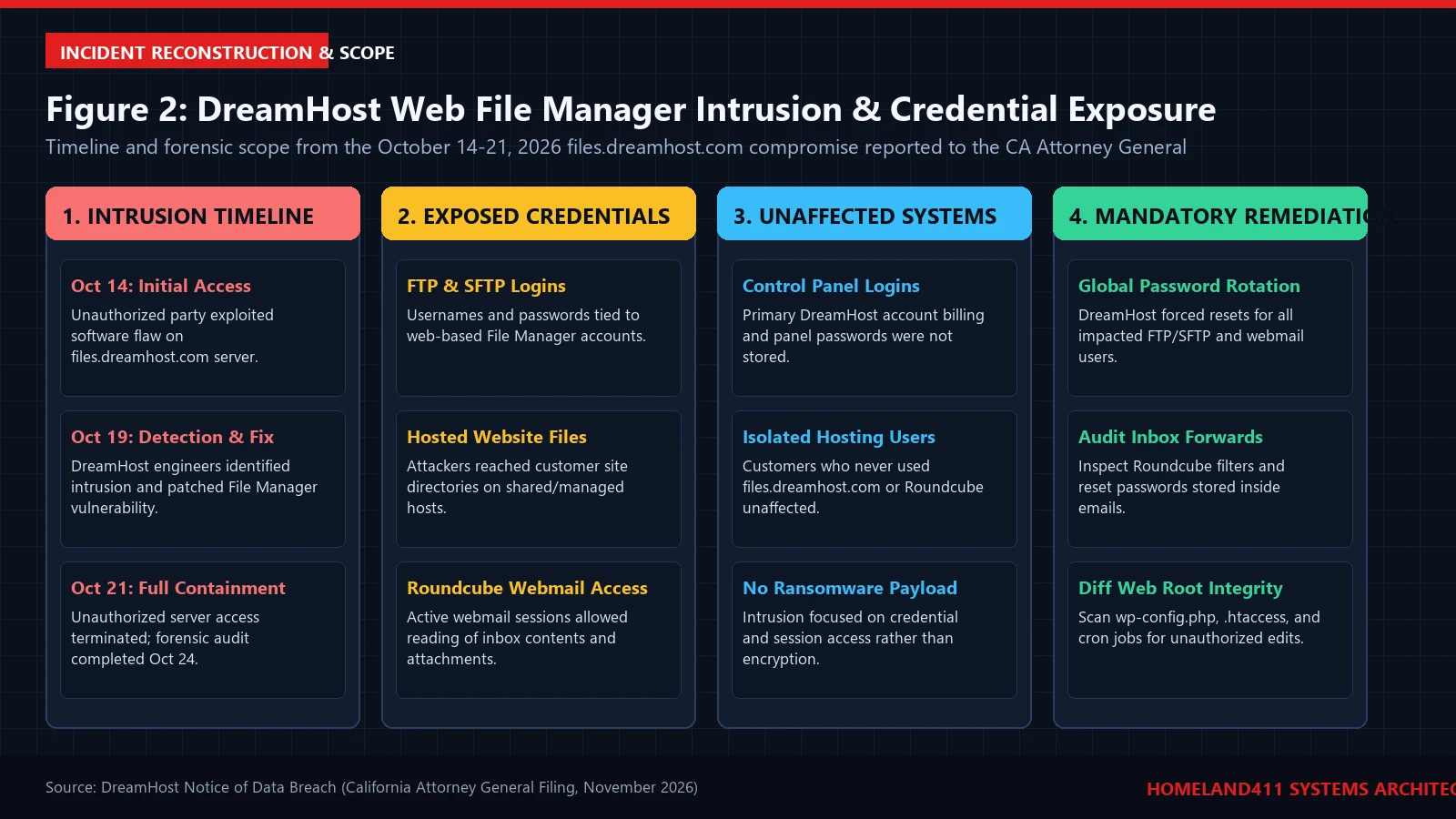
The DreamHost File Manager allows site administrators to edit website files inside a browser at files.dreamhost.com instead of using a desktop SFTP client. According to DreamHost, an attacker exploited a vulnerability in the third-party software powering the File Manager. That flaw allowed the intruder to harvest the FTP and SFTP credentials of every customer who signed in during the exposure window. DreamHost stated that the attack was deliberate.
From that initial foothold, the intruder also reached segments of DreamHost’s webmail systems and obtained login credentials for a smaller group of users. DreamHost believes the attacker may have viewed the contents of some mailboxes and is contacting those customers individually. Neither the California filing nor the public incident notice named the vulnerable third-party software or attributed the attack to a specific threat group. Furthermore, no CVE identifier has been disclosed in the National Vulnerability Database. DreamHost confirmed the incident is unrelated to recent PHP upgrades.
| Breach Dimension / Date | Affected DreamHost System | Confirmed Forensic Scope | Customer & Regulatory Status |
|---|---|---|---|
| Aug 15 – Oct 23, 2026 | Web File Manager (files.dreamhost.com) |
Third-party software flaw exploited to harvest FTP/SFTP logins | Server isolated Oct 23; rebuilt with enhanced telemetry |
| Exposed Credentials | FTP, SFTP & Roundcube Webmail | “Well under” 10% of hosted email and FTP/SFTP accounts | Mandatory password resets enforced (DreamHost Guide →) |
| Isolated Infrastructure | Control Panel & Payment Vaults | Zero evidence of billing, credit card, or panel login theft | Payments processed externally; card numbers not stored |
| Oct 29 – Nov 2, 2026 | Public & Statutory Filings | Incident notice published Oct 29; CA Attorney General filing Nov 2 | 12 months of Equifax credit monitoring offered to affected users |
DreamHost Breach Scope and Downstream Website Tampering Risks
The stolen data centers on access credentials rather than static identity records. DreamHost estimates that “well under” 10% of hosted email and FTP/SFTP accounts were affected across its platform. Because the company sent precautionary reset notices to a broader pool of customers than forensic logs confirmed were exposed, a reset email alone does not prove an account was breached. DreamHost has not released an absolute victim count, and BleepingComputer reported that questions regarding the total went unanswered.
Compromised FTP passwords pose a direct threat because they grant write permissions to a website’s production directories. An attacker holding valid SFTP logins can plant PHP web shells, inject payment skimmers, edit .htaccess redirect rules, or create hidden WordPress administrator accounts. DreamHost stated that it patched the vulnerability, preserved the compromised server for forensic work, and relaunched a rebuilt File Manager. Hosted websites stayed online and incoming mail kept arriving throughout the response.
Mandatory Remediation Steps for Affected DreamHost Hosting Accounts
Anyone who used the DreamHost File Manager between August and October 23, 2026, must treat those FTP, SFTP, and webmail credentials as compromised. Because DreamHost cannot contact sub-users directly, account owners must alert the people they manage and consult our guide on how to check whether your credentials or identity data leaked:
- Rotate FTP, SFTP, and Mailbox Passwords in the Control Panel: Set unique passwords under
Mail > Manage EmailandWebsites > SFTP Users & Filesinsidepanel.dreamhost.com, allowing 15 minutes for propagation. - Audit Production Website Directories for Unauthorized Edits: Check file modification dates between August 15 and October 23 across
wp-config.php,.htaccess, theme files, and WordPress administrator accounts. - Inspect Roundcube Webmail Forwarding Rules and Filters: Remove any unfamiliar mail forwarding rules or filters that could copy password-reset messages to an outside address.
- Revoke Reused Passwords and Enroll in Credit Monitoring: Change any other account that shared the same password, and activate the 12-month Equifax monitoring code in DreamHost’s breach letter.
Customers should also watch for phishing emails that imitate breach notices. DreamHost emphasized that its support messages never ask for a password or include sign-in links: “DreamHost will never email you asking for your password.” Users should navigate to panel.dreamhost.com directly in their browser.
Prior DreamHost Security Incidents and Pending Regulatory Disclosures
This is not the first time FTP credentials have been targeted at the hosting company. In June 2007, attackers abused a flaw in DreamHost’s web control panel and compromised about 3,500 FTP accounts, as The Register reported. In January 2012, DreamHost detected unauthorized access to a database server and forced resets of FTP and shell passwords across its customer base.
“We discovered that an unauthorized third party accessed the server that runs our web-based File Manager at files.dreamhost.com.”
— DreamHost LLC, Official Notice of Data Breach Filed with the California Attorney General
Plaintiff law firms including Strauss Borrelli PLLC and Shamis & Gentile announced this week that they are investigating the DreamHost data breach for possible class claims, though no lawsuit had been reported as filed as of Thursday. While state regulators in jurisdictions such as Maine and Texas typically list affected resident totals in supplemental breach portals, neither DreamHost nor federal authorities at CISA have published a timetable for disclosing final victim counts or naming the vulnerable File Manager component.