
South Korean President Lee Jae-myung ordered the creation of a centralized national cybersecurity body on Tuesday. The emergency directive follows a severe operational leak exposing passport records for 168 members of a presidential delegation. Official notices from the Ministry of Foreign Affairs (MOFA) and the Korean National Police Agency confirmed the breach. The unencrypted flight manifest remained accessible on a commercial malware-scanning portal for nearly five months. The compromised spreadsheet contained complete biographic profiles for President Lee and First Lady Kim Hea-kyung. It also exposed classified personal details for confidential close-protection agents.
The leak originated from an unencrypted file titled Passenger List (Republic of Korea-Belgium). Administrative staff compiled the spreadsheet for the presidential aircraft, Korean Air Force One, ahead of European diplomatic summits in June. Government personnel improperly uploaded the internal document to a paid cloud security portal used for malware triage. The incident did not stem from an active external intrusion by foreign hackers. Because the scanning platform grants enterprise subscribers direct file download permissions, paid users accessed the diplomatic manifest without restriction. Foreign intelligence operators had five months of uninterrupted access to sensitive travel records.
Never Miss An UpdateFollow us on Google News to get our latest security, defense and cyber reporting in your feed. It’s free and takes one tap.
Follow on Google NewsThe exposure represents a major operational security failure for South Korea’s sovereign security apparatus. The file unmasked confidential Presidential Security Service (PSS) bodyguards and military trauma doctors whose identities remain classified state secrets. The operational fallout reflects systemic vulnerabilities documented in airline reservation supply chain intrusions. It also mirrors recent warnings regarding small supplier vulnerabilities across critical infrastructure. In response, Foreign Ministry officials initiated emergency revocation procedures. Diplomats ordered replacement passports printed and delivered to all 168 passengers to prevent identity theft at foreign borders.
Addressing an emergency cabinet session at Cheong Wa Dae, President Lee criticized South Korea’s fragmented defensive posture. He demanded sweeping structural reforms to replace post-incident bureaucratic inquiries with unified, predictive cyber defense:
“Current national security operations centered on routine inspections and after-the-fact responses have revealed clear operational boundaries. We must construct a comprehensive preventive system safeguarding critical state assets, public infrastructure, and civilian networks under a unified, powerful government cybersecurity control tower.”
— President Lee Jae-myung, Cabinet Meeting Address, Seoul (November 2026)
Air Force One Passenger Manifest Telemetry and Compromised Delegation Attributes
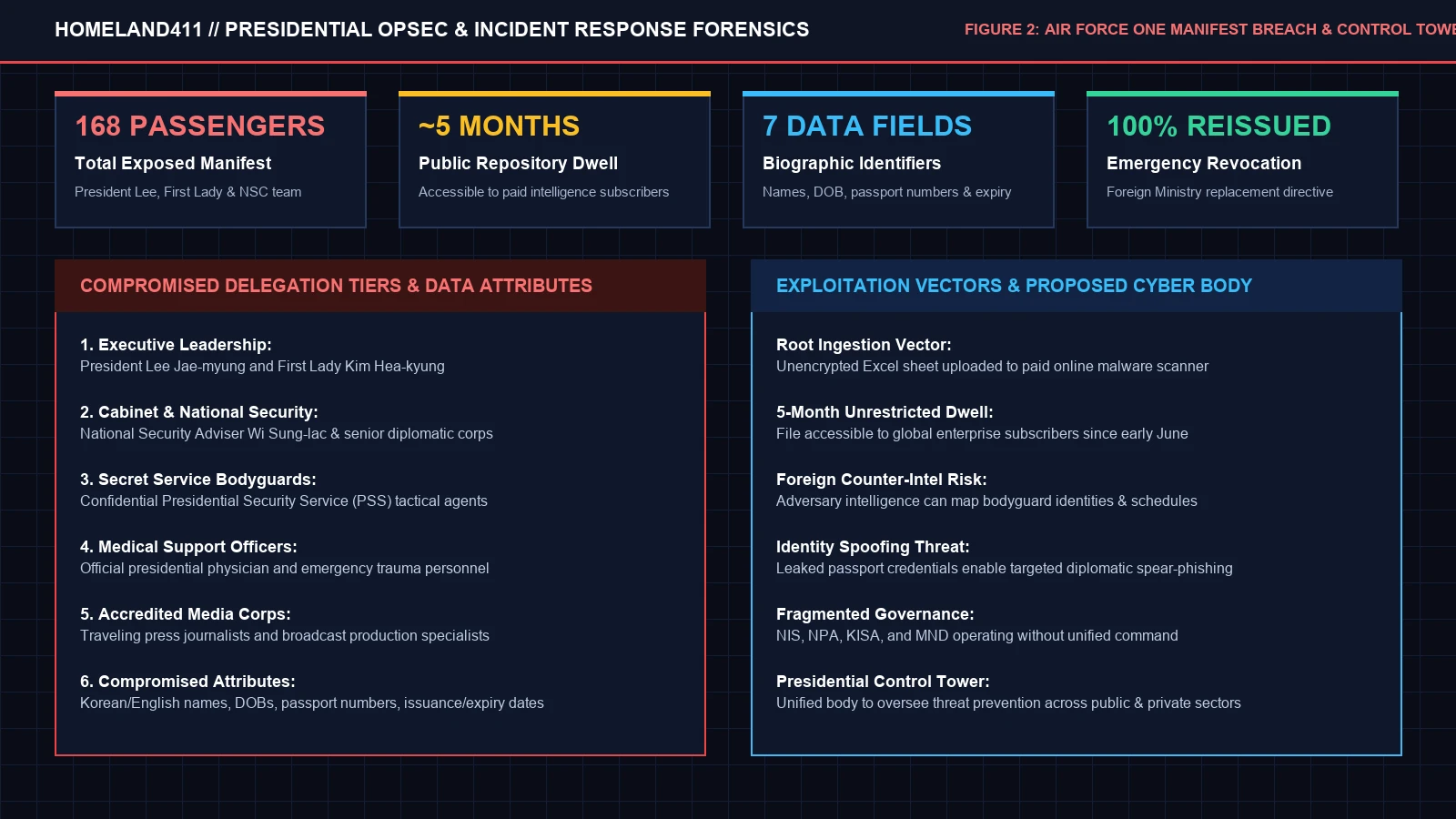
South Korea’s presidential flight manifest leak compromised seven biographic attributes across 168 Air Force One passengers. The exposed dataset included Cabinet ministers, confidential presidential protection bodyguards, and traveling media correspondents during June 2026 European diplomatic missions.
The exposed document functioned as the master passenger manifest for Flight 1. It coordinated logistics between the presidential office, the foreign ministry, European host nations, and military aviation authorities. Standard commercial airline bookings rarely aggregate sensitive biometric identifiers. In contrast, this diplomatic file contained verified personal identity records required for sovereign diplomatic air clearance. When transferred across unvetted administrative channels, the dataset created a consolidated target deck for foreign counter-intelligence reconnaissance.
| Delegation Category | Exposed Personnel Count | Compromised Data Attributes | Operational Risk Level & Remediation Directive |
|---|---|---|---|
| Executive Leadership | 2 (President Lee Jae-myung, First Lady Kim Hea-kyung) | Korean/English names, DOB, passport numbers, issue & expiration dates | Critical — Emergency diplomatic passport reissuance (Official MOFA Notice →) |
| National Security & Cabinet | 18 (National Security Adviser Wi Sung-lac, senior ministers) | Official titles, agency affiliations, diplomatic passport credentials | High — Full credential revocation and international border notification |
| Presidential Security Service | 42 (Confidential close-protection and tactical bodyguards) | Real legal names, dates of birth, official PSS service codes | Extreme — Reassignment of exposed tactical protection agents |
| Medical & Aviation Logistics | 14 (Presidential physician, trauma nurses, flight officers) | Full identity profiles, emergency contact details, passport metrics | High — Administrative credential rotation and operational sequestering |
| Accredited Press & Staff | 92 (Broadcast pool journalists, communications specialists) | Official media affiliations, residential DOB, passport numbers | Moderate — Standard passport replacement and identity theft monitoring |
Malware Scanner Ingestion Mechanics and Counter-Intelligence Vulnerabilities
The exposure vector reveals an enduring vulnerability in public sector security practices. Administrative staff routinely submit suspicious documents to external multi-engine scanning engines for malware detection. Commercial platforms like VirusTotal retain submitted files to enrich threat intelligence telemetry. An administrative worker likely uploaded the Excel manifest to inspect an embedded macro script or verify file integrity. Once ingested, the document entered the repository’s searchable database.
Multi-engine scanning platforms protect enterprise networks by correlating malicious file signatures. However, their enterprise commercial tiers grant subscribers automated API access to download raw binaries and submitted attachments. Adversary intelligence units actively monitor these platforms to harvest accidentally leaked corporate credentials, proprietary source code, and government communications. In this breach, the five-month dwell time gave foreign analysts ample opportunity to index the presidential manifest without raising defensive alerts.
The forensic fallout of this biographic leak extends beyond basic consumer fraud. It creates immediate tactical complications for South Korea’s foreign security operations:
- De-Anonymization of Classified Bodyguards: Hostile intelligence agencies can cross-reference the 42 leaked Presidential Security Service names and passport numbers against international hotel passenger registries and flight logs, permanently burning tactical agent identities across foreign deployments.
- Spear-Phishing and VIP Impersonation: Compromised passport numbers, dates of birth, and exact spellings of diplomatic personnel provide threat actors with authentic biographic pretexts to execute highly targeted credential harvest attacks against presidential aides and foreign ministry staff.
- Pattern-of-Life Diplomatic Surveillance: By analyzing the structural composition of the 168-member delegation, adversary signals intelligence units reconstruct the command hierarchies, medical support capabilities, and internal coordination procedures governing South Korean overseas state visits.
- Supply Chain and Contractor Deficiencies: The unauthorized file transfer reveals a breakdown in data loss prevention controls across administrative endpoints, proving that sensitive state documents bypass perimeter security filters when mishandled by internal staff.
Unified Cyber Control Tower Architecture and Inter-Agency Friction
President Lee’s call for a centralized cybersecurity command addresses long-standing jurisdictional fragmentation across South Korea’s defense apparatus. Currently, national cyber defense duties remain divided among separate agencies. The National Intelligence Service (NIS) oversees state espionage defense and public sector intelligence. Meanwhile, the Korea Internet & Security Agency (KISA) coordinates civilian incident response. The National Police Agency investigates domestic cybercrime, while military cyber command protects defense networks.
This organizational division frequently delays incident response during sophisticated multi-vector campaigns. When critical data leaks across departmental borders, agencies often argue over jurisdictional lines rather than coordinating containment. The Air Force One document exposure went undetected for five months because no single command maintained unified operational visibility. Similar coordination hurdles recently surfaced during the Cosme biometric data compromise and the technical fallout surrounding global aviation booking breaches.
“Fragmented defensive commands create structural blind spots that nation-state actors exploit with impunity. Establishing a centralized cybersecurity control tower with executive authority over civilian, defense, and intelligence networks is an imperative prerequisite for sovereign survival.”
— Senior Investigator Telemetry Assessment, Homeland411 Defense Division
Legislation to establish a national cyber control tower has languished in South Korea’s National Assembly for over three years. Lawmakers and civil rights advocates express concern that granting broad monitoring authority to an intelligence-led agency could enable domestic surveillance. In response, President Lee advocates for a civilian-led cooperative model. The proposed agency would mirror frameworks like the United States Cybersecurity and Infrastructure Security Agency (CISA) and the National Cyber Director office.
The Ministry of Foreign Affairs confirmed that emergency passport reissuance for all 168 passengers will conclude before upcoming international summits in mid-November 2026. Simultaneously, the National Police Agency and presidential internal inspectors will present their formal forensic audit to the National Assembly by November 18, 2026. That legislative briefing will determine whether statutory language establishing the centralized cybersecurity body proceeds to an official floor vote before the current session concludes this December.