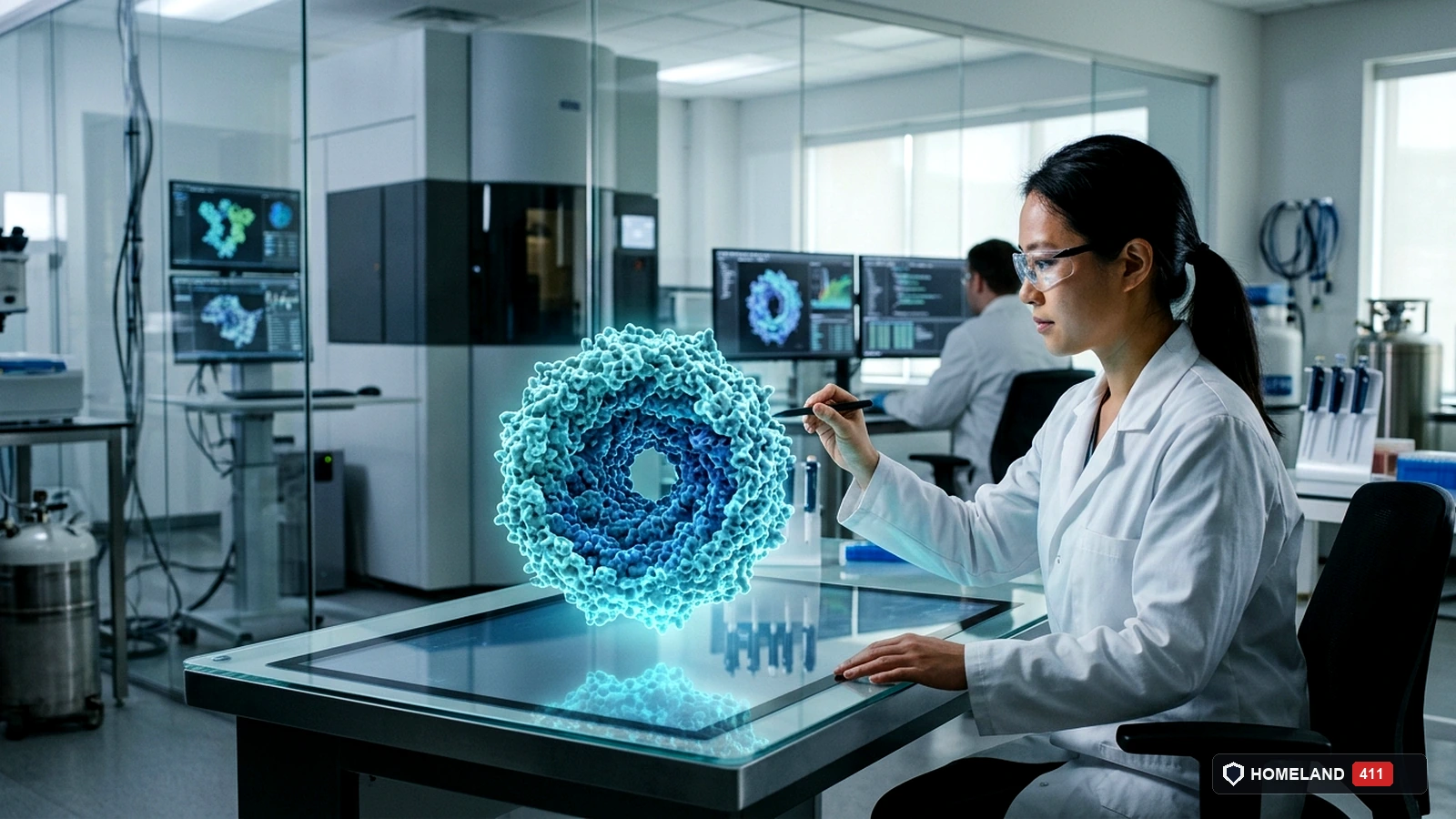
Anthropic announced Wednesday that its internal biology research team mapped the first three-dimensional structure of a bacterial vault particle. Working alongside Claude, the team resolved an atomic model from bacterial and bacteriophage genomes. The breakthrough answers a forty-year structural biology mystery by showing that hollow protein barrels exist outside eukaryotes. Researchers identified uncharacterized major vault protein homologs by scanning fifteen billion predicted protein sequences with Claude. Laboratory validation subsequently confirmed that a phage-encoded protein designated L05 self-assembles into symmetrical nanoscale capsules inside Escherichia coli cells.
First identified in 1986 in eukaryotic liver tissue, vault particles represent the largest non-viral protein complexes in living cells. Yet four decades of biochemical study failed to determine their physiological purpose or evolutionary origins. Anthropic’s team directed Claude to examine deep metagenomic databases, uncovering homologous open reading frames across diverse bacterial phyla. The project demonstrates Anthropic’s expanding investments in AI-driven bioscience and sovereign compute. Those capital allocations mirror the infrastructure commitments examined in Homeland411’s analysis of Anthropic’s compute allocations and balance sheet filings.
Never Miss An UpdateFollow us on Google News to get our latest security, defense and cyber reporting in your feed. It’s free and takes one tap.
Follow on Google NewsThe successful synthesis of prokaryotic vaults provides researchers with a robust experimental system to evaluate how large molecular containers assemble. Mammalian vaults require complex eukaryotic cell cultures for recombinant expression, severely limiting production yields. Producing stable bacterial vaults in fermentation hosts lowers key manufacturing barriers for molecular nanotechnology. These architectural efficiencies parallel the rapid enterprise deployments analyzed in our coverage of critical enterprise infrastructure defenses across high-reliability supply chains.
Inside the L05 Architecture: 96 Subunits and 25% Larger Internal Volume
Single-particle cryogenic electron microscopy confirmed that the bacteriophage L05 vault organizes into an expanded macromolecular barrel of ninety-six identical subunits. This structure differs markedly from the seventy-eight-subunit stoichiometry characteristic of classical mammalian vaults documented in the National Institutes of Health PubMed Central database.
Reconstructed density maps demonstrate that the L05 shell exhibits forty-eight-fold rotational symmetry along its equatorial midline. The resulting macromolecular container is measurably shorter and wider than eukaryotic counterparts, producing a twenty-five percent increase in internal lumen capacity. That expanded chamber offers substantial space for therapeutic enzymes and synthetic molecular cargo, establishing a versatile physical chassis for targeted drug delivery.
| Structural Dimension | Mammalian Eukaryotic Vault | Bacteriophage L05 Vault | Cryo-EM & Algorithmic Observation |
|---|---|---|---|
| Subunit Stoichiometry | 78 Major Vault Protein copies | 96 Major Vault Protein copies | Single-particle reconstruction confirms 48-fold rotational symmetry |
| Capsid Geometry | Elongated hollow ellipsoid | Expanded wide barrel structure | L05 shell is measurably shorter along the longitudinal axis |
| Internal Lumen Volume | Baseline mammalian capacity | 25% Volumetric Expansion | Provides expanded volume for molecular cargo and payload delivery |
| Expression Host System | Mammalian / Insect cell lines | Recombinant Escherichia coli | Bacterial host enables high-yield fermentation and purification |
| Discovery Methodology | Density gradient centrifugation | Claude in silico metagenomic search | Screened fifteen billion predicted structures from AlphaFold DB |
Anthropic announced the laboratory milestone publicly through official communication channels. The team detailed how researchers combined foundation model reasoning with wet-bench structural biology to characterize the ancient protein container.
Claude Science Pipeline: Computational Screening Across 15 Billion Predicted Proteins
The discovery stemmed from a multi-stage workflow where Claude acted as a computational co-investigator across sequence discovery, structural prediction, and lab protocol design. Rather than relying solely on pairwise sequence alignments, researchers deployed Claude to identify remote structural conservation across billions of candidate amino acid sequences.
The team queried vast structural datasets deposited across public repositories and the Research Collaboratory for Structural Bioinformatics (RCSB) Protein Data Bank. Claude evaluated candidates based on thermodynamic stability, fold propensities, and assembly interfaces. The screening protocol narrowed forty-four putative genes down to the four most viable expression targets.
- Metagenomic Sequence Mining: Claude screened fifteen billion predicted protein sequences across uncultivated environmental microbes to isolate hidden vault homologs.
- Structural Compatibility Scoring: Algorithmic filters evaluated interface residues to identify capsids capable of self-assembling without eukaryotic chaperone machinery.
- Recombinant Protocol Formulation: Claude formulated expression protocols for bacterial vectors, optimizing inducer concentrations and harvest temperatures in Escherichia coli.
- Cryo-EM Particle Analysis: Machine learning workflows assisted in 2D class averaging, orientation alignment, and 3D density map fitting at atomic resolution.
Biomedical Nanotechnology and Dual-Use Frontier AI Governance
The successful characterization of prokaryotic vault capsids unlocks tangible commercial opportunities for bio-nanotechnology beyond evolutionary insights. Naturally occurring vault particles have long attracted interest as non-immunogenic delivery systems for therapeutic proteins and synthetic messenger RNA vaccines. Producing mammalian vaults at scale in standard microbial fermenters previously posed insurmountable technical bottlenecks. Shifting vault expression into scalable bacterial hosts allows bioengineers to fabricate targeted nanocapsules that assemble with ninety-six-subunit precision.
The milestone also highlights the rapid advancement of frontier models capable of orchestrating complex scientific workflows across biological domains. Federal cybersecurity reviews examined in Homeland411’s reporting on federal critical software compliance mandates highlight similar systemic governance challenges. The intersection of autonomous AI reasoning and biological engineering demands rigorous safety benchmarking. Research institutions and federal oversight bodies continue to refine evaluation frameworks to ensure dual-use computational bio-tools remain secure against adversarial misuse.
“Uncovering intact vault architectures outside the eukaryotic kingdom fundamentally reshapes our understanding of cellular evolution while offering a scalable, programmable nanocontainer that expresses efficiently in standard bacterial hosts.”.
— Senior Research Fellow, Frontier Biosciences Consortium
The Forward Molecular Horizon
Anthropic confirmed that atomic coordinates for the bacteriophage L05 vault will be submitted to the open-access bioRxiv preprint server and the Worldwide Protein Data Bank by mid-November 2026. The research team will evaluate secondary candidate proteins identified during the initial screening sweep to determine whether other microbial vaults exhibit distinct subunit symmetries. Industrial biomanufacturing trials testing macromolecular encapsulation in bacterial bioreactors are scheduled to commence in the first quarter of 2027.