
Threat actors are weaponizing autonomous agentic artificial intelligence frameworks to systematically crawl open-source repositories and compromise corporate cloud environments. Microsoft Threat Intelligence confirmed that adversaries now deploy autonomous tools like ARTEX to harvest exposed cryptographic keys, OAuth credentials, and model inference tokens across public GitHub projects. In one documented intrusion, an autonomous agent advanced from initial code discovery to unauthorized Azure Key Vault exfiltration in under five minutes. The campaign illustrates an alarming evolution in algorithmic tradecraft. Autonomous software systems now execute full-spectrum reconnaissance, credential validation, and lateral cloud movement without human intervention. Security researchers detailed the threat in an official Microsoft Threat Intelligence research bulletin. Unchecked agentic scanning exposes enterprise development pipelines to instantaneous identity takeover.
Unlike traditional static code scrapers that flag regular expressions for manual triage, agentic models analyze code syntax and formulate contextual execution plans. The AI agent evaluates stolen credentials, benchmarks cloud tenant endpoints, and deploys reconnaissance routines directly against enterprise perimeters. These automated pipelines mirror software development threats exposed in Homeland411’s ongoing investigation of malicious instructions in AI coding environments. By automating the cognitive bridge between discovery and exploitation, the framework compresses defensive response windows from several days to mere seconds.
Never Miss An UpdateFollow us on Google News to get our latest security, defense and cyber reporting in your feed. It’s free and takes one tap.
Follow on Google NewsTelemetric data confirms the threat actor conducted widespread service principal sign-ins against multiple victim directories. The intrusions originated from external network infrastructure, including an active Tor routing node. Intruders leveraged valid application credentials to access Microsoft Entra ID tenants. Once inside, attackers escalated privileges to exfiltrate proprietary blob storage and search Azure DevOps repositories. These tactics reflect dangerous administrative compromise models analyzed in Homeland411’s reporting on credential harvesting and unauthorized administrative access across corporate hosting platforms.
Microsoft Threat Intelligence has observed threat actors using agentic AI tools to search public GitHub repositories for exposed secrets and then using stolen secrets for further malicious activity against the compromised organization. https://t.co/WLKFOFd6Cq Searching open code repositories for exposed credentials, secrets, keys, and other authentication material is a well-documented technique, but agentic tooling like ARTEX allows threat actors to scale and accelerate scanning for secrets, analyzing the output, and conducting follow-on attacks. Microsoft has also investigated follow-on activity related to successful service principal sign-ins involving multiple application IDs, including cases where a single multitenant application credential was used across multiple tenants. The threat actor used the compromised credentials for cloud resource discovery, and credential and data exfiltration. Microsoft encourages organizations to scan their code for secrets. In addition to removing the secrets from the code base, affected organizations should immediately rotate any exposed keys or credentials. Read our blog for more details, detections, and guidance for public monitoring and reducing exposure.
— Microsoft Threat Intelligence (@MsftSecIntel) November 5, 2026
The autonomous framework demonstrated adaptive troubleshooting capabilities during cloud interaction sequences. When the agent encountered HTTP 400 Bad Request rejections while probing control-plane interfaces, it dynamically evaluated error parameters and adjusted API specifications. Within thirty seconds, the model substituted supported API versions to successfully execute secret metadata queries. These autonomous self-healing loops highlight how foundation models deconstruct defensive access boundaries with machine persistence.
Autonomous Agent Attack Vectors and Cloud Exploitation Lifecycle
Adversaries configured the ARTEX framework to target sensitive development credentials, concentrating heavily on cloud workload identities and foundation model API endpoints. Security analysts mapped the automated kill chain from public GitHub scraping to downstream identity takeover across multiple commercial sectors.
| Attack Phase | Autonomous Agent Tooling | Targeted Cloud Telemetry | Observed Threat Impact |
|---|---|---|---|
| Reconnaissance & Discovery | Playwright Headless Chromium & GitHub REST API | Public repositories containing raw client secrets | Rapid identification of enterprise OAuth credentials (GitHub Advisory →) |
| Initial Access & Ingress | Custom Python HTTP Clients & Norma SDK WebFetch | Entra ID Service Principal sign-ins from 199.19.77.84 | Cross-tenant unauthorized authentication across multi-tenant apps |
| Adaptive API Negotiation | Autonomous REST Protocol Error Handler | Azure Resource Manager control-plane endpoints | Self-correcting HTTP 400 adjustments to version 2023-07-01 in 28 seconds |
| Credential & Key Exfiltration | Microsoft Graph API & Key Vault Management | Azure Key Vault secret metadata and storage blobs | Complete key bundle theft executed within 300 seconds |
| Workload Subversion | Azure Virtual Machine Run Command | Cloud compute instances and Foundry AI Tools | Arbitrary remote command execution and hijacked AI model capacity |
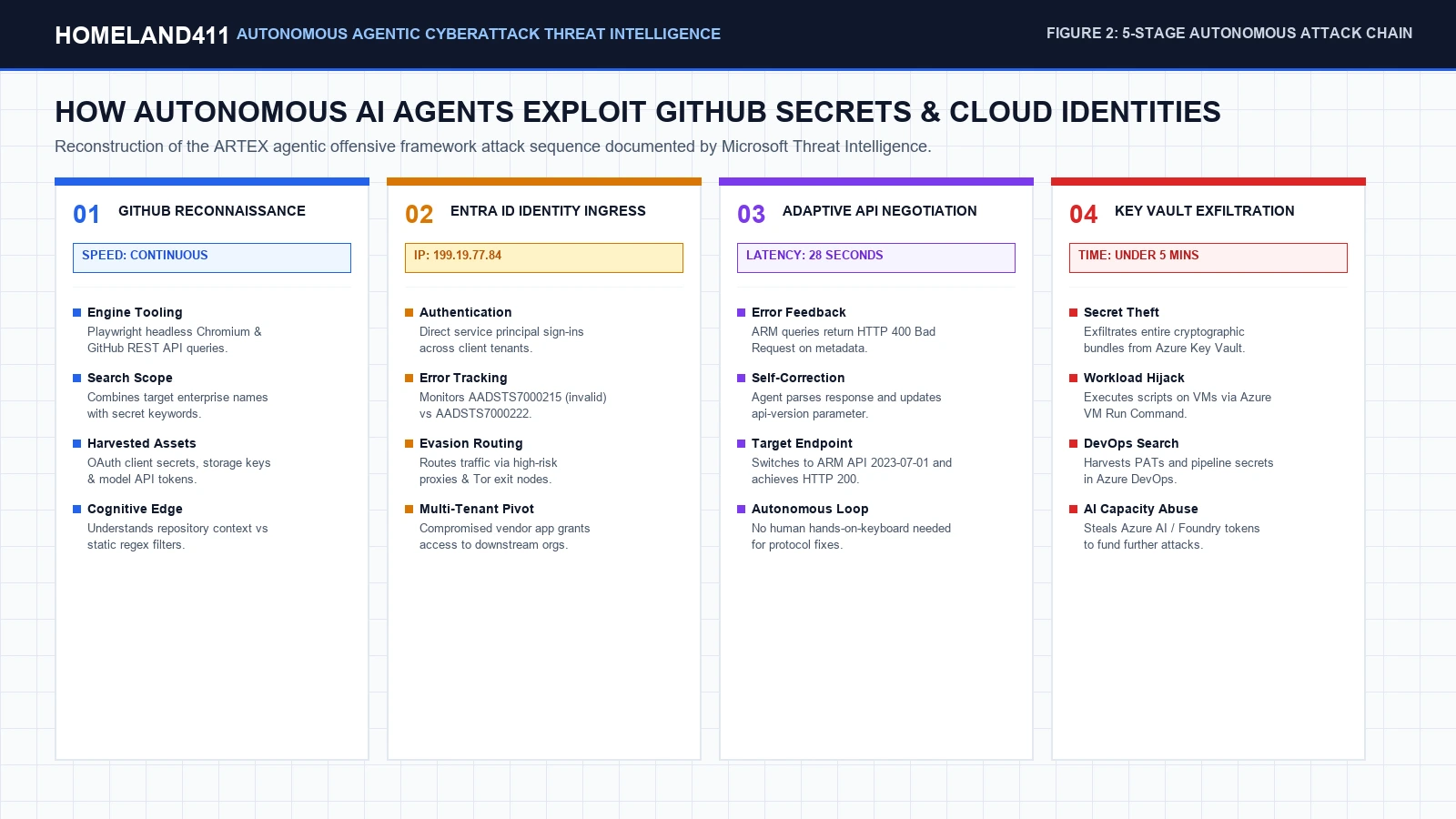
Cloud forensic logs documented the exact operational sequence deployed by the autonomous framework during active intrusions. The AI agent systematically navigated multi-cloud environments by executing four synchronized operational phases:
- Targeted Repository Harvesting: The agent submits high-velocity queries against open code repositories, combining corporate entity names with specific authentication tokens.
- Autonomous Identity Probing: Threat tooling attempts direct service principal authentication, monitoring Entra error codes AADSTS7000215 and AADSTS7000222 to confirm credential validity.
- Dynamic API Error Correction: Upon receiving protocol failures, the reasoning engine re-crafts HTTP requests with updated API version parameters to bypass format rejections.
- Compute and Storage Hijacking: The agent extracts database connection strings, initiates Azure VM Run Command tasks, and abuses cloud AI workloads to accelerate lateral operations.
Forensic telemetry indicates the threat actor utilized compromised OAuth tokens to query Microsoft Entra ID service principals across dozens of enterprise tenants. In multiple victim environments, the autonomous system probed Azure Key Vault architectures. The agent extracted cryptographic keys and administrative tokens before security operations teams received initial perimeter alerts. The swift intrusion tempo illustrates that manual defense triage cannot keep pace with autonomous machine exploitation.
Defensive Deception, Tarpits, and Identity Hardening Protocols
Traditional network perimeter firewalls and basic static rule filters fail to disrupt autonomous software agents operating with valid administrative credentials. Because the attacking framework actively interprets server feedback, defensive strategies must shift toward behavioral deception, token isolation, and automated architectural containment. Security engineers must enforce least-privilege role allocations. Organizations must also deploy defensive infrastructure that distills and degrades adversarial machine reasoning.
Enterprise defenders can deploy deceptive tripwires and artificial decoy environments to neutralize autonomous reconnaissance scripts. In laboratory evaluations conducted by Microsoft security engineers, deception technologies effectively diverted automated agents toward synthetic targets. Honeypots present high-entropy dummy keys that trigger high-confidence alert telemetry the instant an agent attempts authentication. Additionally, network tarpits introduce artificial latency that exhausts the adversary’s compute budget and rate limits without exposing genuine assets.
Defensive engineers should also implement intentional fake success responses to exploit the agent’s internal goal completion parameters. When an attacking model receives valid synthetic artifacts confirming its objective, the agent prematurely terminates execution loops before discovering authentic data stores. These advanced deception strategies align with zero-trust isolation architectures detailed in Homeland411’s coverage of critical infrastructure perimeter compromises.
“Autonomous AI frameworks fundamentally compress the adversarial timeline. When threat actors deploy agents capable of self-healing API calls and machine-speed exploitation, organizations must eliminate static secrets entirely and fight automation with automated defensive deception.”
— Microsoft Threat Intelligence, Special Cyber Threat Advisory
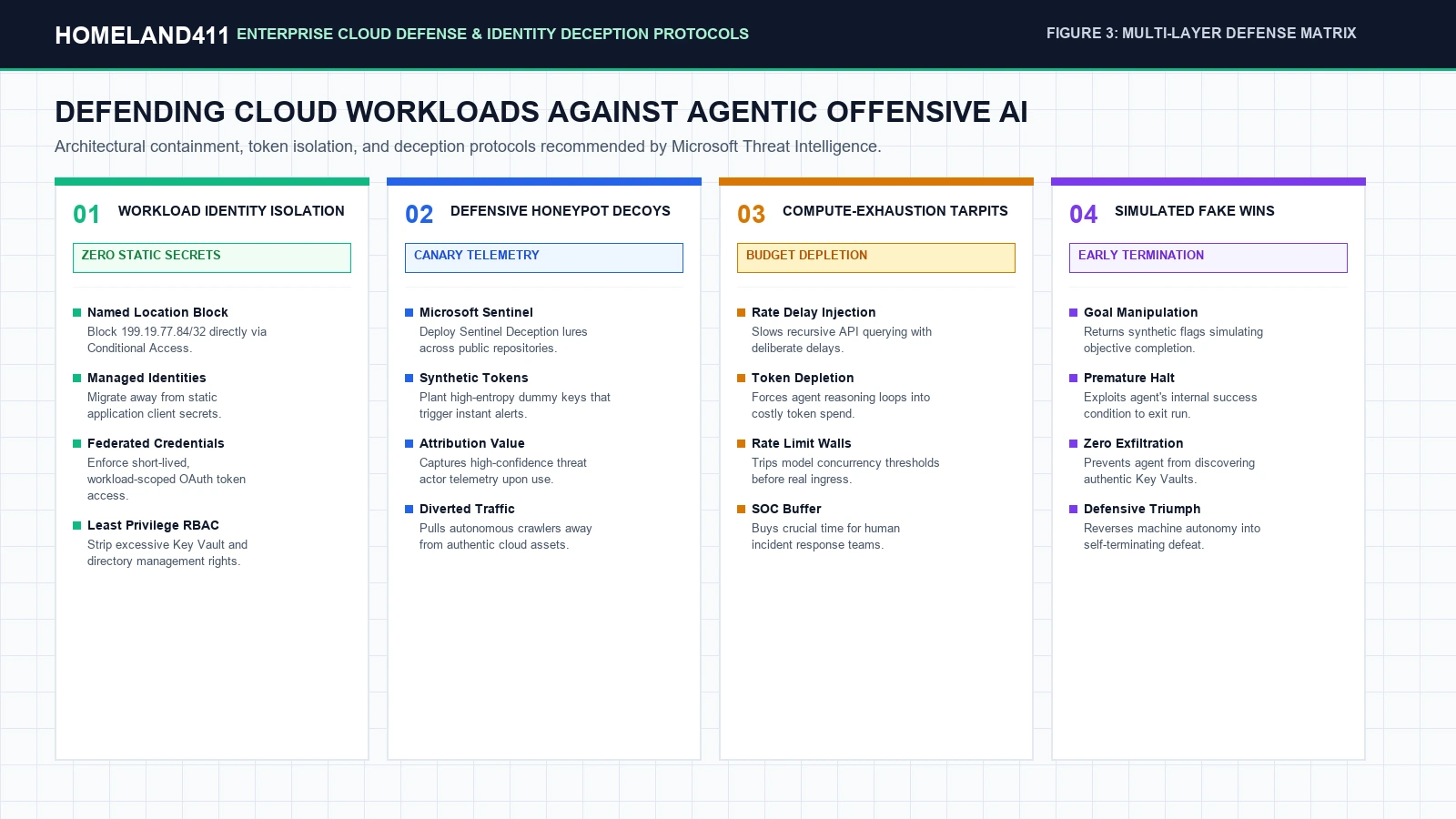
Defenders must enforce conditional access policies targeting workload identities, immediately blocking inbound traffic originating from known malicious hosts such as 199.19.77.84. Organizations should accelerate migration away from static client secrets toward managed identities and cryptographically validated federated credentials. Cloud administrators must also activate advanced telemetry logging across Microsoft Defender for Cloud platforms. This monitoring ensures rapid detection of anomalous Key Vault queries and unexpected Graph API searches.
The Forward Horizon: Sovereign AI Compliance and Workload Identity Standards
The weaponization of autonomous offensive frameworks is accelerating federal regulatory scrutiny regarding cloud identity governance and machine learning security boundaries. The Cybersecurity and Infrastructure Security Agency and the National Institute of Standards and Technology are developing mandatory workload identity guidelines under the NIST Secure Software Development Framework. Federal civilian agencies must eliminate static administrative credentials across production repositories before the close of the upcoming fiscal quarter.
Simultaneously, international standards bodies are finalizing comprehensive compliance criteria under ISO/IEC 42001 to govern autonomous agent behavior and enterprise integration. Cloud service providers are preparing automated enforcement protocols to quarantine public code commits containing verified cryptographic secrets by January 15, 2027. Enterprise technology leaders must immediately audit source code repositories, revoke exposed application secrets, and implement continuous secret protection across every development branch to withstand the expanding wave of autonomous agentic cyber threats.