Global airline reservation intrusions and aviation supply chain breaches have compromised over 500 million traveler records over the past five years. From the 2021 SITA hack to ongoing Amadeus global distribution compromises, unencrypted travel data remains vulnerable. When threat actors infiltrate booking engines, passenger name records and passport details circulate on underground forums. Travelers seeking to check passport leak exposures must audit historical airline breaches systematically. Verifying historical exposure prevents downstream identity theft and unauthorized financial fraud.
Passenger name records serve as the central operational currency for global aviation alliances. A six-character booking locator links passenger legal names, contact numbers, itineraries, and frequent flyer balances. For international flights, reservation engines store Advance Passenger Information System telemetry. These records contain passport numbers, birth dates, and issuance nations. Because global carriers share reservation infrastructure, a single vendor breach compromises travelers across multiple partner airlines.
Never Miss An UpdateFollow us on Google News to get our latest security, defense and cyber reporting in your feed. It’s free and takes one tap.
Follow on Google NewsThe operational liability extends beyond commercial leisure flights into executive and diplomatic travel. As highlighted in recent forensic reporting on South Korea’s presidential flight manifest leak, unencrypted spreadsheets create severe national security risks. Adversaries cross-reference leaked passport metrics with corporate itineraries to orchestrate executive spear-phishing schemes. Learning how to check PNR leak records and activate credit freezes provides indispensable protection for international passengers.
Aviation security analysts at the International Air Transport Association (IATA) stress that reservation defense requires active passenger audits alongside institutional controls:
“Passenger name records were engineered for commercial routing efficiency rather than cryptographic isolation. When reservation locators slip into untrusted environments, travelers face immediate exposure to identity duplication and targeted credential abuse.”
— Aviation Cybersecurity Advisory Board, IATA Security Bulletin (2026)
Comprehensive 5-Year Airline Breach Database: 2021 to 2026 Incidents
Major commercial airline breaches over the past five years compromised hundreds of millions of traveler records. Shared distribution networks exposed passenger identities, passport numbers, and flight histories.
Evaluating personal exposure requires analyzing the specific cyber incidents that affected global carriers from 2021 through 2026. Attack vectors shifted from centralized reservation infrastructure hacks to direct ransomware extortion and mobile session flaws. The following verified chronology details the primary airline intrusions that leaked passenger name records, passport numbers, and loyalty telemetry.
| Airline / IT Target & Year | Incident Type & Threat Actor | Compromised Records & Scope | Exfiltrated Data Attributes & How to Check |
|---|---|---|---|
| Amadeus GDS PSS Breach (2023–2026) | 38-month silent intrusion via stolen administrative API credentials | Multi-carrier impact (Malaysia Airlines, Qantas, JAL, Cathay) | PNR locators, passenger names, flight segments, seating data (Audit Details →) |
| WestJet Airlines (2025) | Third-party system intrusion and credential stuffing attack | 1.2 Million Canadian and international passengers | Legal names, dates of birth, passport numbers, physical addresses |
| Air France & KLM Flying Blue (2023) | Loyalty portal credential stuffing and unauthorized API queries | Undisclosed volume of Flying Blue loyalty members | Passenger names, email addresses, phone numbers, accrued miles balances |
| SAS Scandinavian Airlines (2023) | Anonymous Sudan cyberattack causing app session routing failure | Tens of thousands of active mobile app users | Passenger names, travel itineraries, contact details, partial credit cards |
| AirAsia Group (2022) | Daixin Team ransomware attack and network extortion | 5 Million passengers and complete internal staff records | Passenger booking IDs, legal names, internal employee personnel files |
| TAP Air Portugal (2022) | Ragnar Locker ransomware intrusion and dark web data dump | 1.5 Million international travelers | Names, home addresses, phone numbers, passport numbers, frequent flyer data |
| Air India & SITA PSS Mega-Breach (2021) | Sophisticated multi-airline supply chain attack on SITA servers | 4.5 Million Air India flyers plus Star Alliance partner members | Passport numbers, ticket records, contact details, frequent flyer accounts |
| South Korea Air Force One (2026) | Unencrypted manifest uploaded to commercial malware repository | 168 Presidential delegation passengers | Presidential, Cabinet, and confidential security detail passport credentials |
How to Check PNR Leak and Passport Breach Exposure (Step-by-Step)
To check if your PNR or passport data was leaked, query your airline’s dedicated incident portal using your six-character booking reference, cross-reference your primary email on Have I Been Pwned, and audit loyalty accounts for unauthorized itinerary modifications.
Modern electronic passports feature contactless cryptographic chips compliant with ICAO Document 9303 specifications. Adversaries cannot duplicate physical biometric chips using only a leaked passport number. However, criminals exploit exposed numbers, birth dates, and addresses to bypass identity checks at banks and credit agencies.
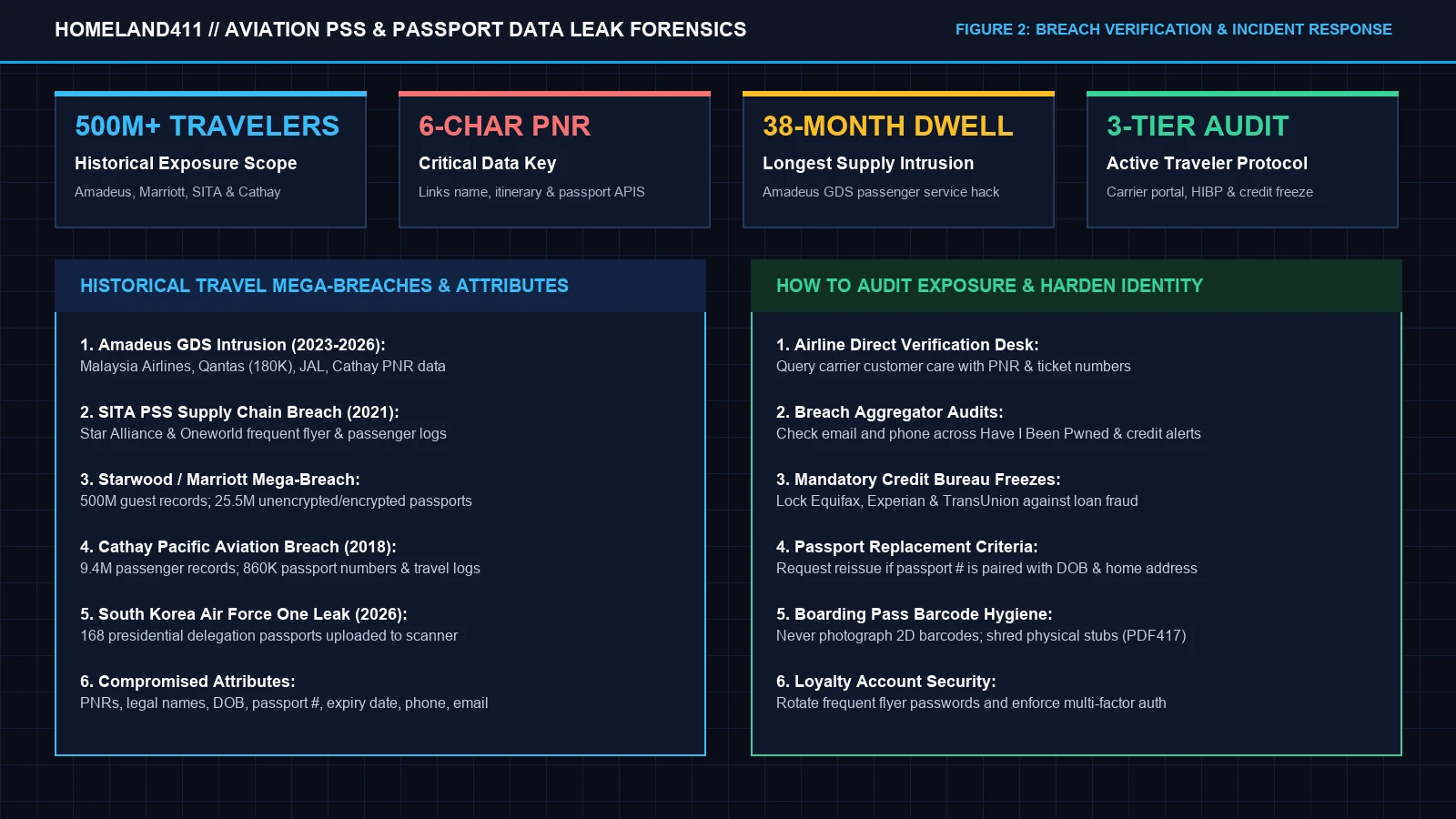
Travelers should execute four concrete verification protocols to check PNR leak exposure and audit passport records across airline and hotel databases:
- Check PNR Leak via Airline Portals: Query dedicated customer resolution portals managed by affected carriers such as Malaysia Airlines, Qantas, and Air India, submitting historical six-character booking locators and e-ticket numbers to confirm exposure status.
- Check Passport Leak via Credential Scanners: Cross-reference primary personal and corporate email addresses across breach aggregation services including Have I Been Pwned to detect secondary account credential leaks linked to commercial travel agencies.
- Audit Frequent Flyer Security Settings: Log directly into airline loyalty dashboards to audit recent mileage redemptions, verify registered contact numbers, and confirm that multi-factor authentication remains active across all linked profiles.
- Inspect Boarding Pass Barcodes: Inspect physical boarding passes and digital wallet boarding cards, ensuring two-dimensional PDF417 or Aztec barcodes are never shared on social media platforms where automated scrapers decode embedded PNR data.
What to Do If Your Passport or PNR Was Leaked: Immediate Identity Defense
When an airline confirms passport exposure, travelers must decide whether document replacement is necessary. Government agencies do not mandate immediate passport renewal for basic number leaks alone. However, travelers facing high-profile exposures should apply for replacement documents to obtain fresh numerical identifiers.
Implementing nationwide credit freezes provides the most reliable defense against financial fraud. Freezing credit files across Equifax, Experian, and TransUnion prevents criminals from opening fraudulent loan accounts using leaked passport details. Active fraud alerts force lenders to verify identities through direct phone calls before approving new accounts. Similar identity safeguards were detailed during recent investigations into biometric and personal data compromises.
“A leaked passport number paired with a date of birth provides sufficient biographic telemetry to pass automated credit screening checks. Freezing credit files across national reporting bureaus eliminates ninety percent of downstream identity exploitation risks.”
— Consumer Financial Protection Analyst, Homeland411 Cyber Policy Desk
Travel security also requires disciplined physical documentation habits. Passengers often abandon paper boarding passes in airport terminals, unaware that barcodes encode reservation locators and loyalty identifiers. Corporate travel departments must enforce shredding policies for paper boarding stubs and prohibit employees from sharing ticket photos on social platforms.
Aviation regulators, including the European Union Aviation Safety Agency, plan to finalize revised passenger data mandates by December 15, 2026. The new rules will require booking systems to use cryptographic tokenization across passenger records, restricting raw passport numbers to secure border networks. Travelers who check passport leak records and discover unauthorized account activity should submit carrier verification requests and establish credit bureau locks before holiday travel begins in late November.