
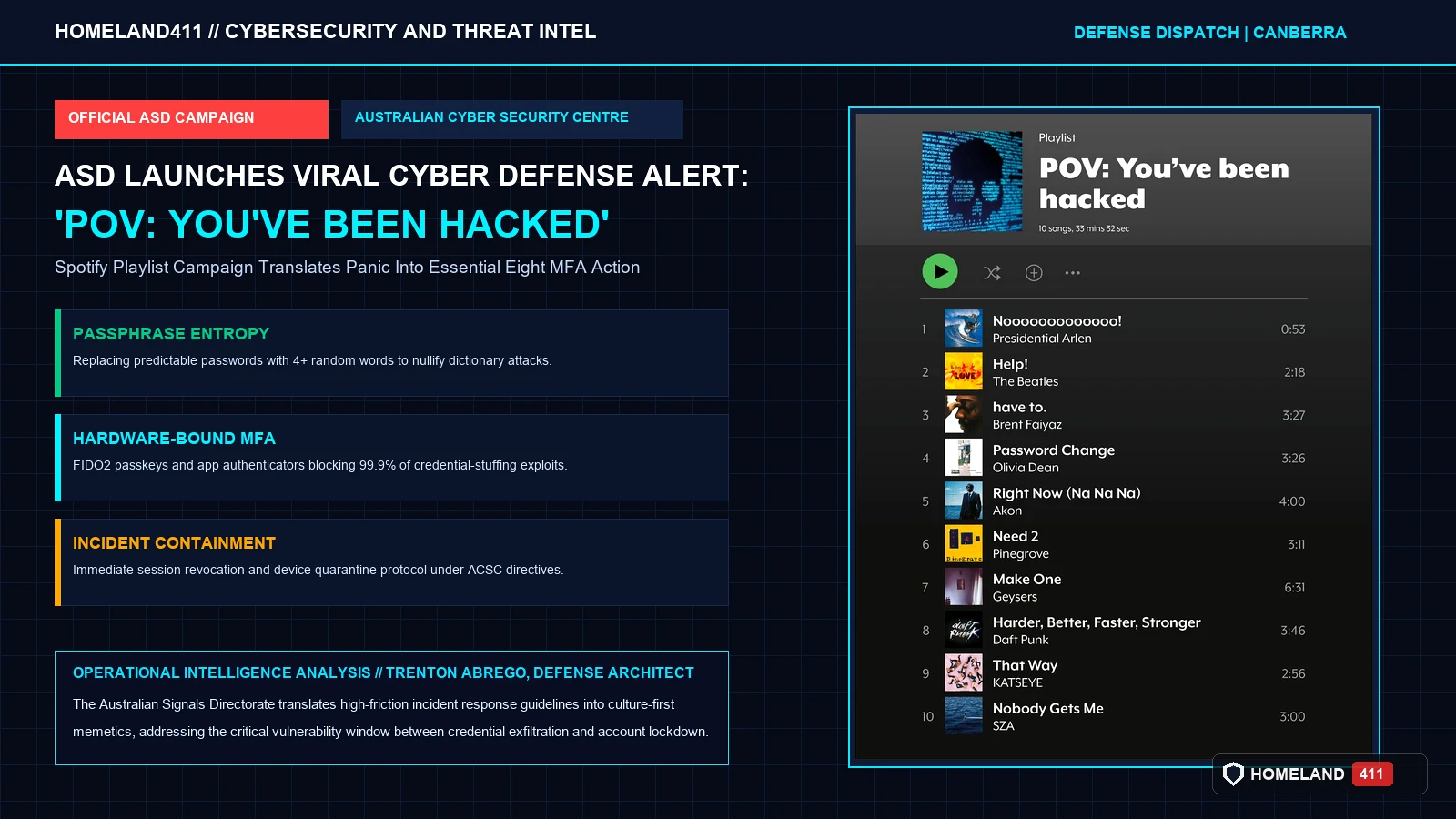
The Australian Signals Directorate deployed an unconventional cyber warning over the weekend, utilizing a mock Spotify playlist titled “POV: You’ve Been Hacked” to curb epidemic credential theft across national networks. Dispatched through the Australian Cyber Security Centre, the intelligence agency sequenced pop-culture track titles to capture the frantic escalation of an account breach. Federal telemetry records an unauthorized cyber intrusion targeting Australian systems every six minutes. Stolen credentials now serve as the primary initial access vector across government and enterprise perimeters.
The viral alert targets the critical window between credential exfiltration and account lockdown. Human hesitation often allows adversaries to execute lateral movement and establish persistence. Rather than publishing a dry technical bulletin, the agency curated ten song titles into an acrostic narrative illustrating the sudden shock of discovering an intruder. System architects paired the streaming graphic with explicit technical guidance on passphrase entropy and hardware-backed multi-factor authentication. Defense and technology communities rapidly circulated the dispatch as administrators recognized the familiar panic of identity compromise.
Never Miss An UpdateFollow us on Google News to get our latest security, defense and cyber reporting in your feed. It’s free and takes one tap.
Follow on Google NewsIntelligence officials emphasized that consumer credential hygiene directly impacts sovereign defense resilience. Workforce personnel routinely reuse corporate credentials across personal digital platforms. Foreign espionage operatives harvest those leaked combinations from underground forums to bypass perimeter firewalls. Following aviation supply-chain intrusions documented in Homeland411’s investigation into the Qantas Amadeus booking system intrusion, investigators tracked automated credential-stuffing botnets probing regional infrastructure. Australian authorities now treat workforce identity discipline as an indispensable layer of national collective defense.
Pop Culture Memetics Meet Signals Intelligence Tradecraft
The Australian Signals Directorate constructed the viral campaign by selecting ten tracks whose titles assemble a coherent sentence when read sequentially down the mock interface. Opening with “Noooooooooooo!” by Presidential Arlen and “Help!” by The Beatles, the list progresses through Brent Faiyaz’s “have to.” and Olivia Dean’s “Password Change.” It continues through Akon’s “Right Now (Na Na Na),” Pinegrove’s “Need 2,” Geysers’ “Make One,” Daft Punk’s “Harder, Better, Faster, Stronger,” KATSEYE’s “That Way,” and concludes with SZA’s “Nobody Gets Me.” Read aloud, the playlist recites: “No! Help! Have to password change right now. Need to make one harder, better, faster, stronger that way nobody gets me.”
The structured humor captures the exact operational stages that incident response teams observe during account takeovers. Victims experience disbelief and panic before acknowledging the compulsory requirement for immediate credential reset. By framing security hygiene through familiar audio culture, the agency routes critical concepts past the cognitive fatigue that weakens traditional corporate training modules. Public response metrics showed rapid dissemination across corporate Slack channels and operational security networks within hours of publication.
Allied defense agencies including the United States Cybersecurity and Infrastructure Security Agency and Britain’s Government Communications Headquarters have similarly embraced digital engagement to communicate operational risk. Intelligence leaders recognize that conventional PDF advisories rarely reach frontline computer users. Frontline workers operate as the initial defense perimeter against access brokers. By translating defensive engineering into viral digital artifacts, intelligence agencies bridge the communication gap separating cryptographic theory from daily operational habits.
Essential Eight Architecture and Multi-Factor Authentication
Behind the engaging pop-culture presentation sits Australia’s authoritative operational defense standard: the Essential Eight cyber security mitigation strategies developed by the Australian Cyber Security Centre. The framework designates multi-factor authentication as a baseline mandatory control alongside application whitelisting and automated operating system patching. Threat actors armed with commodity infostealers harvest plaintext strings from web browsers. Single-factor password authentication is now obsolete across contemporary attack surfaces.
The directorate instructs system administrators and end users to replace legacy short passwords with long, unpredictable passphrases. A four-word passphrase compiled from randomly selected dictionary terms generates exponential mathematical entropy. This structure creates formidable computational barriers for brute-force cracking rigs. Security engineers mandate phishing-resistant authentication protocols, directing organizations toward FIDO2 hardware tokens and time-based authenticator applications while phasing out interceptable SMS text codes. Aligning with federal guidelines published in CISA multi-factor authentication standards, cryptographic keys permanently neutralize stolen credentials.
Automated credential stuffing exploits depend heavily on predictable human behavior, particularly password reuse across corporate and personal accounts. Threat actors deploy distributed proxy networks to bombard single sign-on gateways with millions of stolen credentials harvested from third-party spills. When gateways mandate hardware-backed authentication, the adversary’s attack chain collapses immediately. The playlist campaign highlights that robust authentication layers prevent single-point identity compromises from developing into enterprise-wide ransomware deployments.
Credential Stuffing Pressures Across Australian Commercial Networks
The timing of the directorate’s public intervention reflects acute structural vulnerabilities logged in the ACSC Annual Cyber Threat Report. Australian corporate networks reported tens of thousands of cyber incidents over the preceding financial year. Extortion groups and state-sponsored espionage actors routinely exploit identity brokers for network ingress. Commercial entities processing sensitive personal data face relentless credential stuffing, mirroring the exposure dynamics evaluated in Homeland411’s advisory on how to check passport and PNR data leaks across international transportation hubs.
Critical infrastructure sectors across Australia remain under continuous surveillance from foreign threat actors seeking persistent footholds. Cyber espionage groups allocate significant resources toward harvesting legitimate employee session cookies and administrative tokens. When workforce members fail to secure remote portals with phishing-resistant authentication, adversaries bypass external perimeter firewalls without triggering automated security alarms. ASD cyber defense operators emphasize that individual identity hygiene serves as the critical firebreak protecting interconnected federal and commercial supply chains.
Corporate identity breaches inflict severe financial and reputational damage across regional supply chains, forcing emergency forensic containment and extensive regulatory reporting. The Australian government recently tightened statutory reporting obligations for critical infrastructure operators, requiring mandatory incident notification within twelve hours of significant compromise. Maintaining rigorous authentication architectures drastically reduces the attack surface available to opportunistic cybercriminals, enabling internal defense teams to concentrate monitoring resources on sophisticated advanced persistent threats.
Immediate Incident Containment and Identity Hardening Protocols
When system administrators or individual account holders detect unauthorized activity, the Australian Cyber Security Centre recommends executing immediate tactical containment measures. The following technical sequence isolates active adversaries and establishes secure authentication baselines:
- Force Global Session Termination: Immediately execute a centralized administrative sign-out across all connected browsers, mobile devices, and active cloud instances to invalidate stolen session tokens and hijacked session cookies.
- Deploy High-Entropy Four-Word Passphrases: Discard predictable alphanumeric substitutions in favor of four or more randomly chosen dictionary words, expanding character length to resist distributed dictionary cracking.
- Bind Phishing-Resistant Hardware MFA: Enforce FIDO2 security keys, WebAuthn passkeys, or mobile authenticator apps, completely disabling legacy SMS text verification that remains vulnerable to SIM-swap interception.
- Audit Mailbox Rules and OAuth Authorizations: Inspect cloud email account settings for hidden automated forwarding rules and revoke all third-party application permissions established during the intrusion window.
- Quarantine Compromised Endpoints: Disconnect impacted computing hardware from local enterprise networks, initiating thorough endpoint detection and malware sweeps to eradicate hidden keyloggers or remote access trojans.
The Australian Signals Directorate continues to monitor adversary tradecraft targeting domestic cloud environments and critical infrastructure operations. As generative machine learning models streamline synthetic phishing generation and automate credential validation at scale, defensive agencies must innovate communication strategies. By transforming technical operational directives into viral cultural assets, defense authorities establish durable behavioral guardrails that protect sovereign networks from digital compromise.