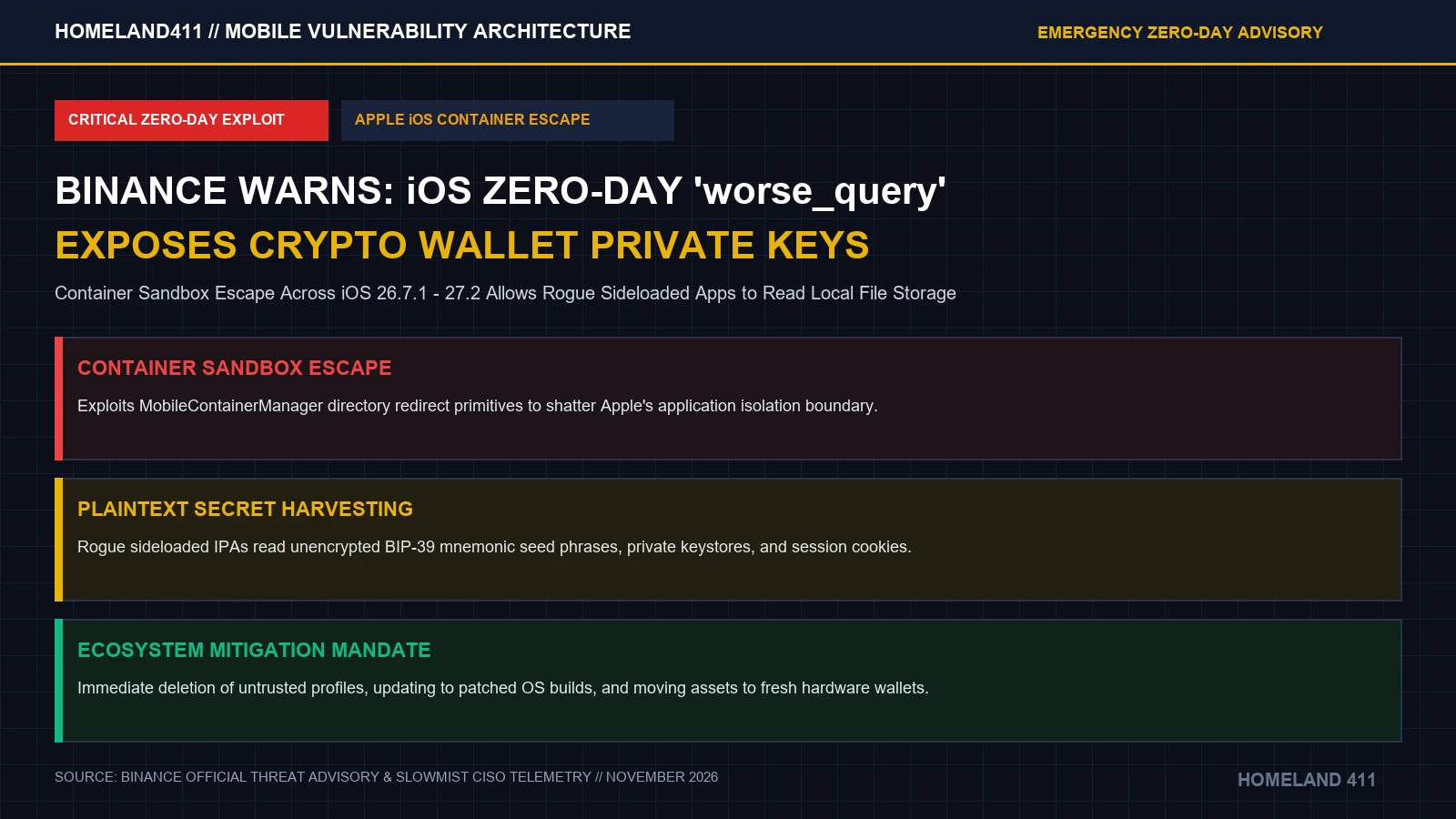
Digital asset exchange Binance issued an emergency cybersecurity alert Tuesday morning, warning of an unpatched zero-day flaw in Apple iOS software. The flaw allows rogue applications to read local files from adjacent apps, putting private keys and credentials at risk. Tracked across research forums as worse_query, the vulnerability breaches container boundaries in iOS 26.7.1, 27.0.1, and 27.2. Attackers weaponizing this exploit bypass mobile operating system isolation without requiring elevated kernel privileges. Core mobile defenses broke down. The exposure threatens digital asset custodians worldwide.
Binance security engineers confirmed that the underlying flaw represents an operating system architectural failure rather than a vulnerability inside exchange mobile clients. When executed on an unpatched Apple device, rogue applications manipulate internal directory tokens to traverse protected system directories and inspect adjacent software containers. Security teams monitoring digital asset ecosystems observe that threat groups actively circulate weaponized packages disguised as mobile games, developer utilities, and cracked commercial applications. These attacks mirror evasion vectors documented in Homeland411’s ongoing investigation of state-sponsored cryptocurrency malware campaigns targeting engineering endpoints. Once an adversary deploys an untrusted application bundle onto an endpoint, default operating system barriers no longer protect stored credentials. Trust boundaries dissolve rapidly.
Never Miss An UpdateFollow us on Google News to get our latest security, defense and cyber reporting in your feed. It’s free and takes one tap.
Follow on Google NewsThe public advisory triggered immediate alarm across decentralized finance ecosystems because mobile wallet security depends entirely on process sandboxing. Under Apple standard security architecture, third-party software operates inside designated sandboxes governed by Apple App Sandboxing container controls. This boundary prevents unprivileged code from accessing external data stores or intercepting inter-process communication channels. However, the worse_query exploit invalidates runtime security boundaries by manipulating internal container registration services. Attackers successfully cross administrative application perimeters without triggering system alerts. Millions of unencrypted mobile wallets face immediate compromise.
Container Sandbox Escape Architecture and MobileContainerManager Exploits
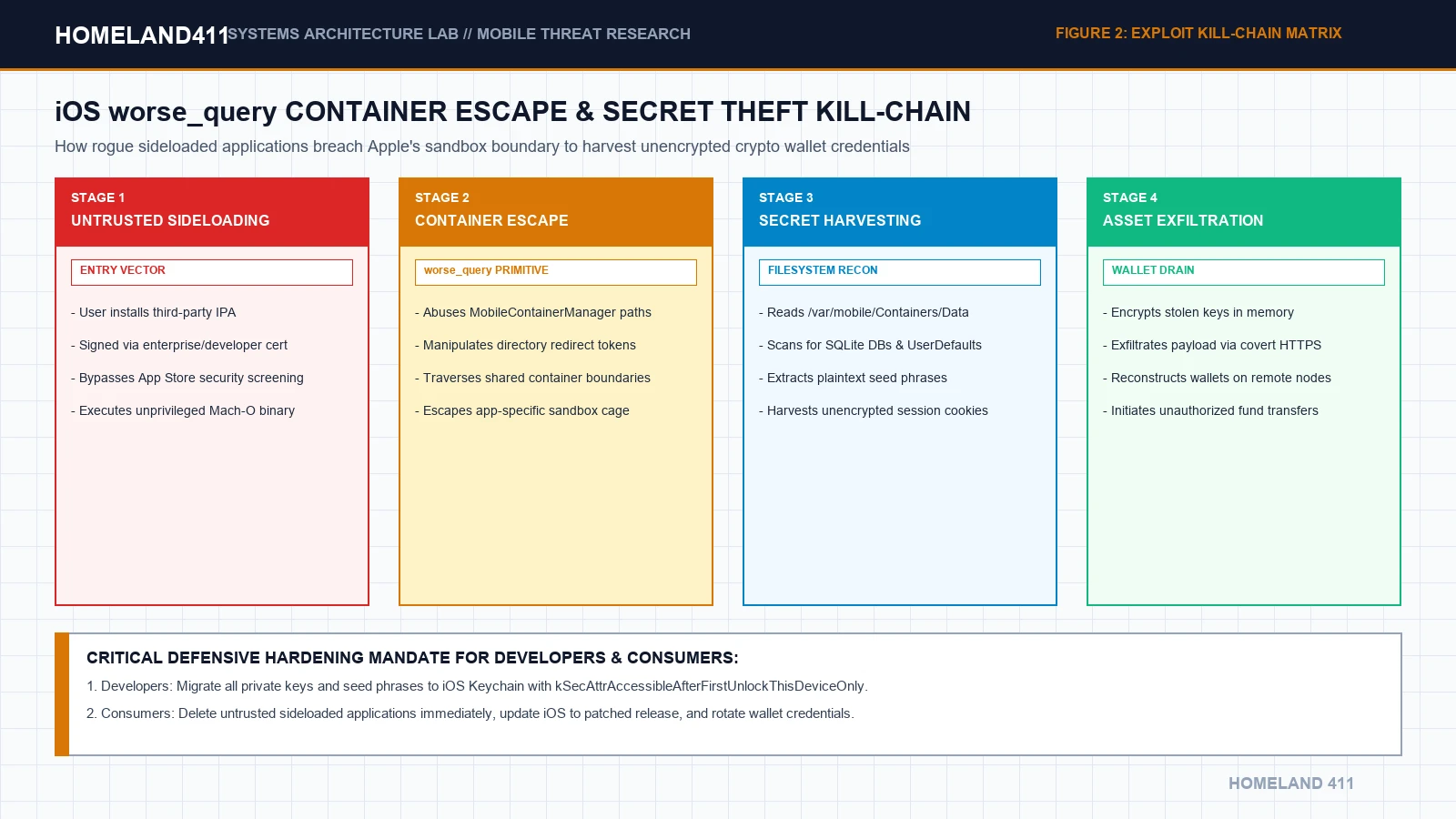
Decompilation of the worse_query proof-of-concept demonstrates that the exploit manipulates directory path resolution inside the Apple MobileContainerManager daemon. The flaw represents an advanced successor to an earlier container probe known as bad_query. Developed by independent security researcher Taj C, operating under the alias forcequitOS alongside researcher 0xjohnny, the exploit targets core container management APIs. In technical documentation published within the worse_query open-source GitHub repository, researchers confirmed that unprivileged processes can systematically escape assigned sandboxed storage trees. The exploit achieves this breakout without executing low-level kernel shellcode or altering protected system memory structures. Sandbox isolation fails completely.
The vulnerability capitalizes on improper validation of shared container tokens and directory redirects within standard user-space environments. When an attacker crafts a malicious application package and signs it using an enterprise certificate, developer profile, or sideloading utility, the application requests access to common group caches. By generating symbolic links across the local filesystem, the application tricks system container management services into mapping external directories directly into its readable namespace. As a result, the malicious process reads file descriptors belonging to unrelated third-party applications residing in /var/mobile/Containers/Data/Application/. Attackers inspect private application data at will.
| Exploit Execution Phase | Target Operating System Component | Technical Failure Mechanism | Asset Impact Severity |
|---|---|---|---|
| Package Installation | Enterprise Provisioning Profile | Bypasses App Store automated binary verification and static analysis controls | Unverified local code execution on consumer endpoints |
| Namespace Breakout | MobileContainerManager Daemon |
Directory redirect manipulation via group container tokens and crafted symlinks | High: Full container boundary escape (NIST SP 800-163 →) |
| Filesystem Traversal | App Container Data Tree | Direct read access to unencrypted SQLite databases, WebViews, and preferences plists | Critical: Plaintext seed phrase and private key exposure |
| Exfiltration Channel | User-Space Network Socket | Asynchronous encrypted HTTPS transmission of stolen session credentials to adversary C2 | High: Unauthorized account takeover and immediate wallet drainage |
System defenders emphasize that while worse_query does not grant traditional root access or disable kernel code-signing enforcement, its practical consequence for cryptocurrency custody is severe. Many mobile wallets store unencrypted transaction logs, temporary session tokens, or cached cryptographic keys within local application folders instead of delegating all sensitive operations to hardware security chips. When unprivileged software gains arbitrary read permissions across the local flash storage array, software-level encryption routines frequently fail to safeguard critical operational data. Secrets leak immediately.
Threat Telemetry, Plaintext Wallet Storage, and Ecosystem Risk
Threat intelligence alerts released by blockchain security specialists corroborate the severity of the Binance bulletin. In an urgent technical advisory published Tuesday, SlowMist Chief Information Security Officer 23pds clarified the boundaries of the attack. While worse_query cannot execute automated remote code execution across network perimeters, it introduces severe exposure for users who install sideloaded packages. Analytical briefings hosted on the SlowMist security telemetry portal emphasize that decentralized wallet applications frequently cache unencrypted BIP-39 mnemonic seed phrases, recovery keystores, and embedded browser session cookies within easily accessible local paths. Threat actors exploit these design shortcuts aggressively.
Underground cybercrime syndicates have developed specialized utilities utilizing the worse_query exploit primitive to automate device profiling and credential scraping. Tools such as WQFiles and customized configuration managers allow users to navigate protected application directories without requiring a full system jailbreak. When threat actors embed these primitives into illicit software distributors or modified gaming applications, the software silently scans local directories for wallet configurations upon startup. Stolen private keys are then formatted into encrypted payloads and transmitted to remote command-and-control servers, enabling automated fund exfiltration within minutes. The risks reflect systemic credential exposure patterns explored in Homeland411’s coverage of cryptographic session token protection across modern mobile and cloud ecosystems. Data exfiltration proceeds undetected.
“A vulnerability (worse_query) affecting iOS 26.7.1, 27.0.1, and 27.2 allows malicious apps to read local files from other apps, putting seed phrases, private keys, and login credentials at risk across the entire ecosystem. This is an iOS-level issue, not unique to Binance.”
— Binance Security Team, Official Ecosystem Security Advisory
The exposure highlights an enduring structural challenge within mobile software engineering, where developers prioritize application execution performance over rigorous hardware-enforced secret isolation. Cryptographic wallet providers that fail to bind private keys to the hardware Secure Enclave leave their user bases completely reliant on operating system sandbox integrity. Once an attacker discovers a container breakout, software-level encryption barriers collapse immediately, exposing assets to direct financial theft. The perimeter fails entirely.
Enterprise Mitigation Protocols and Hardware-Backed Enclave Defenses
To neutralize active compromise vectors, Binance and independent cybersecurity specialists published a series of mandatory defensive protocols for mobile digital asset custodians. Users operating unpatched versions of iOS must purge untrusted software components from their devices immediately. Security teams must ensure no lingering configuration profiles maintain persistent access to local storage.
- Purge Sideloaded Application Profiles: Remove all software installed outside the official App Store, including enterprise developer profiles and manually provisioned IPA binaries.
- Deploy Operating System Updates: Upgrade mobile devices immediately to patched firmware releases documented in official Apple Security Releases and Rapid Security Response bulletins.
- Execute Emergency Fund Migration: Transfer all digital assets from suspect mobile devices to newly generated cryptographic addresses initialized on physically secure hardware devices.
Software developers building cryptocurrency infrastructure must fundamentally overhaul local data storage architectures to withstand future container sandbox escapes. Engineering teams must store all seed phrases, private keys, and session authentication secrets inside the hardware-backed iOS Keychain. Applications must implement the kSecAttrAccessibleAfterFirstUnlockThisDeviceOnly protection class governed by Apple Keychain Services security standards. By forcing all cryptographic signing routines into the Secure Enclave, wallet applications ensure that private keys remain mathematically inaccessible to external processes even if an adversary achieves full filesystem read access. Urgent architectural containment mirrors remediation timelines examined in Homeland411’s reporting on zero-day memory safety remediation timelines across critical software components. Hardware isolation represents the only permanent defense against runtime container escapes.
Neither Apple nor federal cybersecurity authorities have published a dedicated Common Vulnerabilities and Exposures tracking identifier for the worse_query container escape chain as of November 2026. This administrative omission leaves mobile asset custodians dependent on rapid firmware deployment schedules and rigorous local application auditing to safeguard institutional funds.