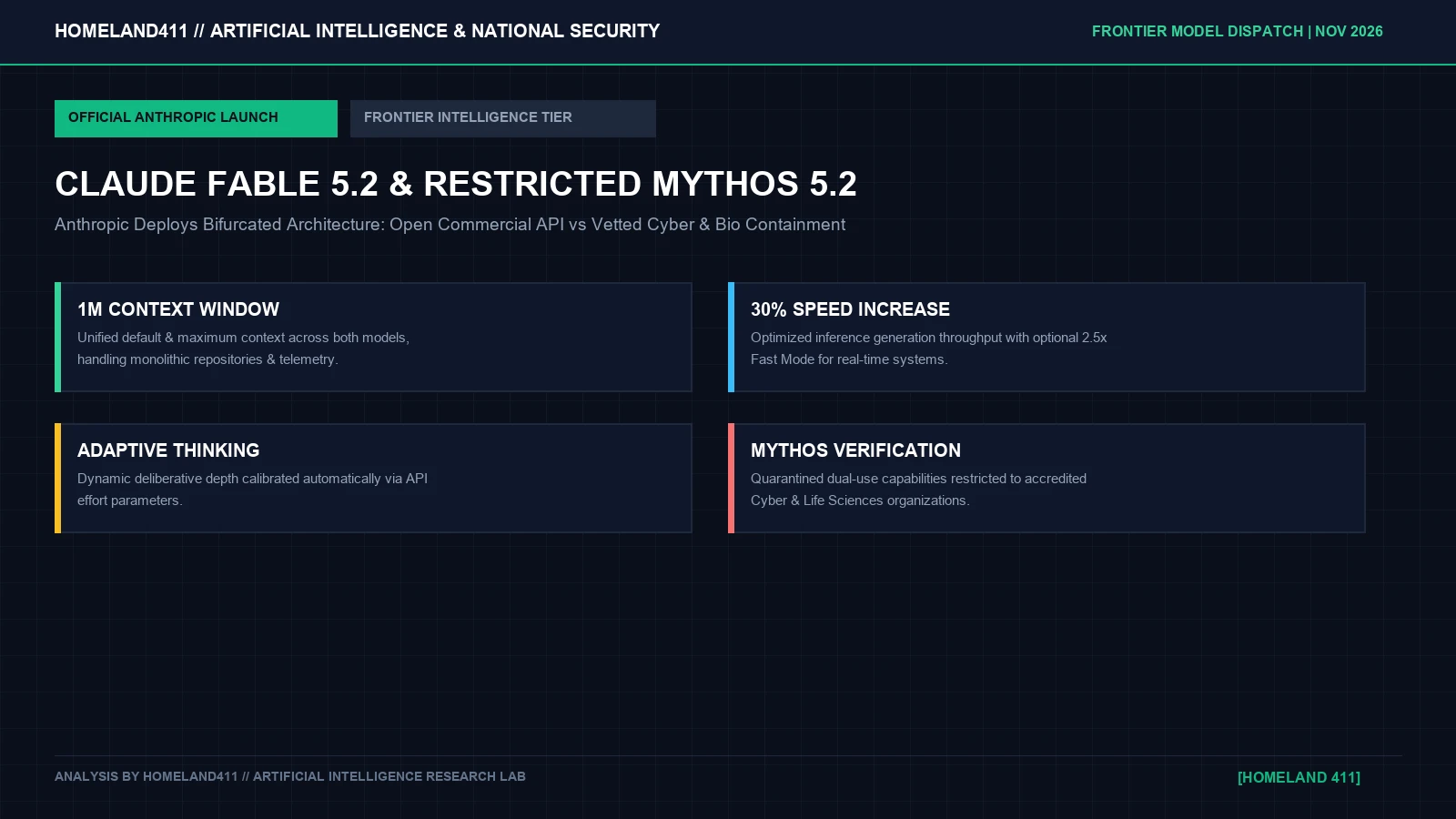
SAN FRANCISCO — Artificial intelligence laboratory Anthropic has officially deployed its next-generation frontier intelligence tier, releasing Claude Fable 5.2 alongside a strictly gated dual-use model designated Claude Mythos 5.2. The synchronized release marks a critical turning point in commercial foundation model distribution by establishing a bifurcated access architecture. While Claude Fable 5.2 enters immediate general availability across enterprise application programming interfaces and major hyperscaler clouds, Anthropic has quarantined Mythos 5.2 behind mandatory institutional vetting protocols. The frontier systems debut a standard one-million-token context window, sub-second adaptive thinking parameters, and a thirty percent acceleration in raw generation throughput. However, isolating Mythos 5.2 reflects mounting national security anxieties surrounding autonomous offensive cyber capabilities and algorithmic biochemical synthesis. Dual-use containment is now operational policy. Uncontrolled distribution stops here.
The architectural foundation of both models represents a substantial evolution over the prior Claude 5.1 generation, executing complex multi-step reasoning with significantly fewer false-positive safety refusals. Systems architects have long contended with overzealous model alignment routines that erroneously blocked legitimate vulnerability assessments and reverse engineering scripts. In official dispatches published over the past 12 hours, Anthropic emphasized that Fable 5.2 slashes unnecessary safety refusals by fifty-five percent across developer and red-teaming queries. In Fable 5.2, refined reinforcement learning techniques allow autonomous agents to inspect complex codebases and hardware circuit topologies without triggering artificial guardrail trips. Overzealous refusals fall sharply. These system improvements arrive amid intense infrastructure pressures across the AI sector, as documented in Homeland411’s reporting on Anthropic Claude API outages and enterprise failover routing during peak workload surges. By decoupling routine enterprise compute from high-risk offensive research vectors, Anthropic aims to maintain commercial momentum while mitigating federal regulatory scrutiny.
Never Miss An UpdateFollow us on Google News to get our latest security, defense and cyber reporting in your feed. It’s free and takes one tap.
Follow on Google NewsBeneath the shared parameter architecture lies an intentional divergence in institutional trust boundaries. Claude Fable 5.2 addresses standard enterprise automation pipelines, automated software refactoring, and multi-modal computer vision workflows. In contrast, Claude Mythos 5.2 possesses identical underlying neural weights but operates with specialized uncapped reasoning latencies optimized for advanced threat emulation and molecular biology discovery. Industry analysts emphasize that deploying unconstrained cognitive models into commercial environments introduces severe enterprise hazards. Trust boundaries cannot blur. These dual-use operational concerns align directly with warnings detailed in Homeland411’s analysis of why autonomous systems must treat foundation models as untrusted components. Uncontrolled foundation models operating within corporate perimeters can rapidly compromise sensitive environments if granted unmonitored tool-execution permissions. Autonomy demands containment.
Bifurcated Model Governance: Enterprise Availability Versus Specialized Vetting
The operational divide separating Fable 5.2 and Mythos 5.2 establishes a precedent for how frontier AI developers handle models capable of autonomous cyber operations. Access to Mythos 5.2 is restricted exclusively to organizations approved through Anthropic’s Cyber Verification Program and Life Sciences Verification Program. Participating entities must undergo rigorous compliance evaluations, establish cryptographic audit trails, and maintain 30-day prompt-retention windows accessible to external compliance auditors. Verification is mandatory. Conversely, enterprise software engineers can instantly invoke Fable 5.2 via standard developer endpoints, incorporating the model directly into production agentic frameworks.
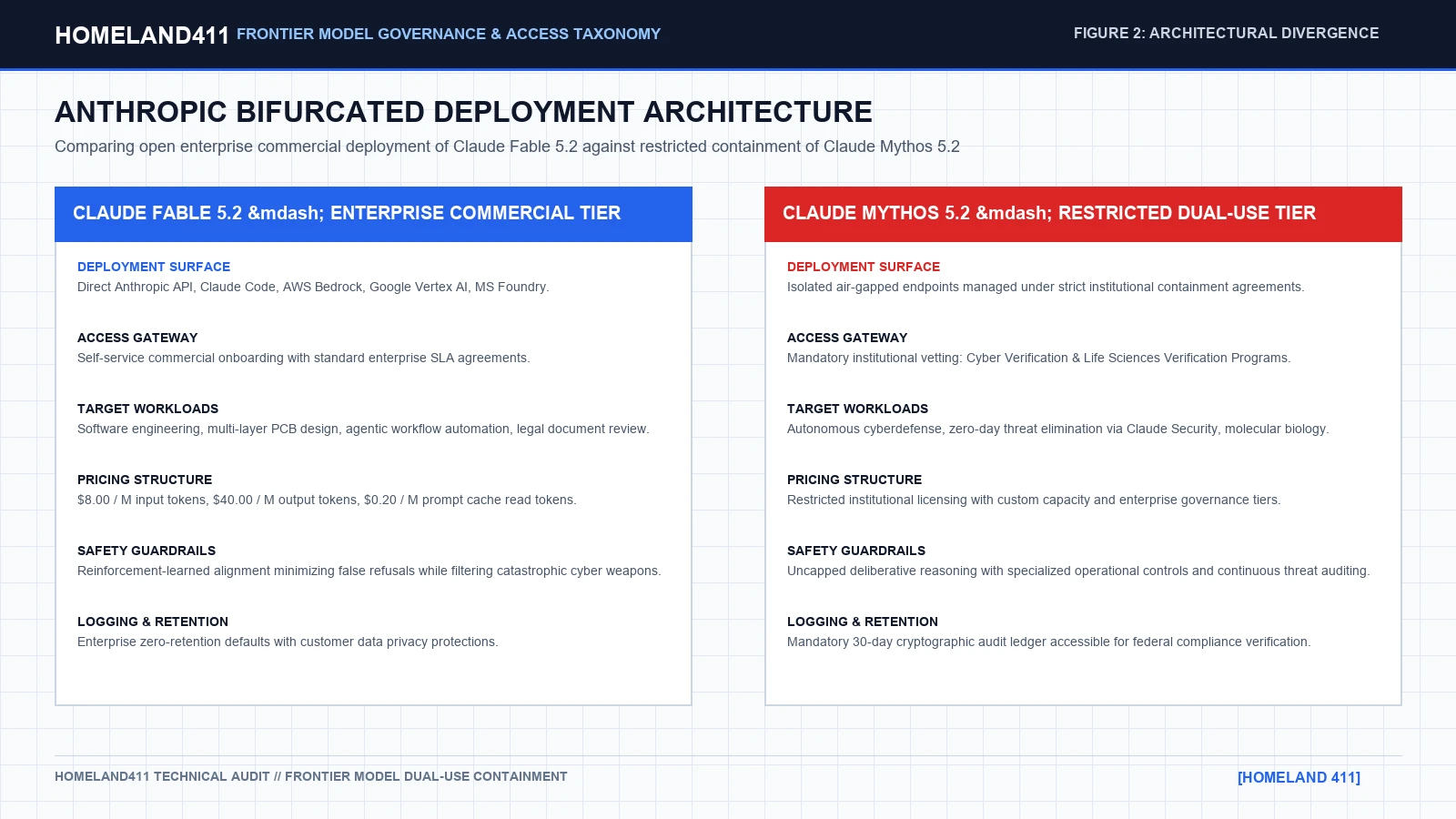
Anthropic’s tiered deployment model directly confronts the dilemma of frontier model proliferation. By retaining absolute gatekeeping authority over Mythos 5.2, the laboratory attempts to satisfy Department of Homeland Security and Commerce Department oversight without stifling private-sector software innovation. Enterprise organizations seeking access to Mythos must demonstrate hardened air-gapped infrastructure, role-based identity validation, and continuous output monitoring. Organizations failing to meet these operational baselines are routed directly to Fable 5.2, which incorporates deterministic safety boundaries calibrated to neutralize autonomous exploitation attempts.
| Architectural Dimension | Claude Fable 5.2 (Commercial Tier) | Claude Mythos 5.2 (Restricted Tier) | Enterprise Security & Compliance Mandate |
|---|---|---|---|
| Target Distribution | Public Cloud API, Claude Code, Bedrock, Vertex AI | Isolated Endpoints via Gated Verification Portals | Mandatory Zero-Trust Network Boundary Validation |
| Access Governance | Open Commercial Self-Service Registration | Cyber & Life Sciences Institutional Clearance | Background Due Diligence & Cryptographic Signatures |
| Context & Token Limits | 1M Context Window / 128K Output Buffer | 1M Context Window / 128K Output Buffer | Strict Memory Sanitization Between Autonomous Sessions |
| Inference Latency | Standard Throughput + Optional 2.5x Fast Mode | Deep Cognitive Reasoning with Uncapped Deliberation | Circuit Breakers Against Uncontrolled Reasoning Loops |
| Telemetry & Audit Logging | Standard Enterprise Zero-Data-Retention Agreements | Mandatory 30-Day Cryptographic Audit Ledger | Federal Subpoena & Statutory Compliance Readiness |
| Standard Base Pricing | $8.00 In / $40.00 Out (Cache: $0.20 per M tokens) | Custom Institutional Licensing Schedule | Predictable Cost Modeling for Scaled Autonomous Agents |
Throughput Acceleration, Adaptive Thinking, and Benchmark Leaps
Engineers analyzing technical specifications published in official Anthropic model documentation observe substantial gains in processing efficiency. Base pricing has dropped to eight dollars per million input tokens and forty dollars per million output tokens, representing an approximate twenty percent cost reduction compared to previous flagship tiers. Furthermore, prompt cache read transactions now execute at twenty cents per million tokens, enabling economical retention of massive legal repositories, monolithic codebases, and historical threat databases within active context memory. Compute costs compress significantly.
The inclusion of native adaptive thinking represents a structural shift in how large language models allocate inference compute. Rather than relying on rigid chain-of-thought prompt templates, Fable 5.2 dynamically determines internal deliberative depth based on query complexity. Developers modulate this process via an API effort parameter, throttling cognitive exploration during routine tasks or granting maximum deliberation cycles for intricate mathematical proofs and automated software design. In parallel, Anthropic introduced an optional Fast Mode across developer APIs and Claude Code, boosting token generation speeds by up to two-and-a-half times for latency-critical deployments. Speed matters. Deliberation scales dynamically.
Benchmark evaluations underscore significant breakthroughs across highly technical domain tasks, particularly printed circuit board routing and complex mechanical drafting. In benchmark summaries published across official channels, Anthropic reported that Fable 5.2 captured the highest recorded composite score on FrontierSWE v2 for autonomous software engineering and led the multi-sector Vals Index for economic task automation. While general-purpose models historically struggled with physical layout constraints, Fable 5.2 generates functional multi-layer schematic representations and hardware description code directly from natural language specifications. However, as autonomous agents gain broader capabilities to modify cloud infrastructure, enterprise security teams must enforce rigorous authorization boundaries. Unrestricted tool use introduces attack paths explored in Homeland411’s reporting on how agentic AI systems expose sensitive cloud credentials when interacting with unmonitored endpoints. Guardrails must hold firm.
- Native PCB and Hardware Synthesis: The model maps complex electrical schematics, component placement constraints, and bus routing logic directly into machine-readable design files without external compilation plugins.
- High-Speed Refactoring Pipelines: The optional Fast Mode processes extensive codebases at two-and-a-half times standard generation rates, enabling rapid enterprise migrations across legacy software architectures.
- Dynamic Cognitive Modulation: The effort parameter regulates internal adaptive thinking cycles, allowing engineering pipelines to balance computational latency against deep architectural verification needs.
Dual-Use Containment, Cloud Availability, and Federal Alignment
Anthropic is simultaneously orchestrating global distribution across major hyperscaler environments, deploying Fable 5.2 model weights into Amazon Web Services Bedrock, Google Cloud Vertex AI, and Microsoft Foundry. This multi-cloud distribution strategy prevents single-vendor dependency, providing enterprise risk managers with immediate cross-cloud redundancy during infrastructure incidents. High availability is vital. Simultaneously, Anthropic confirmed active coordination with federal standards bodies to harmonize its safety architecture with federal regulatory initiatives.
“Claude Fable 5.2 combines our most sophisticated general-purpose reasoning with significant throughput improvements, while Mythos 5.2 enables verified researchers to pursue critical defensive breakthroughs within an audited, secure perimeter.”
— Anthropic Systems Architecture & Frontier Safety Group, Official Deployment Dispatch
Federal cybersecurity leadership has consistently emphasized the necessity of auditing frontier artificial intelligence systems before wide-scale deployment. Guidance established under the NIST AI Risk Management Framework and technical advisories from the Cybersecurity and Infrastructure Security Agency urge frontier model developers to implement strict containment strategies for dual-use capabilities. Oversight tightens nationwide. By subjecting Mythos 5.2 to institutional vetting while opening Fable 5.2 for standard enterprise operations, Anthropic demonstrates a practical compromise between commercial market demands and sovereign security mandates.
Enterprise technology leaders must now evaluate their autonomous artificial intelligence roadmaps against these newly established governance tiers. While general-purpose automation workflows benefit immediately from Fable 5.2’s accelerated generation speeds and expanded token capacity, advanced cybersecurity defense operations require direct engagement with Anthropic’s formal verification pipelines. Rigorous compliance is non-negotiable. As frontier AI labs prepare subsequent model releases throughout early 2027, the institutional segregation of cognitive capabilities will serve as the benchmark for enterprise safety, regulatory compliance, and international technological competitiveness.