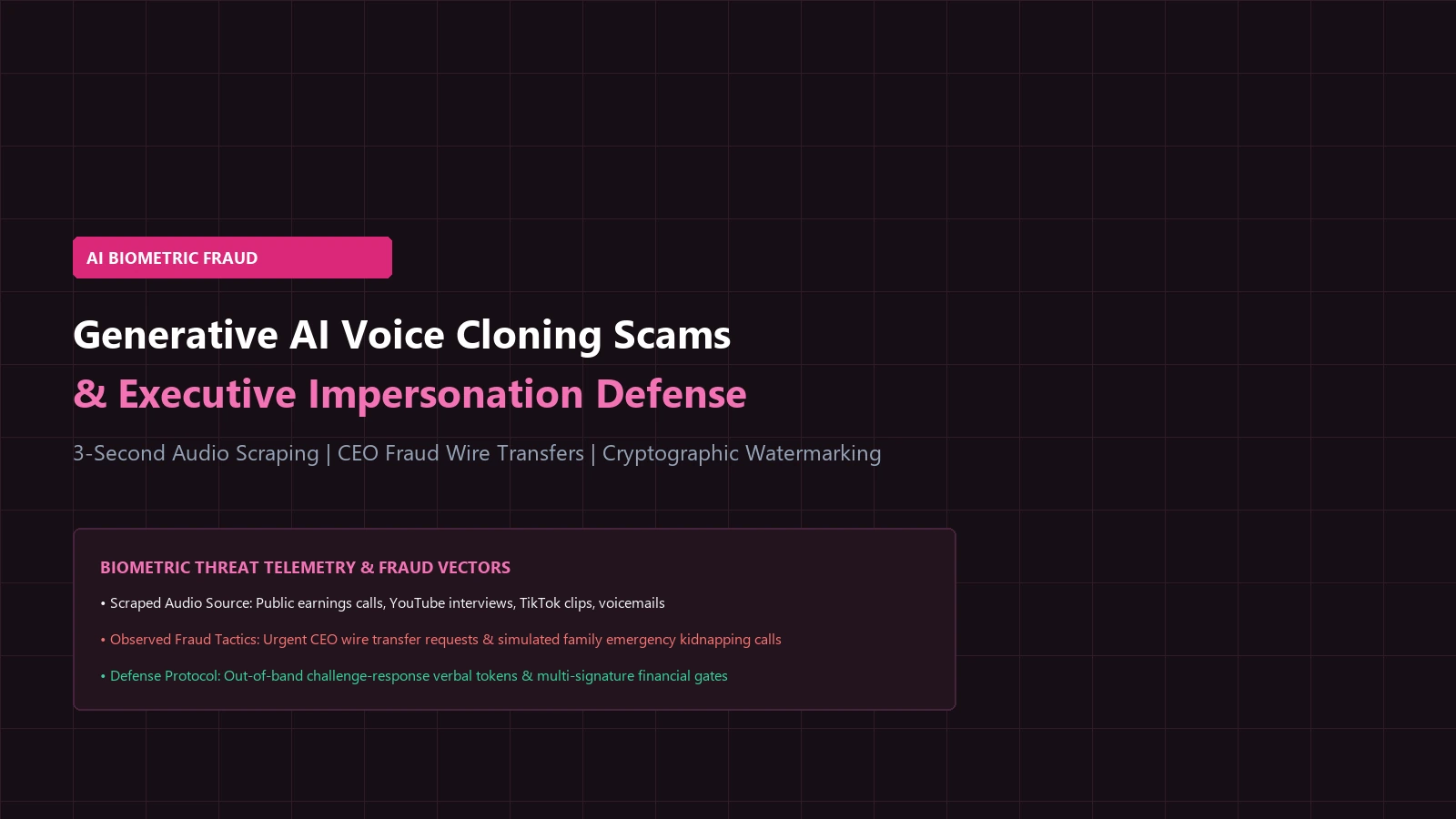
WASHINGTON — Enterprise cybersecurity directors, federal law enforcement agencies, and corporate risk officers are confronting an aggressive wave of sophisticated financial fraud powered by generative artificial intelligence voice cloning engines. Cybercrime cartels are systematically deploying deepfake vocal synthesis tooling to impersonate corporate executives, government officials, and family members with terrifying acoustic fidelity.
Fraud syndicates scrape as little as three seconds of clean audio from public corporate webinars, YouTube interviews, or quarterly earnings calls to generate fully interactive synthetic voice profiles. Corporate financial controllers receive unexpected emergency phone calls that sound identical to their chief executive officer demanding immediate wire transfers.
Never Miss An UpdateFollow us on Google News to get our latest security, defense and cyber reporting in your feed. It’s free and takes one tap.
Follow on Google NewsFinancial institutions scramble to detect synthetic audio. Wire transfer fraud explodes globally. Millions are diverted within minutes. The rapid weaponization of neural vocal models permanently dismantles voice-only identity authentication across modern enterprise environments.
The technical architecture underlying generative voice cloning has evolved rapidly from crude concatenative synthesis to high-fidelity diffusion and autoregressive neural vocoders. Modern neural speech synthesis algorithms map the subtle physiological nuances of human vocal tract acoustics, replicating pitch variations, breathing pauses, and regional dialect inflections.
Attackers integrate these models with low-latency text-to-speech pipelines and voice conversion wrappers, enabling human operators to speak into microphones and hear their words translated in real time into an executive exact timbre. Real-time deception operates fluidly. Human ears fail to perceive digital anomalies.
Adversaries manipulate human psychology by pairing hyper-realistic voice deepfakes with intense cognitive overloading tactics. Fraud calls typically feature simulated background ambient noise, such as airport terminals or traffic sirens, while the caller fabricates an urgent legal or financial crisis requiring immediate compliance.
Corporate finance personnel, operating under extreme perceived executive pressure, frequently bypass standard multi-signature controls to fulfill the fraudulent wire request. Neutralizing biometric voice fraud requires structural zero-trust governance.
Neural Vocal Synthesis Mechanics and Audio Scraping Vectors
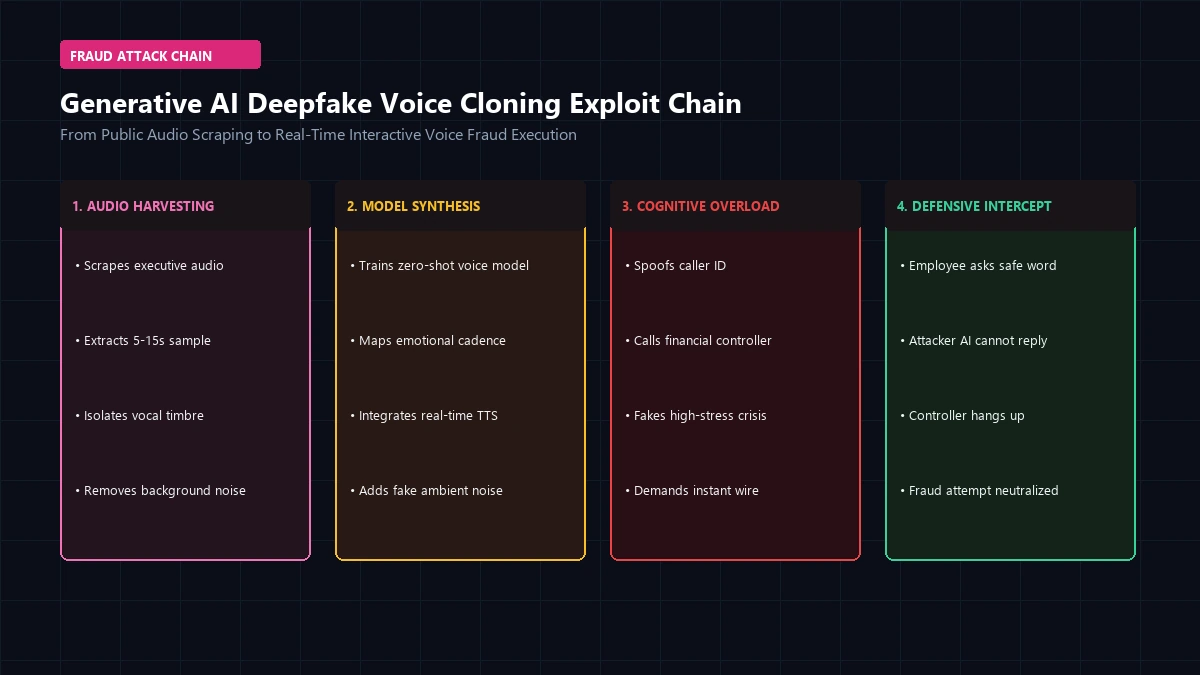
To understand the mechanics of generative voice fraud, security architects must examine how modern neural audio synthesis frameworks operate. Advanced zero-shot voice cloning architectures, such as VALL-E and XTTS, utilize neural audio codec models that break human speech down into discrete acoustic tokens. By analyzing the mathematical relationships between these acoustic tokens, the neural network learns to reproduce an individual unique vocal identity using minuscule reference samples.
Adversaries gather reference audio through automated web reconnaissance targeting corporate media assets. Public investor relations conferences, podcast interviews, and social media videos provide hours of pristine, high-definition vocal recordings. Attackers run automated audio pre-processing pipelines that strip background music and filter acoustic reverberation, isolating the raw vocal harmonics. The resulting reference file trains a localized voice clone within minutes, providing threat actors with a weaponized biometric exploit ready for immediate deployment.
| Voice Cloning Vector | Required Sample Length | Observed Attack Execution | Enterprise Defense Countermeasure |
|---|---|---|---|
| Zero-Shot Vocal Diffusion | 3 to 10 Seconds Audio | Real-Time CEO Impersonation Wire Fraud | Mandate Verbal Challenge-Response Tokens |
| Fine-Tuned Auto-Encoder | 15 to 60 Minutes Clean Audio | Interactive Multi-Party Video Deepfakes | Multi-Signature Hardware Cryptographic Keys |
| Real-Time Voice Conversion | 5 to 15 Seconds Reference | Interactive Phone Call Fraud Exploits | Enforce Out-of-Band Corporate Callbacks |
| Vocal Biometric Replay | Pre-Recorded Audio Fragments | Telephony Banking Password Reset Bypass | Deprecate Voice Biometrics as Auth Factor |
| Emergency Distress Lures | Brief Family Voicemail Audio | Simulated Kidnapping Extortion Calls | Establish Pre-Shared Family Secret Phrases |
Verbal Challenge-Response Tokens and Zero-Trust Governance
Mitigating the threat of generative voice cloning requires fundamentally dismantling the assumption that human vocal recognition equals identity verification. Corporate treasury policies must formally prohibit the authorization of financial disbursements, credential resets, or sensitive data transmissions based solely on telephone, voice message, or video conference interactions. Enterprise governance must mandate multi-factor cryptographic authorization for all material transactions.
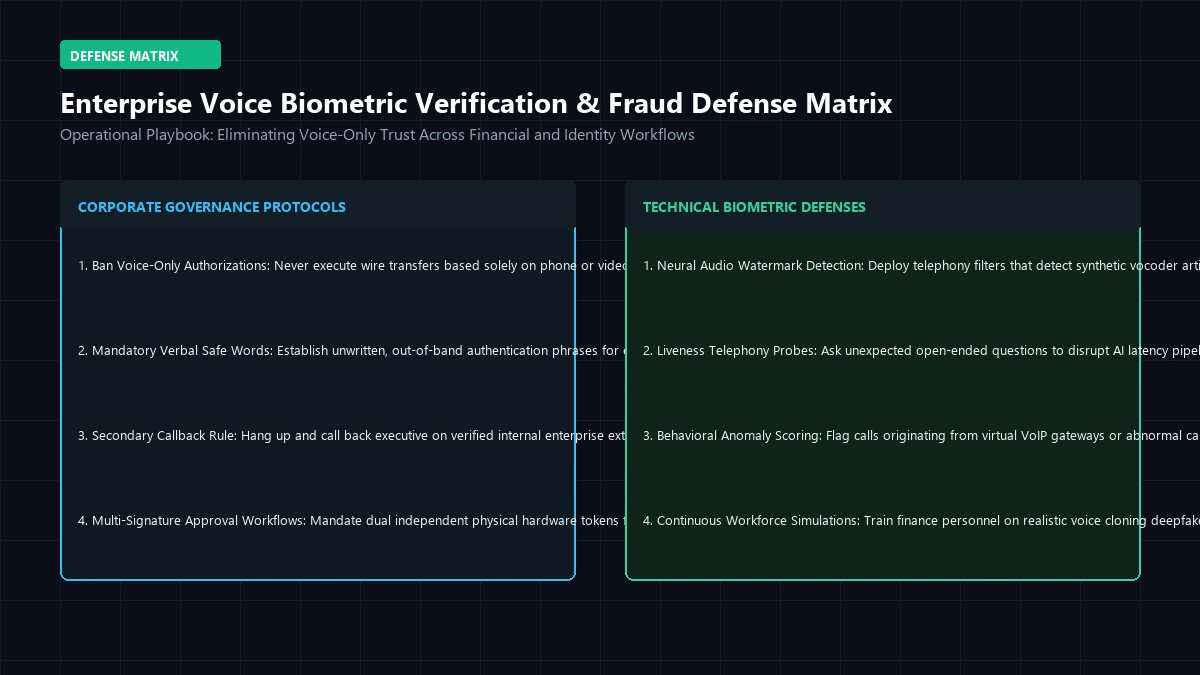
Organizations should establish out-of-band verbal challenge-response protocols for executive leadership and financial controllers. These authentication frameworks rely on unwritten, memorized secret phrases exchanged exclusively in person. When an executive calls requesting an urgent financial transfer, the controller must demand the pre-shared verbal token. Because the adversary neural model operates on scraped public data, the attacker cannot supply the secret phrase, terminating the fraud attempt instantly.
- Ban Voice-Only Financial Authorizations: Enforce strict corporate bylaws requiring independent dual-authorization using physical hardware tokens for all capital movements.
- Implement Verbal Challenge Tokens: Establish unwritten, memorized secret verification phrases shared exclusively between authorized executives and finance directors.
- Mandatory Out-of-Band Callbacks: Require employees receiving unusual executive calls to hang up and dial back the executive on internal enterprise extensions.
- Deprecate Telephony Voice Biometrics: Remove voice-recognition authentication systems from customer service centers, replacing them with FIDO2 hardware passkeys.
Algorithmic Deepfake Detection and Telephony Signal Forensics
Technology defense firms are developing algorithmic detection agents deployed directly within corporate telephony gateways to analyze incoming audio streams in real time. These neural forensic engines inspect audio signals for synthetic artifacts, such as unnatural spectral phase continuities, missing breathing sounds, and synthetic vocoder frequency truncation. When an incoming call exhibits statistical markers of generative synthesis, the system automatically alerts the call recipient.
Security researchers note that generative models frequently struggle to maintain conversational coherence when presented with unexpected, open-ended conversational interruptions. Financial personnel trained to execute dynamic liveness probes can disrupt deepfake scripts by asking unexpected questions regarding personal shared memories or complex corporate trivia. Cultivating institutional awareness transforms human operators into resilient defensive barriers.
The Forward Horizon
The democratization of multimodal artificial intelligence will permanently alter the nature of enterprise social engineering and human authentication. As neural synthesis algorithms advance toward indistinguishable vocal perfection, traditional auditory trust frameworks will collapse entirely. Enterprise resilience demands embracing zero-trust principles across all interpersonal corporate communications. Organizations that enforce cryptographic transaction verification, eliminate biometric voice dependencies, and cultivate disciplined workforce skepticism will neutralize synthetic deception, securing corporate treasuries across an increasingly synthetic digital world.