

Offensive security researchers have published a functional zero-day local privilege escalation exploit named SignDrop, which circumvents core kernel mitigations within the Windows Common Log File System (CLFS) driver. Disclosed on GitHub by an independent researcher operating under the handle MSNightmare, the exploit elevates standard user privileges directly to NT AUTHORITY\SYSTEM. Crucially, the vulnerability weaponizes the exact cryptographic signing defense that Microsoft introduced to stop kernel memory corruption attacks.
The technical disclosure emerged on November 10, confirming that the underlying flaw lives inside the core driver clfs.sys. Threat intelligence analysts rapidly verified that the exploit operates across fully patched Windows 11 and Windows Server builds.
Never Miss An UpdateFollow us on Google News to get our latest security, defense and cyber reporting in your feed. It’s free and takes one tap.
Follow on Google News‼️ Windows SignDrop 0-Day Exploit Lets Attackers Gain SYSTEM Privileges Through CLFS Protection
Details: https://t.co/i1Xs3OXZ89
A public exploit called SignDrop targets a Windows security feature meant to stop attacks on the Common Log File System (CLFS). It claims to turn a normal user account into a SYSTEM account, the highest level of control on Windows. The flaw has no CVE number and no patch as of November 11, 2026. Microsoft has also not confirmed the claims.
A researcher known as MSNightmare, also known as Nightmare Eclipse, posted the proof-of-concept on GitHub on November 10, 2026. The researcher says the bug lives in clfs.sys, the kernel driver behind CLFS. It involves how the driver creates a “.cnpf” authentication file when a new log file is made through the exposed \CLFS device.
#cybersecuritynews
— Cyber Security News (@The_Cyber_News) November 11, 2026
As of November 11, Microsoft has not assigned a CVE tracking identifier to the bug, leaving production environments without an official security update. Security operations centers face immediate defensive challenges because the exploit abuses legitimate operating system driver interfaces without dropping detectable binary payloads to disk.
Weaponizing Defenses: How SignDrop Subverts CLFS Kernel Integrity
The Common Log File System operates as a high-performance logging subsystem utilized daily by operating system services, transactional applications, and database engines. Historically, clfs.sys has represented one of the most targeted components in the Windows kernel, where ransomware syndicates systematically exploited heap corruptions in the driver. These intrusions yielded zero-days like CVE-2023-28252 and CVE-2023-23376, documented in the CISA Known Exploited Vulnerabilities catalog. These repeated attacks forced Microsoft to introduce cryptographic signature verification for base log files.
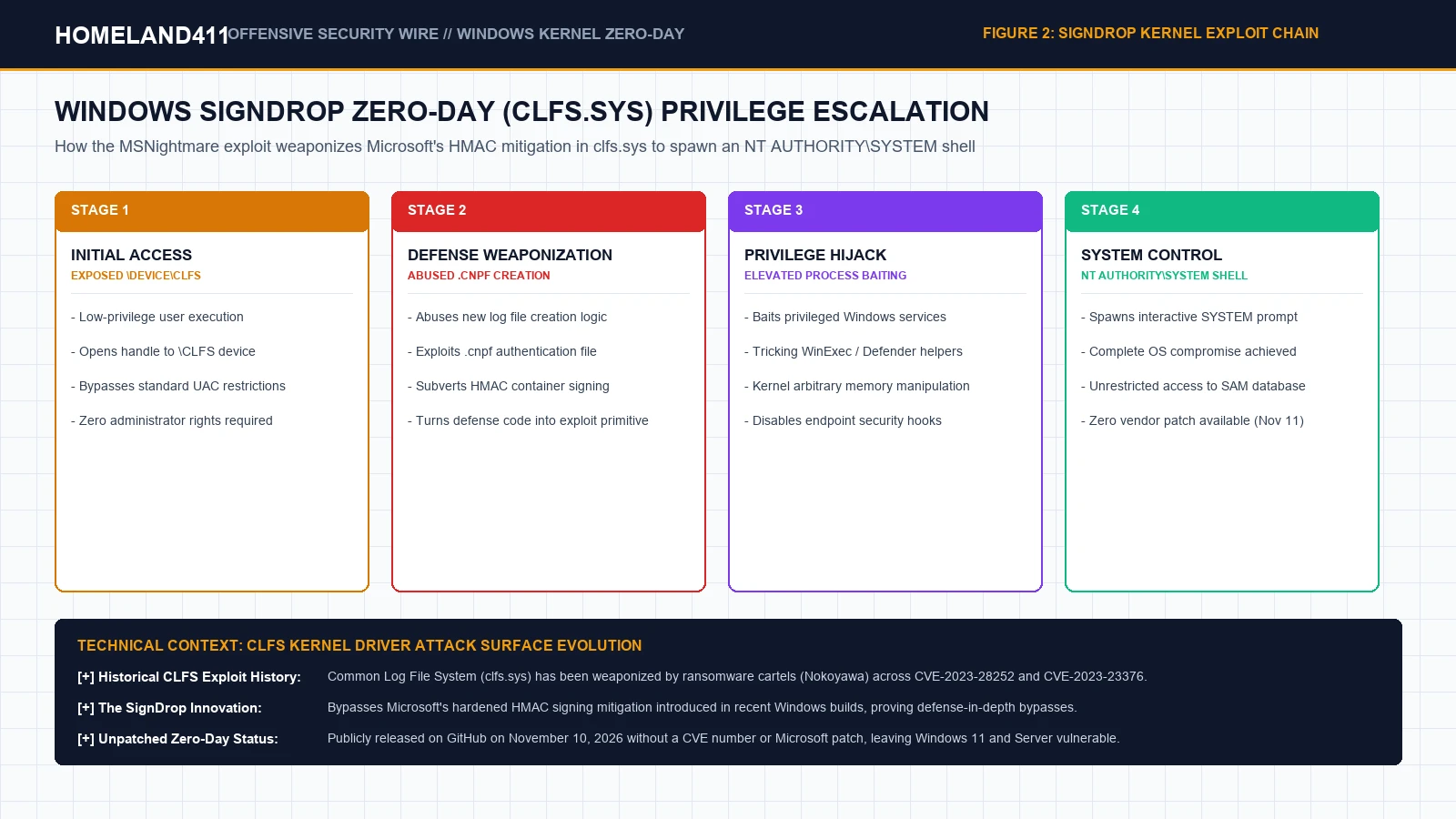
SignDrop achieves privilege escalation by turning that signature mitigation against the kernel itself. When an application initializes a new log file through the exposed \\Device\\Clfs driver interface, the driver constructs an authentication metadata file ending in .cnpf. Microsoft designed this routine to prevent unprivileged actors from modifying binary container offsets. However, the researcher discovered an architectural logic flaw in how clfs.sys binds empty linked containers, allowing attackers to manipulate file system state before signature enforcement completes.
| Exploit Stage / Component | Targeted Kernel Interface | Authentication Subversion Vector | Observed Privilege Escalation |
|---|---|---|---|
| Initial Driver Handle Creation | \\Device\\Clfs |
Unprivileged process opens handle to exposed kernel logging interface | Arbitrary user context execution |
| Authentication File Subversion | clfs.sys Metadata Engine |
Subverts .cnpf HMAC file validation for empty linked containers |
Kernel memory offset manipulation (Advisory Details →) |
| Privileged Service Baiting | Windows Defender & WinExec | Forces privileged background services to parse corrupted container descriptors | Hijacks execution thread context |
| Token Theft & System Elevation | Windows Access Token Manager | Replaces current unprivileged security token with elevated primary token | Interactive NT AUTHORITY\SYSTEM shell access |
Technical disclosures documented in the Cyber Security News advisory and verified against the public MSNightmare GitHub proof-of-concept repository show a two-stage baiting mechanism. The exploit initializes an unprivileged process that deliberately baits privileged services. When privileged components like Microsoft Defender inspect the crafted container, the exploit redirects kernel execution flow so the unprivileged caller immediately receives an interactive SYSTEM execution token.
Enterprise Exposure and the Growing Menace of Kernel-Level Exploits
The timing of the SignDrop public release introduces acute defensive operational risks across enterprise and government infrastructure. Because the proof-of-concept code compiles cleanly into a standalone executable, threat groups can easily weaponize the mechanism as a secondary execution stage following initial post-exploitation breaches.
System architects should review recent threat actor tactics documented in Homeland411 coverage of the CISA KEV addition of Cisco BroadWorks and our technical teardowns of critical Windows CGI remote argument injection. Similar to how mobile operators were forced to address zero-days during the Binance iOS zero-day alert, security leaders must treat unpatched kernel pathways as imminent breach vectors.
Because SignDrop operates entirely through authentic kernel logging interfaces without injecting shellcode or patching driver memory tables, traditional signature-based antivirus solutions generate zero baseline alerts during exploitation. System defenders cannot rely on legacy endpoint heuristics to detect unprivileged access token manipulation occurring inside trusted kernel routines.
Detection Engineering and Interim Hardening Guidance
Because Microsoft has not released an out-of-band security update or published workarounds in the Microsoft Security Response Center portal, system administrators must rely on behavioral detection rules. Security teams should deploy the following mitigation controls across managed Windows fleets immediately.
- Monitor CLFS Device Handle Creation: Configure Endpoint Detection and Response agents to flag unprivileged processes establishing abnormal device handles to
\\Device\\Clfs. - Inspect Temporary .cnpf File Artifacts: Establish file integrity audit rules targeting rapid creation, symbolic linking, and deletion of
*.cnpfand*.blffiles within standard user writable directories such asAppData\Local\Temp. - Enforce Attack Surface Reduction: Enable Windows Defender Attack Surface Reduction rules, specifically blocking untrusted executable processes from spawning child processes under privileged parent tokens.
- Restrict Local Interactive Logons: Strictly isolate multi-tenant jump servers and terminal services where non-administrative users share physical or virtualized kernel runtimes.
Security teams should monitor the MSRC portal continuously for emergency out-of-band updates. Defensive telemetry will be updated here as soon as Microsoft releases an official mitigation.