
The United Kingdom’s National Cyber Security Centre (NCSC) has officially launched the Cyber Adversary Simulation (CyAS) scheme. The initiative introduces a rigorous government assurance standard to test whether critical infrastructure operators can survive real-world cyberattacks. Announced on November 11, the framework creates an accredited tier of commercial red-teaming providers. These specialists will execute end-to-end adversarial simulations across high-risk networks, government bodies, and essential national services.
The technical authority operates as part of the Government Communications Headquarters (GCHQ). It designed CyAS in close partnership with statutory Cyber Oversight Bodies and ministerial regulators. Traditional compliance regimes rely heavily on rigid checklists and static scans. In contrast, CyAS mandates that commercial assessors adopt an unconstrained adversarial mindset. Testers must build custom attack paths matching the techniques, persistence, and evasion used by hostile nation-states.
Never Miss An UpdateFollow us on Google News to get our latest security, defense and cyber reporting in your feed. It’s free and takes one tap.
Follow on Google NewsSpeaking at the launch, NCSC Chief Technology Officer Ollie Whitehouse stated that perimeter security assumptions often crumble under live attack conditions:
“You cannot improve what you do not know. That is why I am delighted to see the launch of the Cyber Adversary Simulation scheme. By enabling rigorous, realistic end to end assessments by the very best adversary simulation experts, CyAS will help organisations build a clearer picture of how they would stand up to genuine cyber attacks and take action to strengthen their security and resilience. Ultimately, stronger resilience across the UK helps prepare the country for crisis by protecting the essential services we all rely on every day from the most pressing threats.”
— Ollie Whitehouse, Chief Technology Officer, National Cyber Security Centre (NCSC)
Beyond Checkbox Auditing: The Capability-Led Standard
Executive Brief // Operational Takeaways
- Government Agency: National Cyber Security Centre (NCSC), the national technical authority under GCHQ.
- New Program: Cyber Adversary Simulation (CyAS) industry assurance scheme.
- Core Methodology: Capability-led red teaming, replacing static penetration testing with unconstrained threat simulations.
- Target Sectors: Operators of Essential Services (OES), Critical National Infrastructure (CNI), and Lead Government Departments.
- Regulatory Integration: Direct evidence alignment with the Cyber Assessment Framework (CAF) and Cyber Resilience Audit (CRA) regime.
- Current Operational Status: Operating as a Minimum Viable Product (MVP) to validate market demand and benchmark Assured Service Providers (ASPs).
For years, enterprise defense has struggled with a fundamental structural flaw. Organizations routinely lean on automated scanners and scripted vulnerability assessments. These evaluations confirm baseline regulatory compliance, but they rarely measure operational survivability under fire. Assessors frequently follow predetermined scripts across narrow network corridors. Consequently, critical operational technology (OT) systems and lateral movement vectors remain unprobed.
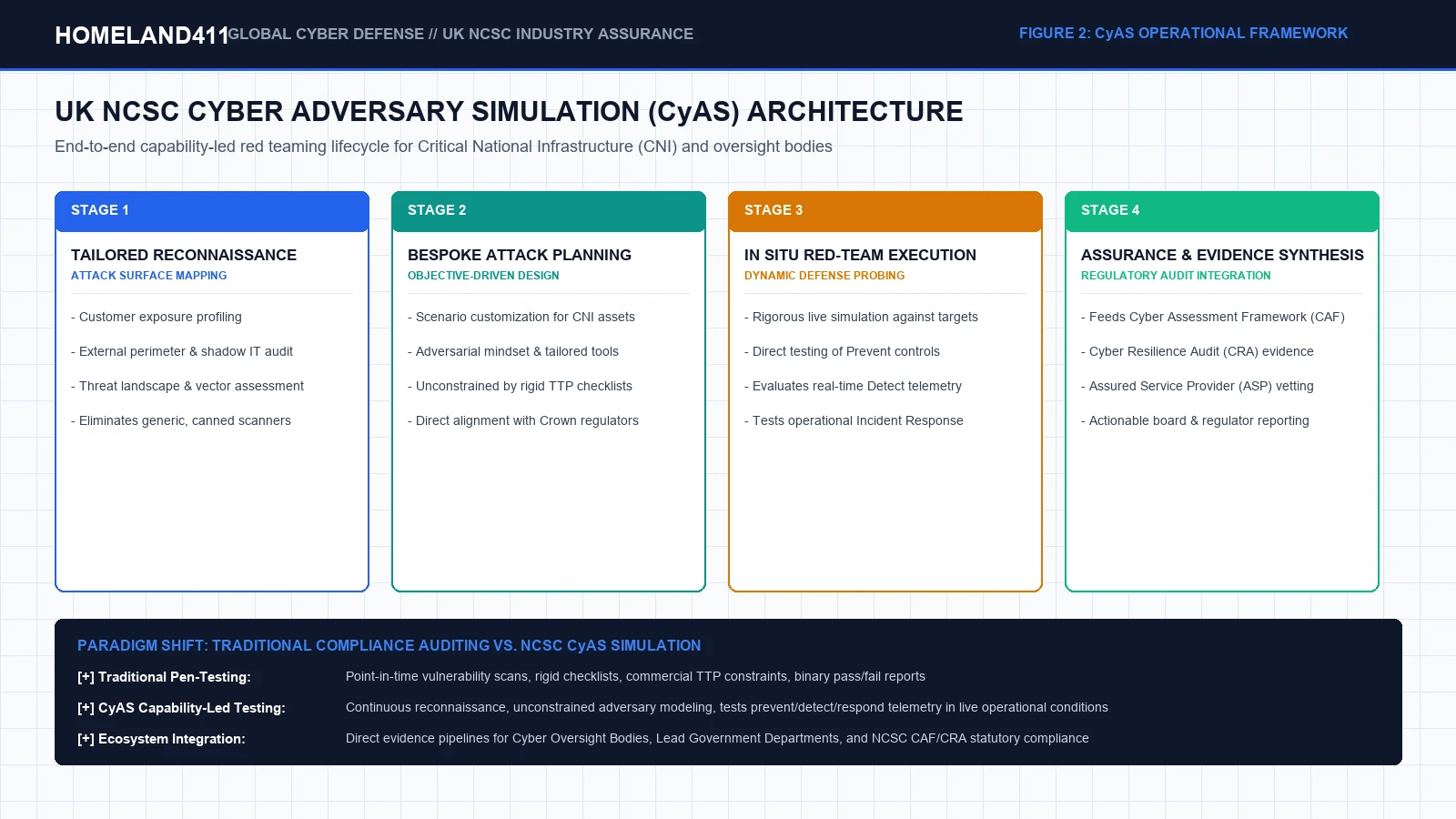
The CyAS framework decisively eliminates this scripted routine. Under the official NCSC CyAS Scheme Standard, accredited Assured Service Providers (ASPs) must lead with open-ended reconnaissance. Teams analyze the target organization’s public attack surface, cloud configurations, and third-party supplier links. They then design custom intrusion strategies tailored to specific operational exposures. Threat actors frequently exploit external blind spots, similar to recent campaigns where attackers leveraged actively exploited enterprise telecommunications flaws added to federal KEV catalogs to bypass gateway controls.
NCSC Deputy Director Chris Ensor emphasized that CyAS targets the dangerous divide between formal policies and live incident readiness:
“Moving beyond traditional pen testing and auditing of controls, the CyAS service enables organisations to practically test their cyber defences, ensuring they are able to protect, detect and respond to cyber attacks.”
— Chris Ensor, Deputy Director for Cyber Growth, National Cyber Security Centre
Simulations do not end with a generic pass-or-fail stamp. Instead, CyAS grades performance across three critical operational capabilities: the organization’s capacity to prevent initial network penetration, its real-time telemetry coverage to detect stealthy internal traversal, and the rapid agility of internal personnel to respond before essential services suffer operational downtime.
Regulatory Integration: Binding CyAS to the Cyber Assessment Framework
The CyAS launch delivers crucial enforcement teeth to statutory oversight in the UK. Essential service operators fall under the legally binding Network and Information Systems (NIS) Regulations. Compliance historically depended on self-assessments completed through the NCSC Cyber Assessment Framework (CAF). While the CAF defined robust security goals, supervisory bodies lacked objective proof that defenses would hold during live incursions.
CyAS directly resolves this verification deficit. The scheme feeds empirical exercise findings into the formal Cyber Resilience Audit (CRA) regime. By enforcing consistent reporting standards, the system provides designated Cyber Oversight Bodies with reliable technical telemetry. Regulators across water, energy, transport, and healthcare can benchmark sector-wide fragility. Officials can pinpoint shared detection delays and eradicate systemic blind spots across national infrastructure.
This oversight aligns with guidance from international defense peers. Notable partners include the Cybersecurity and Infrastructure Security Agency (CISA) in the United States and the European Union Agency for Cybersecurity (ENISA). Sovereign security agencies increasingly confront advanced tradecraft. These vectors span covert zero-day exploitation chains targeting mobile ecosystems to deep supply-chain interdictions. In this hostile threat climate, empirical resilience testing has become a mandatory pillar of national defense.
The strategic urgency behind CyAS is underscored by the NCSC’s latest annual intelligence findings. In its Annual Review 2026: The State of the Cyber Nation, the agency warned that hostile states will likely unleash autonomous AI-driven attack tooling against critical assets by 2028. Automated exploitation tools scan and breach exposed systems within minutes. Operators cannot persist with legacy infrastructure or outdated defensive practices. Allied agencies have echoed this operational call, with the Australian Signals Directorate deploying aggressive cyber defense directives to protect sovereign assets from remote exploitation.
Operational Delivery Model and CNI Implementation Roadmap
The NCSC is rolling out the scheme through a phased deployment to protect the technical standard. Operations begin immediately as a Minimum Viable Product (MVP). During this first stage, the technical authority is vetting commercial applicants across four mandatory assessment pillars:
- Corporate Governance and Legal Clearance: Providers must verify strict corporate integrity, vetted personnel clearances, and robust liability safeguards during live operational network testing.
- Technical Methodology Rigor: Assured vendors must demonstrate bespoke threat-modeling capabilities rather than relying on automated scanning suites.
- Individual Operator Competency: Individual lead testers and exercise coordinators undergo rigorous competency evaluations across complex cloud and industrial control system (ICS) environments.
- Standardized Threat Reporting: Deliverables must provide clear technical remediation blueprints for engineers alongside strategic resilience scores for boards and statutory regulators.
Critical infrastructure operators and government departments can now procure approved suppliers via the NCSC’s official directory. As the minimum viable product matures across early 2027, the agency will expand operational capacity. The technical authority aims to integrate continuous adversarial simulation into national defense drills, ensuring vital services withstand sustained foreign aggression.