
Toronto’s York University has confirmed a major cybersecurity incident that resulted in the unauthorized theft of sensitive personal, medical, and financial records submitted across departmental webforms over a 19-year span. Disclosed to community members following forensic containment, the breach allowed an unauthorized actor to exfiltrate archived form submissions dating from 2007 through October 2026. The incident compromises data across 14 major academic faculties, administrative secretariats, and student housing divisions at Canada’s third-largest university.
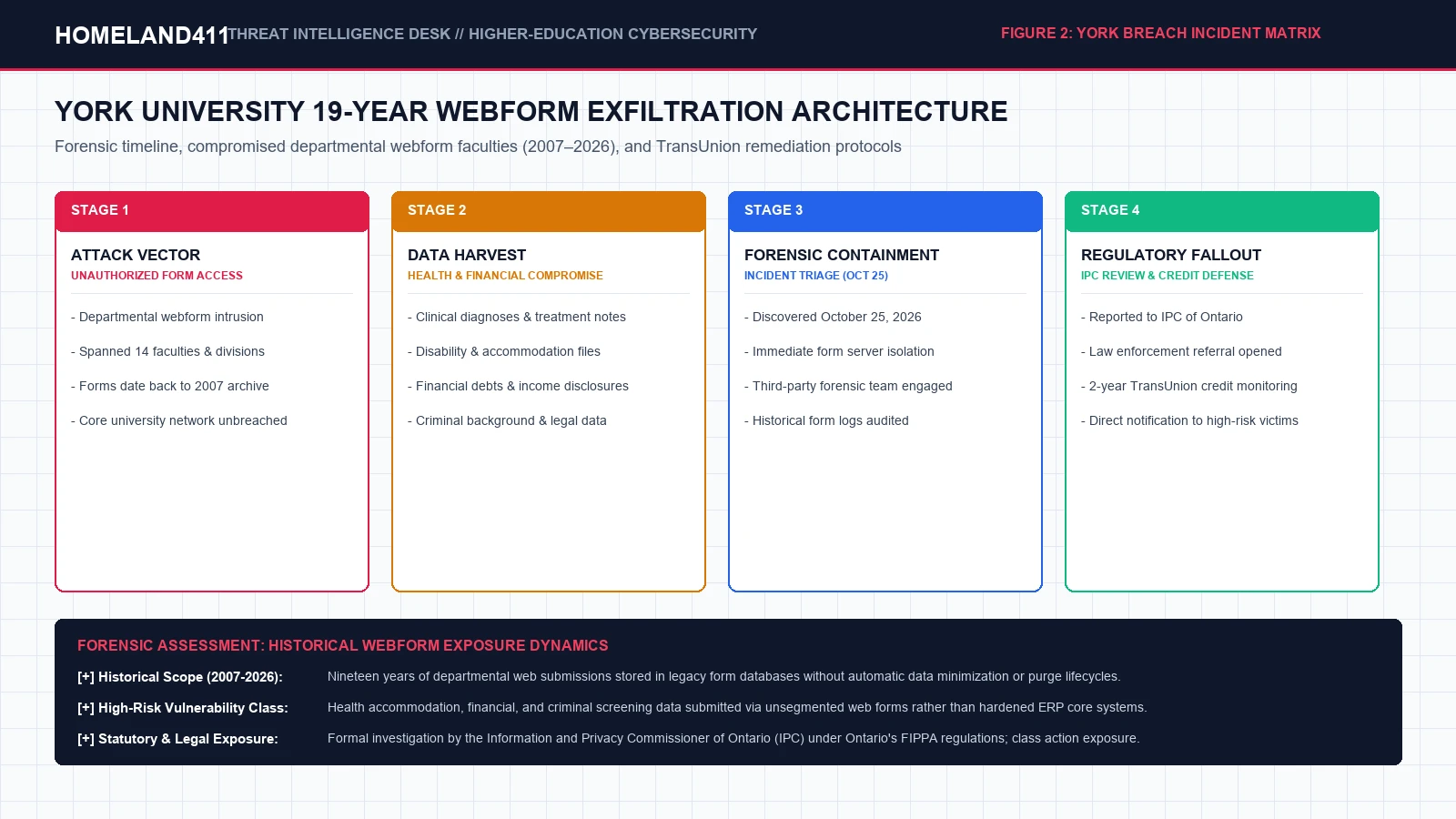
The security compromise was detected on October 25, prompting immediate isolation of affected form applications. Threat intelligence monitors flagged the exposure across underground cybercrime channels on November 11, highlighting the extensive historical breadth of the exfiltrated records:
Never Miss An UpdateFollow us on Google News to get our latest security, defense and cyber reporting in your feed. It’s free and takes one tap.
Follow on Google NewsUniversity officials stated that external digital forensics specialists were engaged immediately to evaluate the intrusion and secure perimeter gateways. Investigators verified that the adversary targeted standalone departmental form handlers rather than penetrating the institution’s centralized enterprise resource systems or primary active directory infrastructure. The breach highlights significant operational vulnerabilities in decentralized higher-education network environments.
Departmental Form Architecture and 19-Year Data Compromise
Incident Brief // What You Need to Know
- Impacted Institution: York University (Toronto, Ontario, Canada).
- Discovery Date: October 25, 2026; public notifications initiated following forensic triage.
- Historical Compromise Window: 19 years of archived web submissions spanning 2007 to October 2026.
- Compromised Data Categories: York identification numbers, contact information, clinical health diagnoses, disability accommodation requests, income/debt disclosures, and criminal background screenings.
- Remediation Offering: Two years of complimentary TransUnion credit monitoring for high-risk victims with exposed government IDs or banking details.
- Regulatory Filings: Formal breach notifications submitted to the Information and Privacy Commissioner of Ontario (IPC) and law enforcement.
The forensic investigation reveals that the compromised webforms supported varied campus administrative workflows over nearly two decades. The repositories housed student residence applications, academic accommodation requests, research surveys, and faculty registration portals. Departments historically retained form submissions in connected database tables without automated data minimization schedules. Consequently, records submitted by students who attended the university in 2007 remained vulnerable to unauthenticated extraction. Legacy database archiving practices created an expansive attack surface.
According to the official York University Incident Disclosure, the unauthorized actor harvested diverse personal information classes across 14 academic and administrative branches. The compromised repositories contained highly sensitive records that exceed standard contact directories:
- Health and Clinical Diagnoses: Records harvested from the Department of Psychology, Division of Students, and Faculty of Science include clinical treatment notes, diagnostic assessments, and formal dietary medical restrictions.
- Disability and Accommodation Requests: Forms maintained by the Centre for Refugee Studies and Vice-Provost Academic stored sensitive disability accommodation filings and institutional accessibility requests.
- Financial and Employment Data: Graduate Studies and Schulich School of Business portals exposed student financial status records, including family income levels, outstanding debts, and external employment histories.
- Screening and Identification Records: Form databases exposed student and employee York identification numbers, home street addresses, emergency third-party contacts, citizenship documents, and legal background check declarations.
This exposure parallels historical vulnerabilities across higher-education institutions documented in Homeland411’s reporting on the Harvard University data breach exposing 851,000 alumni and donor records. Threat actors routinely target academic legacy environments. Distributed departmental websites frequently run legacy content management plugins that escape central enterprise cybersecurity audits. Decentralized server administration often leaves historical form submissions unprotected on internet-facing web servers.
Forensic Attack Surface and Data Retention Hazards
The incident exposes a systemic challenge across major university networks: technical debt and perpetual data retention. When administrative staff deploy online forms for temporary projects, submissions often accumulate indefinitely in underlying relational databases. These form handlers rarely receive automated schema updates or credential rotations. Over multiple academic cycles, forgotten database tables transform into lucrative targets for opportunistic threat actors. In this intrusion, the adversary extracted nineteen continuous years of submissions without penetrating the university’s hardened core ERP infrastructure.
Underground threat actors prioritize educational data dumps because academic records contain comprehensive longitudinal profiles. A single historical webform submission often links an individual’s student identification number to their personal home address, emergency contacts, and private medical disclosures. Threat actors weaponize these composite datasets to orchestrate highly targeted spear-phishing attacks. Fraud syndicates also exploit historical identifying markers to execute synthetic identity fraud and unauthorized account takeovers across financial institutions.
Cybersecurity teams must enforce strict data minimization frameworks to eliminate perpetual retention liabilities. Institutional governance policies must mandate automated data destruction schedules once form submissions fulfill their primary administrative purpose. Web forms collecting sensitive medical accommodations or financial declarations should route submissions directly into encrypted, access-restricted institutional management systems. Web servers must never maintain plaintext form archives on public-facing internet gateways.
Regulatory Oversight, Ontario IPC Inquiries, and Identity Defense
York University formally reported the incident to the Information and Privacy Commissioner of Ontario (IPC) under the statutory mandates of Ontario’s Freedom of Information and Protection of Privacy Act (FIPPA). The provincial privacy watchdog routinely conducts regulatory audits into public institutions that fail to implement reasonable technical safeguards for archived personal health information. The institution also referred the forensic telemetry to federal and regional law enforcement agencies, including the Canadian Centre for Cyber Security (CCCS). Provincial regulators will examine whether the institution violated statutory retention limits by maintaining unencrypted form submissions across nearly two decades.
To shield affected community members whose government identification or banking account numbers were exposed, the university is distributing two years of complimentary credit monitoring services managed through TransUnion Canada. Similar mitigation deployments were required following enterprise contractor breaches evaluated in Homeland411’s analysis of the Conduent data breach exposure check and Kroll regulatory filings. Credit monitoring alerts individuals immediately when unauthorized inquiries or fraudulent loan applications occur in their name.
Threat intelligence specialists urge current students, faculty, and alumni who submitted departmental forms since 2007 to monitor their personal credit bureaus and review breach tracking platforms such as Have I Been Pwned. Stolen credentials and identity records frequently surface in automated credential-stuffing campaigns, matching the threat vectors observed in recent cryptographic key exposure alerts targeting mobile ecosystems. As cyber extortion syndicates increasingly monetize legacy academic data dumps, organizations must enforce aggressive database lifecycle purges to prevent forgotten forms from turning into multi-decade liabilities.