WASHINGTON — For the global cryptocurrency industry, the structural paradox of modern digital asset custody has reached an inflection point. While decentralized blockchains offer mathematical finality and cryptographic security, centralized exchanges must simultaneously function as high-frequency payment gateways. To fulfill millions of daily customer withdrawals, execute automated arbitrage, and rebalance liquidity across global markets, exchanges cannot leave all capital locked inside physical vaults. They are forced to maintain billions of dollars in automated, internet-connected hot wallets—creating the single most concentrated, high-yield target in modern cyber warfare.
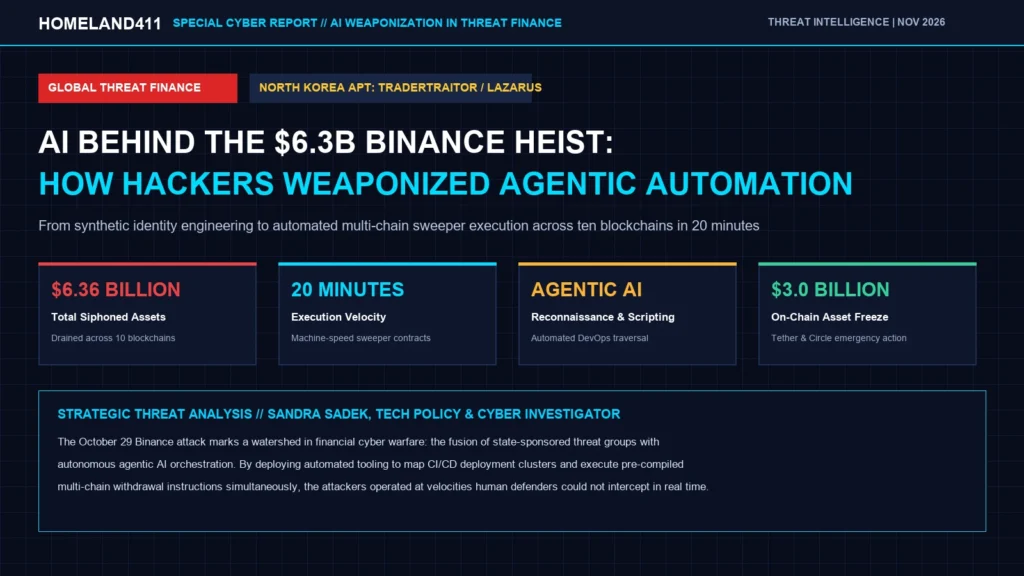
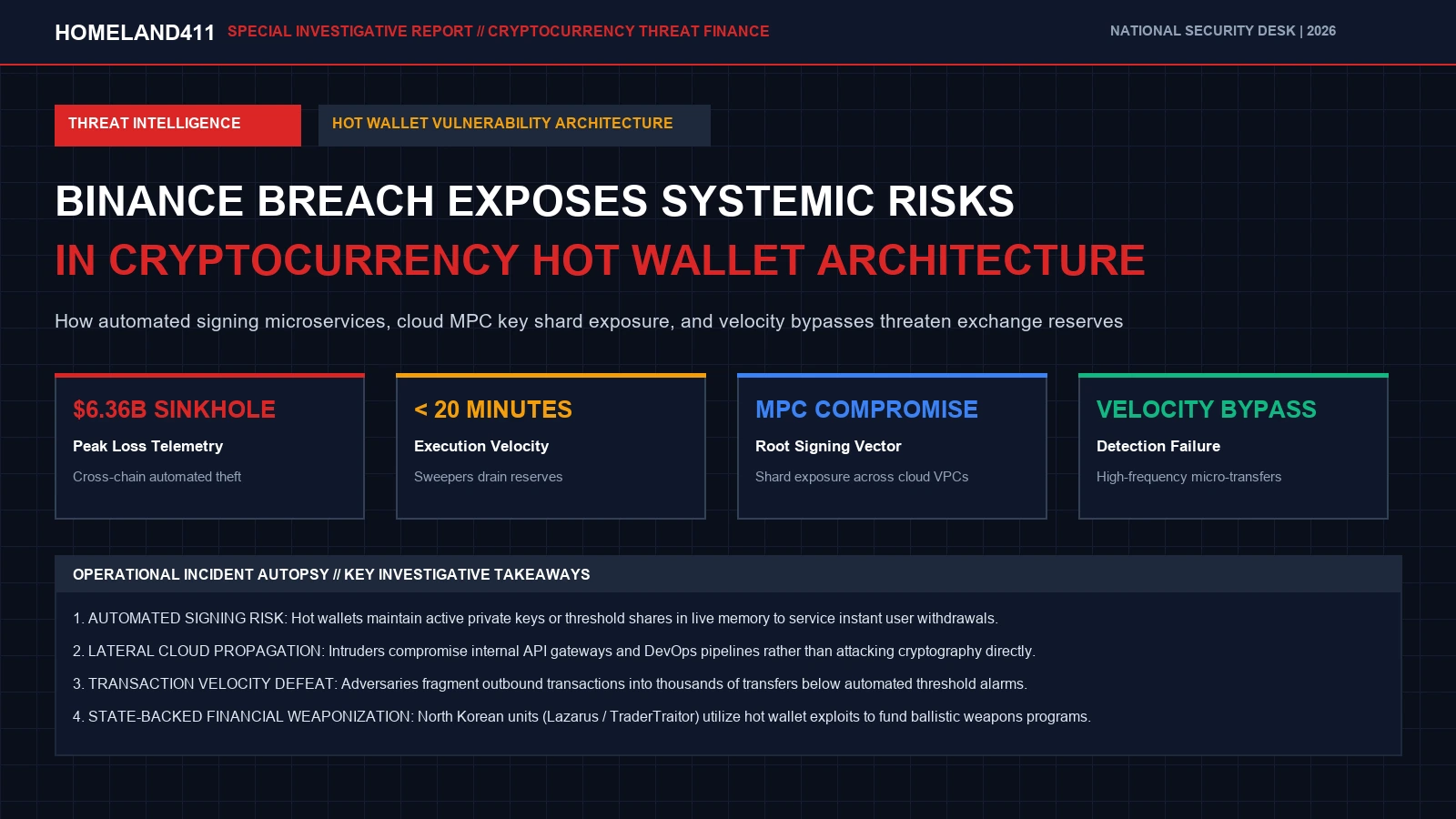
The systemic vulnerability of this operational architecture was laid bare during recent coordinated intrusions targeting Binance, the world’s largest digital asset exchange by trading volume. Forensic post-mortems conducted by federal cyber investigators and private threat intelligence firms confirmed that adversaries did not break the underlying elliptic-curve cryptography securing distributed ledgers. Instead, the attackers systematically dismantled the off-chain signing infrastructure, automated API routing microservices, and Multi-Party Computation (MPC) key-shard orchestrators that govern hot wallet transaction execution. Within a twenty-minute operational window, automated sweeper scripts drained hundreds of millions of dollars across multiple blockchain ecosystems before internal risk engines triggered circuit-breaker freezes.
Never Miss UpdatesFollow us on Google News to get our latest security, defense and cyber reporting in your feed. It’s free and takes one tap.
Follow on Google NewsFor executive leadership, financial regulators, and homeland security strategists, the incident marks a definitive shift in the threat environment. Cryptocurrency hot wallets are no longer merely vulnerable to opportunistic phishing or isolated credential stuffing. They represent critical financial infrastructure subject to industrialized, state-sponsored cyber exploitation designed to bypass velocity limits, compromise cloud-hosted signing nodes, and extract liquid capital at machine speed.
Deconstructing the Hot Wallet: The Operational Friction Between Liquidity and Defense
To understand why cryptocurrency exchanges remain acutely vulnerable to catastrophic balance-sheet theft, one must examine how institutional custody is engineered in practice. Industry standards established under standards like NIST SP 800-207 Zero Trust Architecture mandate continuous authentication and strict physical isolation. Yet commercial market forces demand the exact opposite: sub-second transaction signing and frictionless liquidity.
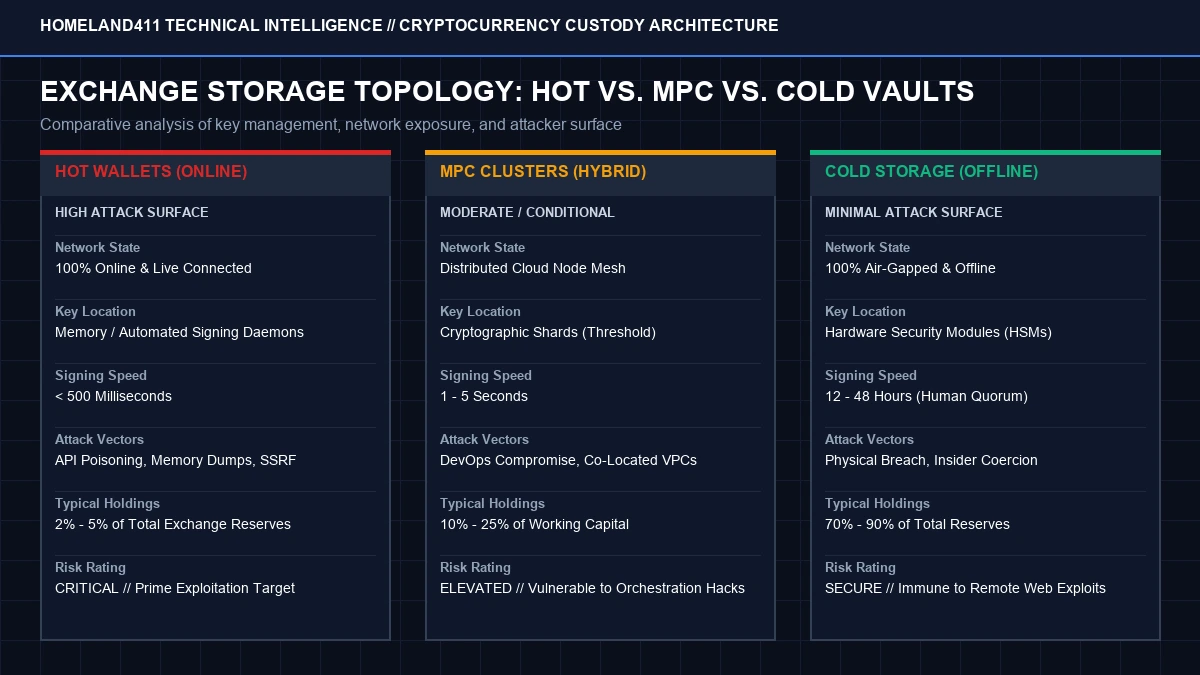
In institutional exchange architecture, digital asset reserves are partitioned across three primary custody tiers:
- Deep Cold Storage (Air-Gapped Vaults): Housing between 70% and 90% of total customer reserves, cold storage systems operate completely offline. Private keys reside on specialized Hardware Security Modules (HSMs) or paper-printed Shamir Secret Sharing shards housed inside physical bank-grade vaults. Initiating a transfer requires a physical human quorum, dual-key biometric authorization, and time delays ranging from 12 to 48 hours. Remote exploitation over the internet is technically impossible.
- Multi-Party Computation (MPC) Warm Clusters: Serving as the intermediary liquidity buffer, warm wallets hold between 10% and 25% of operating assets. Rather than storing a complete private key, the cryptographic secret is mathematically split into multiple encrypted shards distributed across isolated cloud Virtual Private Clouds (VPCs). Signing requires a threshold quorum (e.g., 3-of-5 nodes) communicating via secure multi-party protocols.
- Automated Hot Wallets (Live Daemon Nodes): Accounting for 2% to 5% of exchange holdings, hot wallets are live, network-facing microservices. They run daemon software connected directly to public blockchain RPC nodes (such as
gethfor Ethereum,bitcoindfor Bitcoin, and specialized Tendermint nodes). When a verified user requests an outbound transfer, the hot wallet daemon automatically constructs, cryptographically signs, and broadcasts the transaction in less than 500 milliseconds without human intervention.
While allocating only 3% of reserves to hot wallets appears conservative on an institutional balance sheet, an exchange processing tens of billions in daily volume will regularly expose $500 million to $1.5 billion in live, internet-facing signing infrastructure at any given moment. If an adversary gains control of that automated pipeline, the potential single-event loss exceeds the annual budget of many Fortune 500 enterprises.
The Fallacy of MPC Invulnerability
Over the past four years, enterprise cryptocurrency custody vendors aggressively marketed Multi-Party Computation (MPC) as the definitive cure for private key compromise. Under standard MPC implementations, a single private key never exists in assembly on any single server or memory chip. Because the key is divided into polynomial shares, vendors claimed that an attacker would need to breach multiple independent cloud providers simultaneously to forge a valid signature.
The Binance intrusion dismantled this assumption. Forensic telemetry indicates that sophisticated threat actors do not attempt to crack the underlying threshold mathematics or brute-force the elliptic-curve polynomial equations. Instead, they exploit the centralized orchestration layers that instruct the MPC nodes when and what to sign.
In commercial exchange deployments, MPC nodes do not make independent moral decisions. They are passive cryptographic workers orchestrated by internal software microservices. If an attacker breaches the exchange’s internal Kubernetes cluster, manipulates the withdrawal approval queue, or obtains valid administrative bearer tokens, the attacker does not need to steal the key shards. The adversary simply submits forged transaction requests through legitimate internal channels. The MPC cluster obediently calculates the threshold signature, generates a valid blockchain transaction, and broadcasts the drain to the public network.
Forensic Teardown: The 4 Primary Hot Wallet Attack Vectors
Technical debriefs published by incident responders and blockchain intelligence investigators at Chainalysis reveal that hot wallet breaches follow a structured, multi-stage operational kill-chain mapped across the MITRE ATT&CK matrix. Threat actors exploit four recurring systemic failure points:
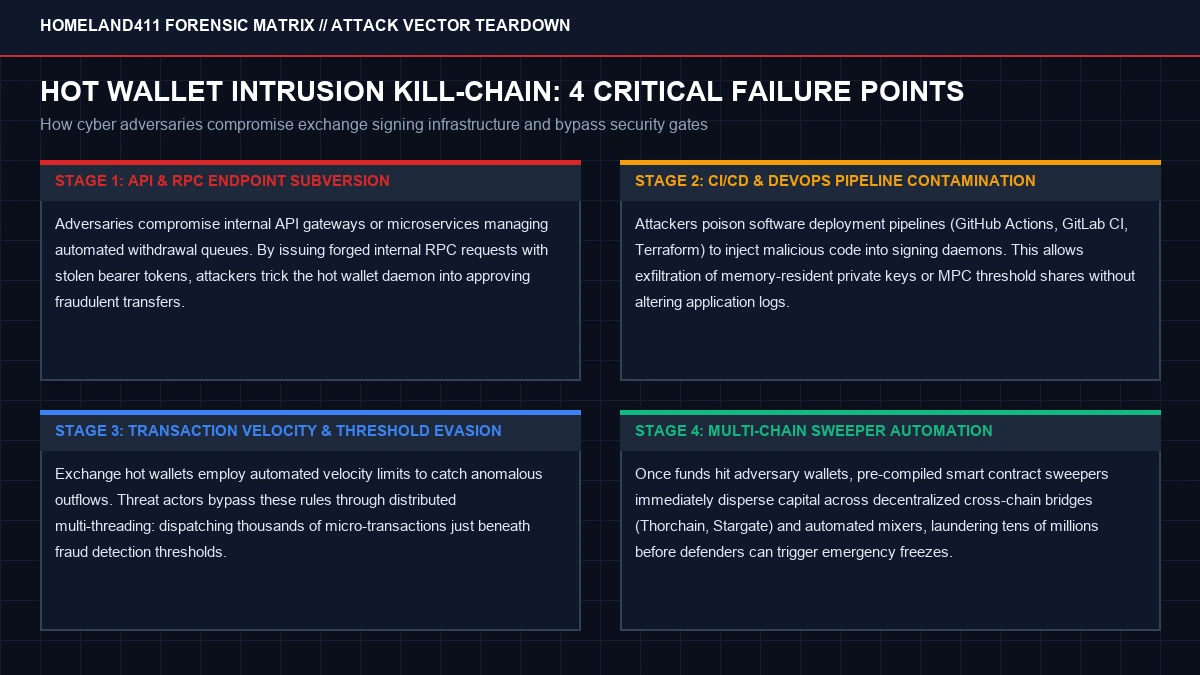
Vector 1: Internal API Gateway Subversion and Session Hijacking. Modern exchanges rely on complex webs of internal microservices. The user-facing mobile app talks to an API gateway, which communicates with a risk-scoring service, which in turn queues approved transfers to the hot wallet daemon. By identifying unauthenticated internal RPC endpoints or exploiting Server-Side Request Forgery (SSRF) vulnerabilities in auxiliary services, attackers inject fraudulent withdrawal commands directly into the queue, bypassing user authentication checks entirely.
Vector 2: Cloud CI/CD and DevOps Pipeline Contamination. Exchange infrastructure changes constantly. Developers deploy automated code updates multiple times per day using continuous integration and deployment pipelines (such as GitHub Actions, GitLab CI, and Terraform). Threat actors target the human engineers maintaining these pipelines. By compromising a DevOps engineer’s corporate laptop or poisoning third-party software dependencies, attackers inject malicious middleware directly into container images running the hot wallet signing daemons.
This technique mirrors the systemic software dependencies documented in Homeland411’s investigation into critical infrastructure supplier vulnerabilities, where hardened core databases remain exposed to compromised administrative tooling and third-party SaaS management monopolies.
Vector 3: Transaction Velocity and Threshold Evasion. To prevent catastrophic balance depletion, exchange hot wallets employ automated velocity controls: transfers exceeding a specific dollar amount (e.g., $100,000) require secondary human sign-off, and total hourly outflow limits are enforced by code. Adversaries circumvent these guardrails through distributed multi-threading. Using hundreds of pre-compromised user accounts, the attackers dispatch thousands of simultaneous micro-withdrawals ranging from $5,000 to $15,000. Because each individual transfer falls below the automated anomaly threshold, the transactions execute instantaneously, draining tens of millions of dollars before risk alerts trigger.
Vector 4: Automated Multi-Chain Sweeper Execution. In legacy financial heists, laundering stolen wire transfers takes days. In cryptocurrency intrusions, the adversaries deploy pre-compiled smart contract sweepers. The moment stolen assets land in an initial external address, automated scripts instantly split the capital across decentralized cross-chain liquidity bridges, swap volatile tokens for stablecoins, and route funds through privacy mixers.
As documented in Homeland411’s forensic report on the Lazarus Group multi-chain attack, state-sponsored cyber units have industrialized this automated sweeping apparatus to hop across ten independent blockchains in under twenty minutes, outrunning emergency asset freezes enacted by centralized stablecoin issuers.
Comprehensive Custody Architecture Comparison Matrix
To evaluate the technical trade-offs between liquidity velocity and systemic risk, Homeland411 compiled verified operational metrics comparing the four dominant digital asset custody architectures:
| Custody Tier | Network Connectivity | Key Storage Mechanism | Signing Latency | Primary Failure Vectors | Typical Exchange Allocation |
|---|---|---|---|---|---|
| Hot Wallet Daemon | 100% Online & Network-Facing | Memory-resident keys or local signing daemons | < 500 Milliseconds | API gateway poisoning, SSRF, memory scraping, velocity bypass | 2% – 5% ($100M – $500M) |
| Cloud MPC Cluster | Distributed VPC Cloud Mesh | Threshold cryptographic shares (e.g., 3-of-5) | 1 – 5 Seconds | Orchestration service compromise, DevOps pipeline injection | 10% – 25% ($500M – $2.5B) |
| Multi-Sig Smart Contract | On-Chain Distributed Verification | Multiple independent private keys (e.g., Gnosis Safe) | Minutes (Gas & Block Times) | Smart contract logic flaws, re-entrancy, signer key theft | 5% – 15% ($250M – $1.5B) |
| Air-Gapped Cold Vault | 100% Offline & Disconnected | Physical Hardware Security Modules (HSMs) | 12 – 48 Hours | Physical facility intrusion, insider coercion, executive extortion | 70% – 90% ($5B – $50B+) |
State-Sponsored Threat Finance: North Korea’s Weaponization of Hot Wallets
The targeting of exchange hot wallets is not merely a commercial concern for private trading firms; it is an acute national security challenge. Federal cyber advisories released by the Cybersecurity and Infrastructure Security Agency (CISA), the FBI, and the Department of the Treasury’s Office of Foreign Assets Control (OFAC) attribute the overwhelming majority of large-scale hot wallet intrusions to North Korea’s Democratic People’s Republic of Korea (DPRK) state-sponsored cyber units, specifically units tracked as Lazarus Group, APT38, and TraderTraitor.
Facing sweeping international economic sanctions that cut off access to global banking networks, the Pyongyang regime has transformed cryptocurrency theft into a cornerstone of sovereign revenue. United Nations Security Council panels estimate that North Korean cyber operatives have stolen in excess of $3 billion in digital assets since 2018, with more than half of those funds directly funding the regime’s illicit intercontinental ballistic missile (ICBM) and nuclear weapons programs.
Unlike conventional criminal syndicates that operate with limited technical infrastructure, state-backed units operate dedicated research labs tasked with reverse-engineering exchange software architectures. They spend months conducting passive reconnaissance, mapping out internal network topographies, and identifying single points of operational failure.
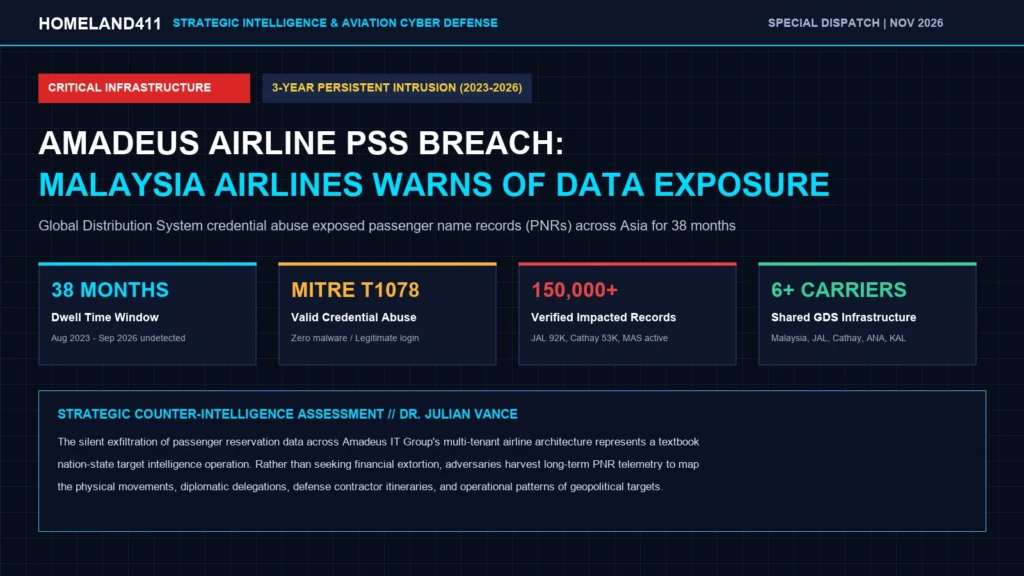
This dynamic mirrors the cascading supply-chain exposures observed in the commercial aviation sector, such as the multi-year third-party intrusion analyzed in Homeland411’s report on the Amadeus airline reservation system breach, where threat actors targeted centralized service brokers to harvest intelligence across dozens of interconnected regional operators.
Regulatory Repercussions and Federal Compliance Directives
The recurring failure of exchange hot wallet security has triggered an aggressive regulatory response from financial authorities and law enforcement agencies across the globe. Voluntary industry self-regulation is rapidly giving way to binding federal mandates:
- FinCEN Travel Rule Enforcement: The Financial Crimes Enforcement Network (FinCEN) is tightening enforcement of Bank Secrecy Act (BSA) provisions, requiring digital asset brokers to verify and transmit originator and beneficiary information for all hot wallet transfers exceeding $3,000.
- SEC Mandatory Cyber Incident Disclosures (Form 8-K): Under SEC Item 1.05 rules, publicly traded digital asset platforms and enterprise custodians must disclose material cybersecurity incidents within four business days of determining materiality, preventing exchanges from concealing hot wallet reserve shortfalls.
- The Limitations of Proof-of-Reserves (PoR): Following the collapse of FTX, major exchanges adopted cryptographic Merkle Tree Proof-of-Reserves to reassure depositors. However, security analysts emphasize that Proof-of-Reserves offers zero protection against hot wallet theft: a snapshot proving solvency at 12:00 AM is rendered meaningless if an automated hot wallet is systematically emptied at 12:15 AM.
- Mandatory Cold-to-Hot Ratio Caps: Regulatory bodies in jurisdictions including the European Union (under the Markets in Crypto-Assets / MiCA framework) and the New York Department of Financial Services (NYDFS) are actively evaluating rules that legally restrict the maximum percentage of customer funds permitted to reside in online hot wallets to no more than 3%.
The Defensive Blueprint: Hardening Institutional Custody Against Machine-Speed Drains
Eliminating the hot wallet threat entirely is impossible so long as users demand instant withdrawals. However, defending exchange reserves against catastrophic compromise requires financial platforms to abandon passive monitoring in favor of hardware-enforced, active cryptographic isolation:
1. Hardware-Enforced Out-of-Band Policy Engines. Automated signing daemons must not possess unilateral authority to approve transactions. Exchanges must implement physically isolated policy engines running within dedicated Hardware Security Modules. If an outbound transaction violates predefined velocity rules, alters known smart contract addresses, or exceeds hourly thresholds, the hardware must physically reject the signature request at the silicon level, independent of operating system commands.
2. Cryptographic Proof-of-Authority and FIDO2 Enclaves. Administrative orchestration services must require hardware-bound FIDO2 cryptographic credentials (such as physical YubiKeys) for all operational adjustments. Eliminating bearer tokens, API passwords, and software-based multi-factor authentication prevents remote attackers from impersonating DevOps personnel.
3. Ephemeral Hot Wallet Addresses and Micro-Liquidity Sweeps. Rather than maintaining permanent hot wallet pools containing hundreds of millions of dollars, exchanges should transition toward ephemeral signing addresses funded on-demand via automated micro-sweeps from warm storage. Limiting each hot wallet instance to minimal working capital ensures that an adversary executing a total breach can capture only a fraction of operating liquidity.
4. Isolated Sidecar Anomaly Detection. Fraud detection engines must not run on the same cloud network fabric as the transaction-processing nodes. Deploying out-of-band monitoring sidecars in completely isolated VPCs ensures that an attacker who compromises internal production servers cannot simultaneously disable behavioral alerting pipelines.
5. Automated Cross-Chain Blacklist Integration. Centralized exchanges must collaborate closely with major stablecoin issuers and cross-chain bridge validators. Establishing automated, API-driven threat sharing allows immediate, automated freezing of tainted smart contract addresses before stolen capital can clear decentralized liquidity pools.
Strategic Outlook: The Future of Digital Asset Security
The recurring exploitation of cryptocurrency hot wallets exposes an uncomfortable truth for the digital finance sector: convenience and cryptographic security exist in permanent opposition. Centralized exchanges that prioritize instantaneous transaction speeds without implementing rigorous, hardware-enforced policy boundaries will continue to serve as the liquidity providers of choice for nation-state cyber armies.
For institutional market participants, sovereign regulators, and enterprise depositors, evaluating cryptocurrency exchanges based purely on user interface smoothness or trading fee discounts is a fatal oversight. The ultimate measure of an exchange’s institutional solvency is the cryptographic resilience of its custody architecture. As automated, machine-speed intrusion vectors continue to evolve, platforms that fail to harden their hot wallet pipelines will discover that in the digital asset economy, an architectural failure is not merely a technical glitch—it is an existential event.