
Jamaica’s Cabinet approved the Artificial Intelligence Proficiency, Ethics and Expertise (APEX) for Government programme. The decision establishes binding regulatory guardrails for public sector automation across the Caribbean nation. Technology Minister Dr. Andrew Wheatley announced the measure during a post-Cabinet press briefing. Comprehensive AI training and ethical compliance are now mandatory for civil servants utilizing automated tools. The directive addresses acute ministerial concerns that ad-hoc adoption outpaced formal administrative rules. Unregulated usage exposed sensitive state records to external commercial ingestion.
The executive mandate requires public personnel to complete verified competency certification before deploying foundation models into ministerial workflows. Regulators structured the programme to halt unauthorized data uploads and enforce rigorous output verification protocols. The framework also establishes unambiguous legal liability for algorithmic errors. That regulatory perimeter reinforces sovereign data protection protocols analyzed in Homeland411’s reporting on national cybersecurity governance and sovereign data protection across allied administrations.
Never Miss An UpdateFollow us on Google News to get our latest security, defense and cyber reporting in your feed. It’s free and takes one tap.
Follow on Google NewsUnder the Cabinet directive, initial training cohorts launch before the close of the current fiscal year. The programme will operate continuously to audit newly released machine learning tools against statutory privacy baselines. These institutional controls mirror the strict operational boundaries detailed in our investigation of prompt injection vulnerabilities and assistant manipulation across automated production environments.
Inside the APEX Mandate: Curbing Shadow AI and Protecting Sovereign State Records
Rapid adoption of commercial generative AI tools created an unmonitored shadow IT footprint within civil service branches. Unvetted employees routinely pasted policy drafts, citizen dispute filings, and administrative memos into public commercial models. That unregulated pipeline exposed sovereign records to third-party scraping and off-shore server training matrices without formal institutional consent.
The APEX framework establishes rigid data classification tiers. These boundaries dictate which operational assets may interface with machine intelligence. Minister Wheatley emphasized that civil servants lacked systematic guidance on data boundary parameters, automated hallucination detection, and statutory liability when machine learning models generate flawed public records. The new regime enforces strict compliance with Jamaica’s Data Protection Act, imposing rigorous accountability on ministerial information officers.
| Governance Pillar | Pre-APEX Public Sector Risk | Mandated APEX Compliance Standard | Statutory Enforcement Mechanism |
|---|---|---|---|
| Data Ingestion Boundary | Unvetted civil servant uploads to public commercial LLMs | Mandatory data classification and local air-gapped enclaves | Jamaica Data Protection Act statutory breach penalties |
| Output Verification | Unchecked administrative reliance on model hallucinations | Mandatory human-in-the-loop review for all citizen decisions | Dual-key administrative sign-off logged in audit trails |
| Institutional Liability | Ambiguous responsibility for algorithmic errors and bias | Designated Senior Information Officer statutory ownership | Cabinet public service performance and accountability metrics |
| Model Procurement | Ad-hoc individual subscriptions to unvetted third-party tools | Centralized vetting via Technology Ministry procurement gateway | Mandatory security accreditation and Caribbean dialect testing |
| Civil Service Training | Informal staff experimentation with zero ethics instruction | Compulsory APEX certification required for system access | Quarterly compliance audits administered by Cabinet Office |
By centralizing model verification under the Technology Ministry, Jamaica insulates public administration from foreign vendor dependency and intellectual property contamination. The initiative aligns directly with recommendations from the UNESCO Artificial Intelligence Readiness Assessment Methodology report. That alignment positions Jamaica as an institutional benchmark for Caribbean digital governance.
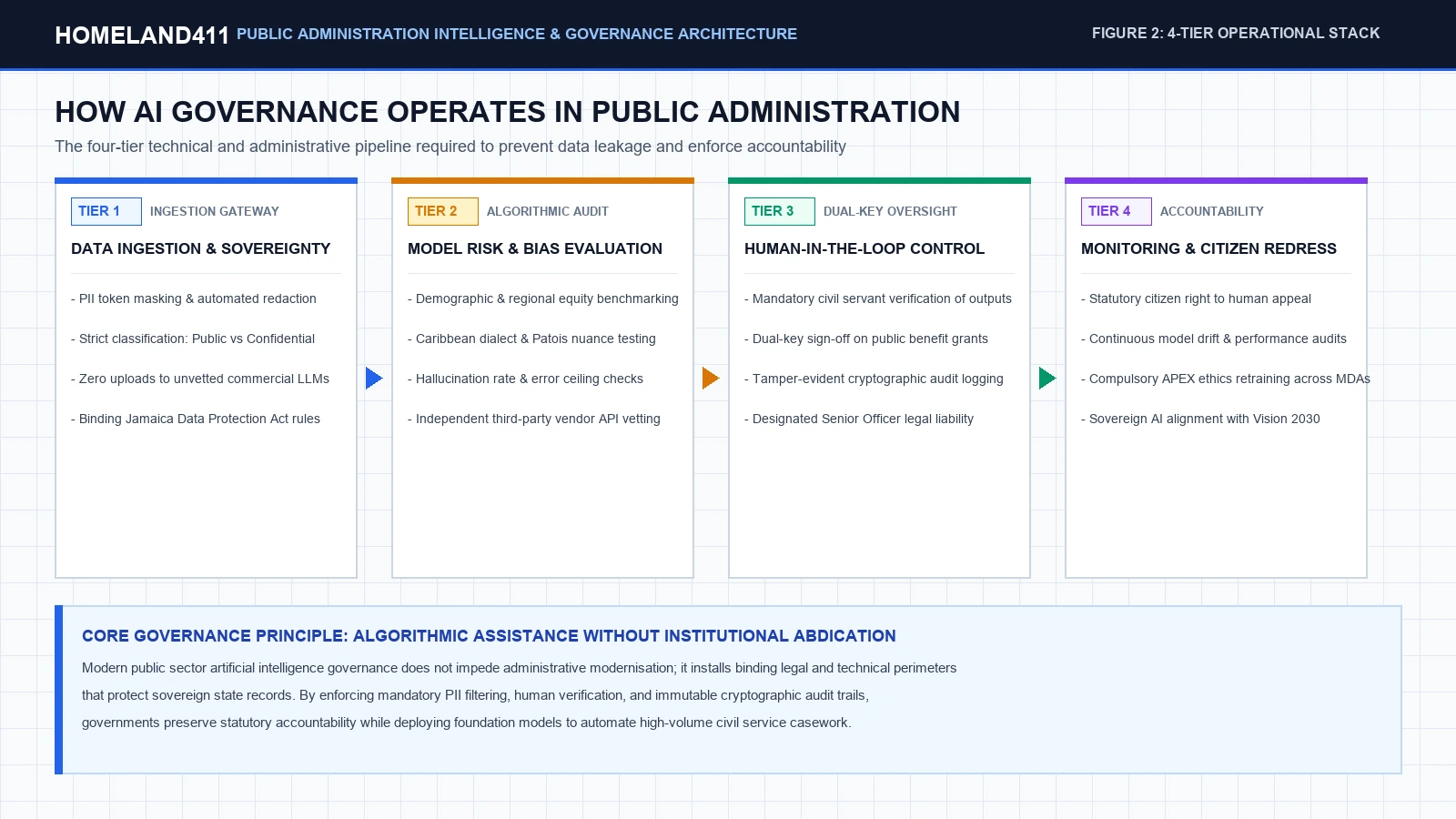
The Mechanics of Public Sector AI Governance: A 4-Tier Operational Stack
Modern public sector artificial intelligence governance operates as a multi-layered technical and administrative architecture. Enforcing ethical machine learning across government departments requires moving beyond voluntary guidelines into enforceable operational controls. Jamaica’s APEX initiative operationalizes a four-tier governance stack designed to preserve constitutional rights while capturing machine intelligence efficiency.
The operational framework enforces strict verification across four consecutive administrative boundaries:
- Data Sovereignty and Ingestion Enclaves: Confidential government records undergo automated token masking and personal identity scrubbing before entering model inference pipelines, preventing unauthorized model fine-tuning.
- Model Risk and Algorithmic Auditing: Technical committees evaluate commercial foundation models for demographic skew, synthetic hallucinations, and local linguistic comprehension, ensuring equitable outcomes across diverse citizen cohorts.
- Dual-Key Human-in-the-Loop Verification: Public administrators retain non-delegable authority over social benefits, license approvals, and judicial case routing, barring fully autonomous administrative actions.
- Tamper-Evident Auditability and Citizen Redress: Every machine-assisted government decision generates an immutable cryptographic log, securing the constitutional right of citizens to contest algorithmic outcomes.
This four-tier perimeter ensures public agencies prevent automated discrimination while maintaining audit readiness. The structural rigor parallels the risk mitigation models examined in Homeland411’s analysis of frontier foundation model architectures and sovereign compute deployments across mission-critical research bodies.
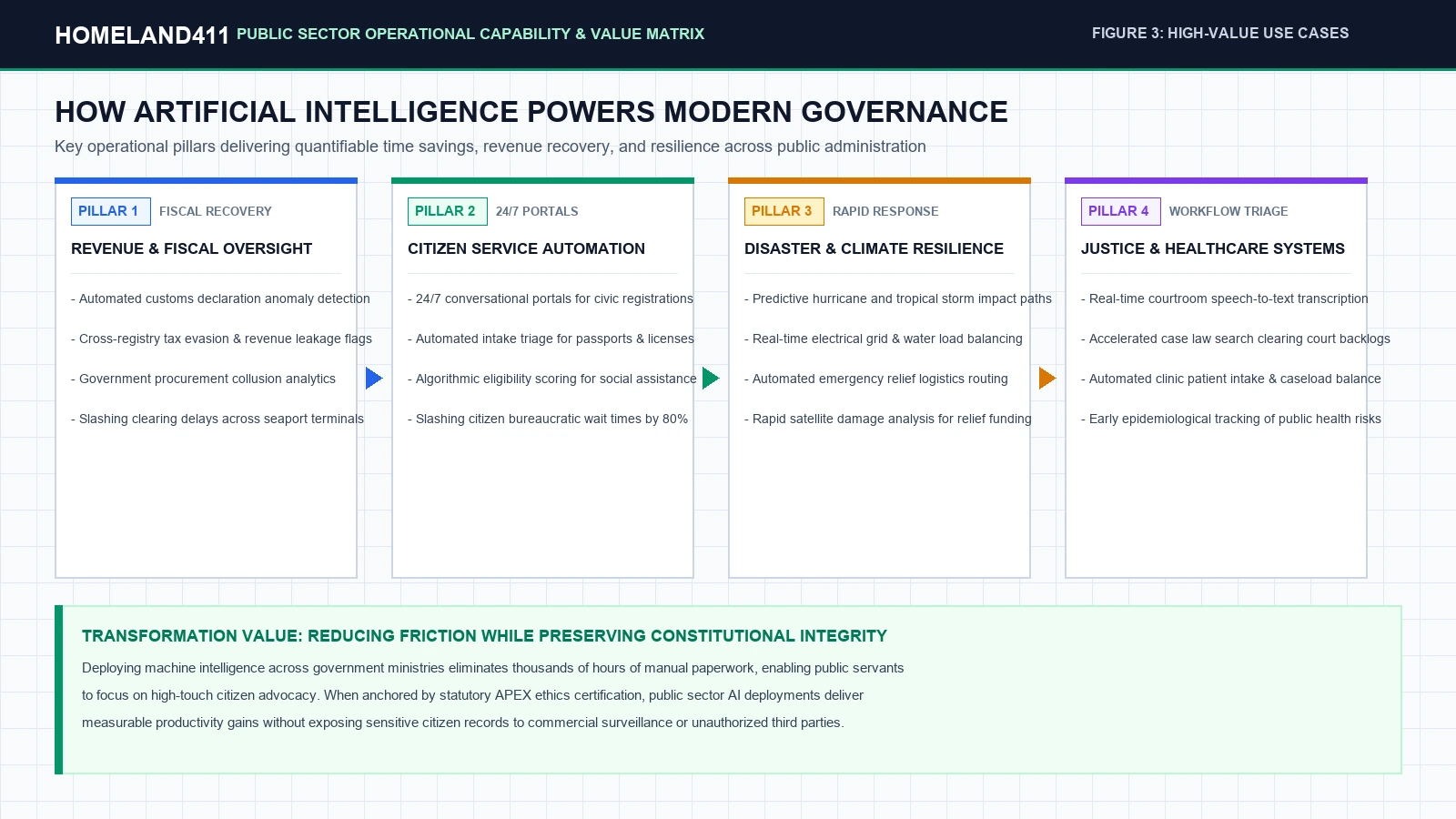
High-Value Public Sector Applications: How Machine Intelligence Powers Modern Governance
When deployed within strict governance guardrails, artificial intelligence compresses administrative turnaround times from weeks to minutes. Public administration workflows carry massive document-processing burdens that routinely bottleneck economic activity. Machine intelligence automates structured document verification, freeing specialized public officers to handle complex casework requiring nuanced human judgment.
National customs and tax authorities utilize machine learning algorithms to detect anomalies across cross-border freight declarations and tariff classifications. These predictive models cross-reference historical shipping manifests against commercial registries, identifying revenue leakage and customs fraud in real time. The resulting fiscal intelligence secures public revenues without causing costly port congestion.
Citizen-facing agencies deploy conversational natural language interfaces to provide continuous access to civic registrations and social welfare verification. Automated intake triage routes passport applications, commercial business permits, and land titling petitions directly to qualified adjudicators. By automating document pre-screening, agencies eliminate procedural backlogs while ensuring equal access across rural communities.
In disaster response and critical infrastructure, machine intelligence delivers predictive modeling for tropical cyclones and severe climate events. Algorithms process satellite imagery and meteorological telemetry to optimize electrical grid load allocation, water reservoir reserves, and emergency supply chains. These rapid simulations protect vulnerable coastal communities during seasonal weather crises.
The Forward Horizon: Caribbean Digital Sovereignty and Vision 2030 Milestones
The roll-out of the APEX programme marks a decisive shift in how sovereign Caribbean states manage rapid technological transformation. Rather than imposing blanket prohibitions that stifle digital efficiency, Jamaica’s Cabinet chose structured professionalization. That strategy establishes enforceable guardrails while cultivating technical proficiency across all ministerial tiers.
“Public officers have been utilizing artificial intelligence systems without formal guidelines regarding data boundaries or liability. The APEX programme guarantees that public servants possess the mandatory expertise, ethical discipline, and security awareness required to protect government data while serving the public.”
Dr. Andrew Wheatley, Jamaican Minister without Portfolio for Science, Technology and Special Projects
The Technology Ministry is now finalizing the initial training curriculum for rollout across ministerial departments. Concurrently, the Cabinet Office is preparing companion procurement directives. Those procurement standards will require all government contractors to demonstrate strict adherence to APEX protocols before delivering algorithmic tools to the state. With formal statutory evaluations scheduled for the upcoming legislative session, Jamaica establishes an exportable model for responsible public sector machine intelligence.