
Enterprise cybersecurity architecture must treat large language models inside autonomous artificial intelligence agents as untrusted software components by default. A comprehensive research paper released by Kaspersky demonstrates that probabilistic neural networks cannot reliably distinguish system instructions from unverified data inputs. Security researchers argue that deploying external bolt-on defensive filters fails to mitigate indirect prompt injection or unauthorized tool execution. The investigation outlines an architectural paradigm shift based on Cyber Immunity principles. This methodology enforces hardware-level isolation, deterministic policy monitors, and microkernel sandboxes around non-deterministic reasoning cores. Security specialists published their technical framework in an official Kaspersky Cyber Immunity research report. Building native resilience directly into the operational fabric prevents compromised agents from hijacking enterprise networks.
Modern autonomous agents execute multi-step planning loops, query internal document stores, and invoke arbitrary application programming interfaces across corporate perimeters. When an agent reads unauthenticated emails or parses untrusted web content, embedded adversarial commands can overwrite developer instructions. These instruction poisoning vectors mirror software vulnerabilities exposed in Homeland411’s reporting on malicious prompt injection and instruction poisoning in developer ecosystems. Without hardware-enforced compartmentalization, a subverted foundation model inherits all administrative rights allocated to the host application process.
Never Miss An UpdateFollow us on Google News to get our latest security, defense and cyber reporting in your feed. It’s free and takes one tap.
Follow on Google NewsThe research emphasizes that traditional software development paradigms assume core application code executes deterministically according to strict mathematical logic. Foundation models operate probabilistically. This fundamental reality renders neural weights incapable of acting as their own security reference monitors. Treating the language model as a trusted compute component exposes organizations to catastrophic lateral movement and credential exfiltration. These architectural vulnerabilities parallel real-world intrusions documented in Homeland411’s ongoing analysis of autonomous agentic exploitation of cloud secrets across corporate infrastructure.
Kaspersky proposes applying microkernel isolation models that strictly segregate the model reasoning core from execution tools and data pipelines. By stripping the probabilistic model of direct operating system privileges, security architects eliminate single points of failure across automated workflows. A dedicated, deterministic security monitor intercepts every outbound function call. The monitor enforces immutable access control rules before any network packet transmits. This rigorous design pattern restricts the trusted computing base to mathematically verifiable components that resist adversarial manipulation.
Traditional Agent Perimeters Versus Cyber Immune System Architecture
The architectural divergence between conventional perimeter wrappers and Cyber Immune design highlights how deterministic policy monitors neutralize rogue agent behaviors before execution.
| Architectural Dimension | Conventional AI Agent Stack | Cyber Immune Agent Architecture | System Security Consequence |
|---|---|---|---|
| Trust Model Assignment | Implicit trust granted to internal model logic | Untrusted by default across all neural weights | Eliminates assumption that prompt guardrails prevent execution (KasperskyOS Specs →) |
| Policy Enforcement | Heuristic text filters and prompt pre-checks | Deterministic, out-of-band security monitor | Guarantees mathematical compliance regardless of model prompt state |
| Component Isolation | Shared process memory and inherited credentials | Hardware sandboxing and microkernel domains | Restricts blast radius when reasoning engines parse weaponized input |
| Tool Interface Governance | Direct, unmediated API and shell access | Default-deny schema validation and typed arguments | Blocks command injection and arbitrary parameter tampering |
| High-Impact Operations | Automated background script execution | Mandatory cryptographic human-in-the-loop gates | Prevents irreversible database drops and unauthorized fund transfers |
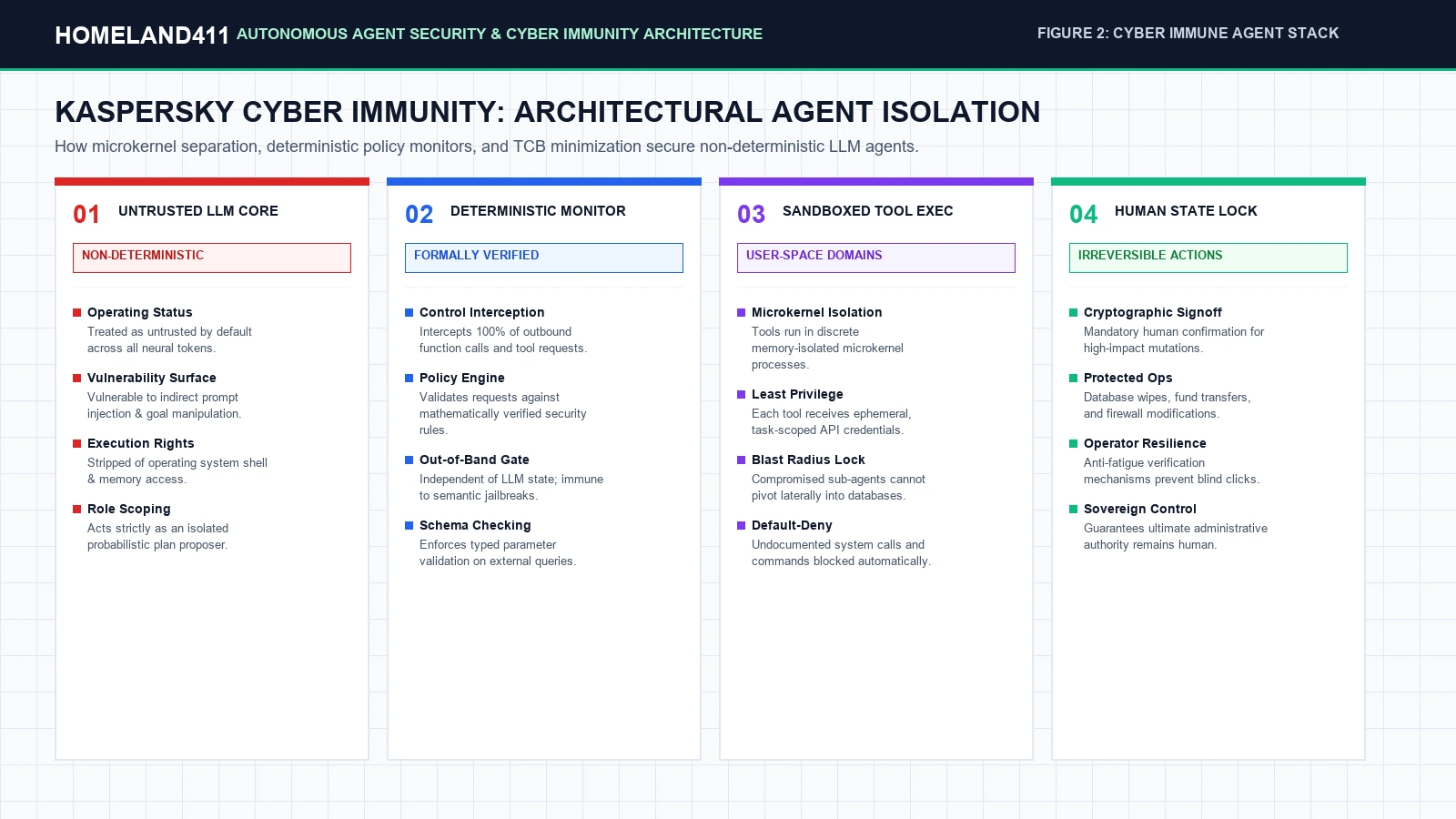
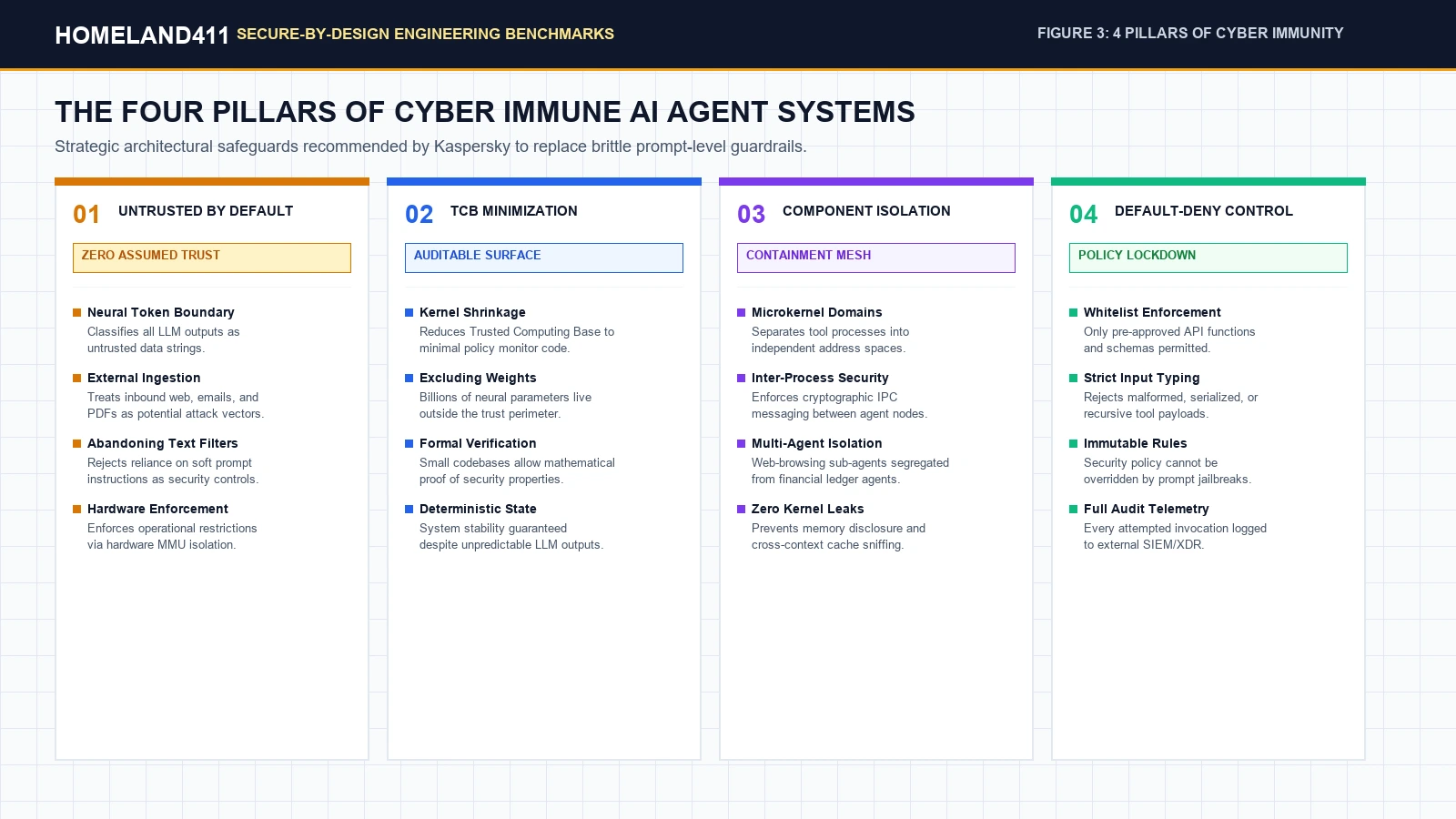
Kaspersky outlines four foundational engineering tenets required to construct resilient agentic systems capable of surviving hostile operational environments:
- Minimization of the Trusted Computing Base: Systems isolate non-deterministic neural weights, ensuring that only small, auditable policy verification engines possess root execution privileges.
- Universal Component Sandboxing: Responders run individual sub-agents inside distinct virtual environments, preventing lateral pivot paths between untrusted web ingestion and internal payroll databases.
- Strict Default-Deny Invocation: The security architecture blocks all undocumented tool calls, validating parameter formats and schema bindings against formal security policies.
- Human-in-the-Loop State Locks: Critical administrative actions, including data deletion and firewall reconfigurations, require cryptographically verified human operator confirmation.
Applying these principles neutralizes vulnerabilities cataloged under the OWASP Top 10 for Large Language Model Applications, specifically preventing agent goal hijacking and excessive authorization. When an attacker attempts to steer an agent toward restricted data vaults, the isolated security monitor halts the unauthorized payload at the kernel boundary. The language model may experience internal prompt corruption. The host operating system remains physically protected from unauthorized actions.
Deterministic Policy Enforcement and The Microkernel Security Boundary
Cyber Immunity redefines how software developers construct automated enterprise agents by enforcing security properties at compile time rather than relying on reactive threat signatures. Large language models continuously ingest external unstructured text. Treating internal tokens as authentic administrative commands introduces systemic operational vulnerabilities. Structural isolation ensures that even a fully compromised language model cannot execute arbitrary shell scripts or bypass network segregation firewalls.
Kaspersky showcased its technical research through official industry communications, detailing how modern enterprises can implement microkernel separation patterns across emerging agentic workflows:
Kaspersky’s new research explains why the LLM inside an AI agent should be treated as untrusted by default, and how Cyber Immunity principles can build trust directly into the agent’s architecture. https://t.co/1Op9OEBBJu https://t.co/AOGGPBczo7
— Kaspersky (@kaspersky) November 6, 2026
The integration of microkernel operating systems provides mathematically verified process isolation that outclasses traditional containerization. In conventional Linux server deployments, kernel privilege escalation flaws frequently allow container escape attacks when applications execute unvalidated code. Under a microkernel model, each agent tool executes in an independent user-space memory domain. Communication remains strictly governed by an immutable inter-process communication policy. These robust boundary controls mirror physical isolation protocols detailed in Homeland411’s investigations of critical infrastructure zero-trust boundaries.
“The LLM inside an AI agent should be treated as untrusted by default, and Cyber Immunity principles can build trust directly into the agent’s architecture… rather than relying on prompt-level guardrails, security must be embedded into the foundational system design through component isolation and default-deny governance.”
— Kaspersky Research Division, Official Research Report: AI Agent Security Through the Lens of Cyber Immunity
Enterprise engineering teams must align development pipelines with federal guidelines outlined in the NIST Secure Software Development Framework and CISA Secure-by-Design Principles. Rather than waiting for third-party penetration testers to expose authorization bypasses, organizations should deploy hardware-enforced execution sandboxes across every automated workflow. Auditing all agent interactions through centralized security monitoring systems ensures complete visibility across distributed microservices.
The Forward Horizon: Deterministic Verification and Sovereign Agentic Standards
The rapid proliferation of enterprise artificial intelligence agents is forcing federal defense agencies and international standard setters to establish binding architectural benchmarks. The National Institute of Standards and Technology is drafting specialized risk profiles under the NIST AI Risk Management Framework to address autonomous agent authorization risks. Regulators intend to mandate formal compartmentalization audits for commercial systems deployed across critical infrastructure sectors by mid-2027.
Concurrently, European cybersecurity authorities are preparing certification baselines under the European Union Cyber Resilience Act, requiring manufacturers to document component trust boundaries before shipping autonomous products. While European Union regulators and international standard setters have not published a binding statutory enforcement cutoff for autonomous agent compartmentalization, enterprise technology leaders must immediately audit internal model trust boundaries. Transparently documenting component isolation ahead of formal standards ratification ensures organizations mitigate emerging algorithmic exploit vectors without relying on unverified compliance timetables.